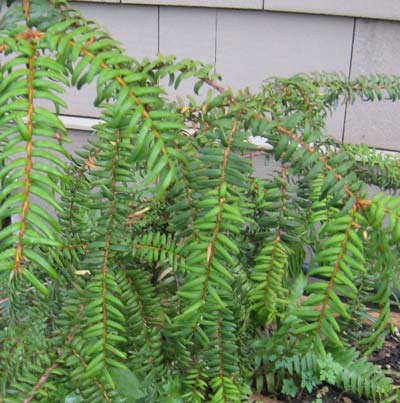
Plant in cultivation [A. Jacobson, 2009].

Plant in cultivation [A. Jacobson, 2009].
Conservation Status

Pseudotaxus chienii
White-berry yew; 白豆杉 bai dou shan [Chinese].
The genus was described in 1947 as Pseudotaxus W.C.Cheng, syn. Nothotaxus Florin. A variety of molecular studies have consistently placed Pseudotaxus sister to Taxus (e.g., Hao et al. 2008, Stull et al. 2021).
Synonyms, none in common use:
Wang and Yang (2007) investigated P. chienii subsp. liana and found that the characters identified by Silba as distinguishing the subspecies are continuously variable through the species; they affirmed the synonymy of this putative variety.
Shrubs to 4 m tall. Crown not described. Bark gray-brown, peeling in strips. Branchlets round, green or yellow-green in first year, dark green in second year. Leaves borne at 40-45° to axis when young but at 50-90° on mature trees; petiole absent or less than 1 mm; blade bright green adaxially in 1st year, thereafter dark green, linear, straight or slightly falcate, 1-2.6 cm × 2-4.5 mm, not leathery, midvein 0.4 mm wide, stomatal bands 0.5-1.1 mm wide, broader than or about as wide as marginal bands, in 9 rows on young plants increasing to 13-19 rows on adult plants, marginal bands 0.2-0.3 mm wide. Aril 5-7 mm diameter with a single ovoid seed, 5-8 × 4-5 mm. Pollination occurs from late March to May, seed maturity in October (Fu et al. 1999). See García Esteban et al. (2004) for a detailed characterization of the wood anatomy.
China: N Guangdong, N Guangxi, NW and S Hunan, SW Jiangxi, S Zhejiang; cultivated as an ornamental in Zhejiang (Fu et al. 1999). Rare understory shrub in cool, moist temperate montane forest dominated by evergreen or deciduous angiosperms (Farjon 1998).
No data as of 2026-01-10.
The wood is used as a carving material and for making utensils (Fu et al. 1999).
No data as of 2026-01-10.
Pseudotaxus means "false Taxus". Sung Shu Chien (1885-1965) has been called the "founder of Chinese botany" and established the Flora of China editorial board (Liu et al. 2022); he also collected the type specimen.
Cheng, W. C. 1934. Contr. Biol. Lab. Chin. Assoc. Advancem. Sci., Sect. Bot., 9(3): 240.
Cheng W. C. 1947. Research Notes, Forestry Institute; National Central University, Nanking. Dendrological Series 1:1.
Florin, C.R. 1948. On Nothotaxus; a new genus of the Taxaceae from eastern China. Acta Hort. Berg. 14: 385-395.
Hao, D. C., P. G. Xiao, B. Huang, G. B. Ge, and L. Yang. 2008. Interspecific relationships and origins of Taxaceae and Cephalotaxaceae revealed by partitioned Bayesian analyses of chloroplast and nuclear DNA sequences. Plant Systematics and Evolution 276:89–104.
Liu, Huan, Kaijing Huang, Xuefan Yuan, and Hao Cheng. 2023. Sung Shu Chien: the founder of modern Chinese botany. Protein & Cell 14(2):79-83. doi.org/10.1093/procel/pwac047.
Silba, J. 1996. A new species of Pseudotaxus Cheng (Taxaceae) from China. Phytologia 81(4):327. Available: Biodiversity Heritage Library, accessed 2025.12.26.
Silba, J. 2007. J. Int. Conifer Preserv. Soc. 14(1): 19.
Stull, G. W., Qu, X. J., Parins-Fukuchi, C., et al. 2021. Gene duplications and phylogenomic conflict underlie major pulses of phenotypic evolution in gymnosperms. Nature Plants 7:1015–1025. doi.org/10.1038/s4147 7-021-00964.
Wang, K. and Y. Yang. 2007. Taxonomic study on Pseudotaxus (Taxaceae). Journal of Systematics and Evolution 45(6): 862. doi.org/10.1360/aps07027.
The species account at Threatened Conifers of the World.
Lin Qi and Cao Ziyu. 2007. Acta Bot. Yunnan. 29(3): 292.
Back | Home | Contact us
Copyright 2026 The Gymnosperm Database
Edited by Christopher J. Earle
This page accessed on Friday, October 23, 2026
Last Modified 2026-01-10
 Back to top