Conservation Status

Podocarpus acutifolius
Kirk (1883)
Common names
Needle-leaved totara, Westland totara.
Taxonomic notes
Syn: Nageia acutifolia (Kirk) Kuntze 1891; Nageia kirkiana Kuntze 1891 (Farjon 1998). Type locality near source of Buller River (Allan 1961). P. totara var. waihoensis Wardle is thought to have originated as a hybrid between P. acutifolius and P. totara (New Zealand Plant Conservation Network 2010). There is also a naturally occurring hybrid between P. acutifolius and P. nivalis.
Description
Shrub or small tree up to 9 m tall and up to 50 cm in diameter. Bark thin, peeling off in short strips or flakes. Leaves straight, narrow, needle-pointed, 1.5-2.5 cm × 0.75-3.5 mm, midvein indistinct, green in shaded settings but a distinctive yellow-green in open areas. Pollen cones 1-2 cm long, axillary, solitary or up to 4 together on common peduncle 2-3 mm long; peduncle furnished above with 2 narrow-triangular keeled scales and below with 4 ovate scales; apiculus obtuse. Ovules solitary or rarely paired on a peduncle 1 mm long; receptacle of 2 obtuse scales usually red, swollen and succulent. Seeds narrowly ovoid (Allan 1961, Metcalf 2002).
Distribution and Ecology
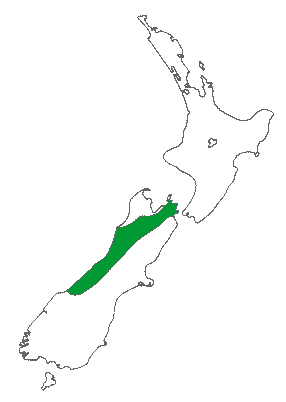
New Zealand: S Island, Marlborough Sounds to Nelson and then down the western side of the island to south Westland (43° 50' S), in lowland and montane forest and scrub (Allan 1961).
Based on data from 60 collection localities, it grows at an elevation of 500m. Within its range, mean annual temperature is 10°C, with an average minimum in the coldest month of 0.7°C, and a mean annual precipitation of 2726 mm (Biffin et al. 2011, Table S5).
Remarkable Specimens
No data as of 2026-01-24.
Ethnobotany
See Conifers of New Zealand for a review of the historic role of forests in native and European cultures of New Zealand.
Observations
No data as of 2026-01-24.
Remarks
Subject to a fungal leaf spot disease caused by Corynelia tropica (Hood 1985).
Citations
Allan, H. H. 1961. Flora of New Zealand. Volume I, Indigenous Tracheophyta. Wellington: R.E. Owen Government Printer.
Hood, I. A. 1985. Algal and fungal leaf spots of native plants. New Zealand Forest Service, Forest Pathology in New Zealand No. 12.
Kirk, T. 1883. Description of a new Pine. Transactions and Proceedings of the Royal Society of New Zealand 16:370-371. Available: rsnz.natlib.govt.nz/volume/rsnz_16/rsnz_16_00_007480.html, accessed 2011.03.27.
Kirk, T. 1889. The Forest Flora of New Zealand. Government Printer, Wellington. 345 pp. Available at Google Books, accessed 2011.03.27.
New Zealand Plant Conservation Network. 2010. Podocarpus totara var. waihoensis. http://nzpcn.org.nz/flora_details.asp?ID=1177, accessed 2011.10.14.
See also
Simpson, Philip. 2017. Totara: A Natural and Cultural History. Auckland University Press, 287 p. Great book on the trees that bear the common name totara.



 Back to top