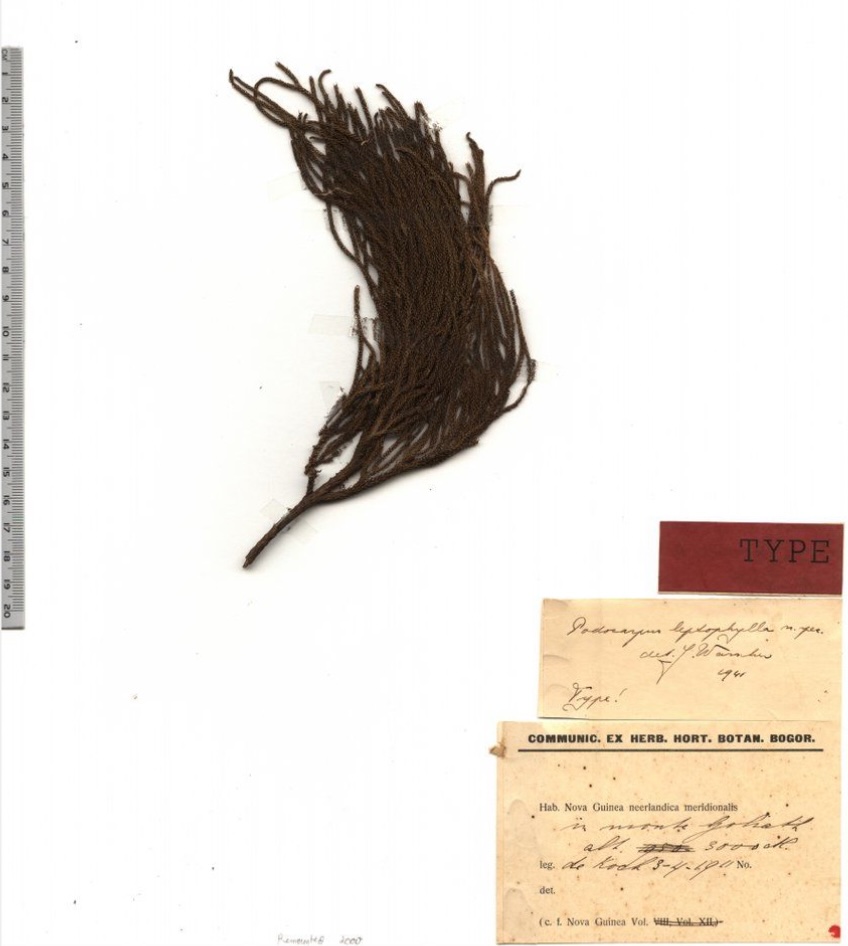
The specimen. This is it, the only known piece. No photos, no drawings, no notes; all that we know of Dacrydium leptophyllum is this one specimen collected in 1911, in what remains one of the most remote locations on Earth.

The specimen. This is it, the only known piece. No photos, no drawings, no notes; all that we know of Dacrydium leptophyllum is this one specimen collected in 1911, in what remains one of the most remote locations on Earth.
Conservation Status

Dacrydium leptophyllum
No common names are recorded.
Type: Indonesia, Papua, Pegunungan Maoke, Mt. Goliath, 1911.04.03, A. C. de Kock 39 (holotype BO1359873). Syn: Podocarpus leptophyllus Wasscher; Dacrycarpus leptophyllus (Wasscher) Gaussen; Bracteocarpus leptophyllus (Wasscher) A.V.Bobrov & Melikyan; Corneria leptophylla (Wasscher) A.V.Bobrov & Melikyan. "The original description expressed uncertainty between Dacrydium and Podocarpus sect. Dacrycarpus for this unique taxon, but unfortunately settled for the latter. The tiny leaves are typical for Dacrydium and the primary branches show no sign of the dimorphism which characterizes Dacrycarpus (de Laubenfels 1988). Phylogenetic placement within Dacrydium has not been investigated.
"Leaves diverging widely from the stem but sharply bent forward parallel to the stem or even directed inward, lanceolate, pungent, 1-1.5 mm long, 0.2-0.3 mm wide, 0.1 mm thick, strongly keeled on the dorsal side, flat or slightly concave on the axial side. Leaves on vigorous branches larger, up to 3 mm long and 0.6 mm wide. Fertile material unknown" (de Laubenfels 1988).
Indonesia: West New Guinea, known only from Puncak Yamin (Mt. Goliath), at 3000-3600 m elevation (de Laubenfels 1988). This is 600 m higher than any other species of Dacrydium except D. gibbsiae, another high mountain endemic.
In a 2011 assessment the IUCN assigned this species a conservation status of "Vulnerable." In fact it has only ever been found once, in one place, over a century ago. The locality remains extremely remote and inaccessible (Mt. Goliath was not even climbed until 2018) so there are unlikely to be any human-caused threats to the species.
No data as of 2026-01-10.
No data as of 2026-01-10.
No data as of 2026-01-10.
No data as of 2026-01-10.
de Laubenfels, David J. 1988. Coniferales. P. 337-453 in Flora Malesiana, Series I, Vol. 10. Dordrecht: Kluwer Academic. Available: Biodiversity Heritage Library, accessed 2025.12.11.
The species account at Threatened Conifers of the World.
Back | Home | Contact us
Copyright 2026 The Gymnosperm Database
Edited by Christopher J. Earle
This page accessed on Friday, October 23, 2026
Last Modified 2026-01-10
 Back to top