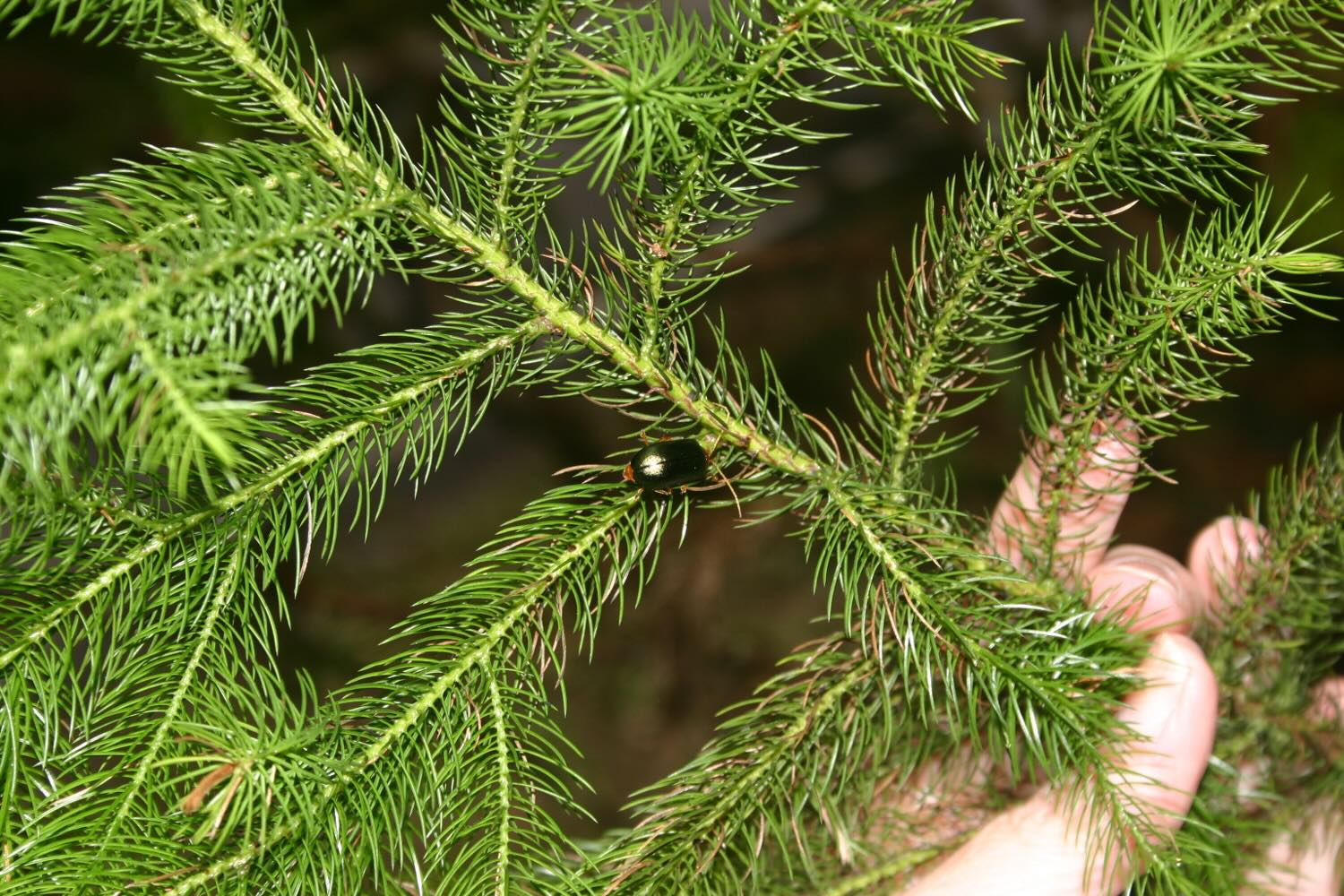
Juvenile foliage of a plant in Mt. Kinabalu National Park. iNaturalist observation 56392507 [Pete Woodall, 2006.01].

Juvenile foliage of a plant in Mt. Kinabalu National Park. iNaturalist observation 56392507 [Pete Woodall, 2006.01].
Conservation Status

Dacrydium gracile
No common names are recorded.
Type: Malaysia, Sabah, Mt. Kinabalu National Park, Silau-Silau Trail, 1979.01.12, D. J. de Laubenfels P 716 (holotype P00748815, isotype K000288691). Syn. Corneria gracilis (de Laub.) A.V.Bobrov & Melikyan. Phylogenetic placement within Dacrydium has not been investigated.
"Tree 7-30 m tall, up to 40 cm diam. Juvenile leaves at least 12 mm long, curved so that the tip is nearly parallel to the branch, pungent, triangular in cross section, lanceolate, up to 0.4 mm wide, at the base 0.2 mm thick. Adult leaves nearly straight, spreading at about a 45 angle but curved so the apex is parallel with the branch, apiculate, 3-9 mm long, the longer leaves on younger plants or lower on the tree, the shorter leaves on older and exposed trees, triangular in cross section, 0.4 mm wide, 0.2 mm thick. Fertile structures usually lateral. Pollen cones 6-7 mm long and 2 mm in diam., subtended by a cluster of leaves 3-5 mm long and usually distinctly shorter than normal foliage leaves. Together the two pollen sacs are 0.7-0.8 mm wide but the apex of the microsporophyll is a lanceolate spur 0.5-1 mm long and c. 0.3 mm wide. Seed-bearing structure also subtended by a cluster of reduced leaves c. 1 mm long, the bracts of the seed cone up to 3 mm long and more or less covering the epimatium, the usually solitary seed itself fully exposed. Fully mature seeds unknown...
"Leaves smaller and much more gracile than those of the similar D. magnum which also occurs in lower elevation forest. The crown has a rather typical shape of a forest tree, not the striking form of the usually open growth species, D. beccarii" (de Laubenfels 1988).
Malaysia: Sabah (Mt. Kinabalu and S to the island's center) and Sarawak, at elevations of 950-1800 m. Grows on soils poor in nutrients (kerangas forest), scattered in the canopy of the lower montane rainforest; in Sarawak also in heath forest on sandstone. Typical associated conifers include Agathis borneeensis, Podocarpus laubenfelsii, Sundacarpus amarus, Falcatifolium falciforme, Nageia wallichiana, and Dacrycarpus imbricatus (de Laubenfels 1988, Farjon 2010).
Distribution data for all species, from GBIF Occurrence Download https://doi.org/10.15468/dl.yvmru2 accessed 2025.12.08. D. gracile color is purple. Click on any point for more info.
In 2011 the IUCN assessed the conservation status of this species as "Near Threatened" because although it is protected within Mt. Kinabalu National Park, the proportion of the total population so protected area is uncertain. Outside the national park it occurs in forest types that have been or are vulnerable to logging, but the past and prospective impact on the number of individuals and area of occupancy is uncertain. The known area of occupancy is well within the thresholds for "Endangered" status, but uncertainty about the number of locations and the extent of decline indicate an assessment of "Near Threatened". This seems a very optimistic rationale; it says that since we don't know if it's endangered, we'll hope it isn't.
No data as of 2026-01-10.
No uses are recorded, but as it grows to be a canopy tree, it can be assumed that some timber exploitation may occur among trees located outside Mt. Kinabalu National Park.
The type specimen was collected along the Silau-Silau Trail in Mt. Kinabalu National Park.
The epithet gracile refers to the thin, slender juvenile leaves.
de Laubenfels, David J. 1988. Coniferales. P. 337-453 in Flora Malesiana, Series I, Vol. 10. Dordrecht: Kluwer Academic. Available: Biodiversity Heritage Library, accessed 2025.12.11.
The species account at Threatened Conifers of the World.
Kitayama, Kanehiro, Shin-ichiro Aiba, Masayuki Ushio, et al. 2011. The ecology of podocarps in tropical montane forests of Borneo: distribution, population dynamics, and soil nutrient acquisition. Pp. 101-117 in B. L. Turner and L. A. Cernusak (eds.), Ecology of the Podocarpaceae in Tropical Forests. Smithsonian Contributions to Botany no. 95. Smithsonian Institution, Washington, DC. Excellent overview of Mt. Kinabalu conifer ecology.
Back | Home | Contact us
Copyright 2026 The Gymnosperm Database
Edited by Christopher J. Earle
This page accessed on Friday, October 23, 2026
Last Modified 2026-01-10
 Back to top