Conservation Status

Dacrydium gibbsiae
Stapf. ex Gibbs (1914)
Common names
No common names are recorded.
Taxonomic notes
Type: Malaysia, Bornea, Mt. Kinabalu, spur above Lobang, L. S. Gibbs 4161 (holotype K000287594). Syn: Corneria gibbsiae (Stapf) A.V.Bobrov & Melikyan; D. beccari var. kinabaluense Corner (pro parte). Phylogenetic position within Dacrydium and fossil history remain unknown.
Description
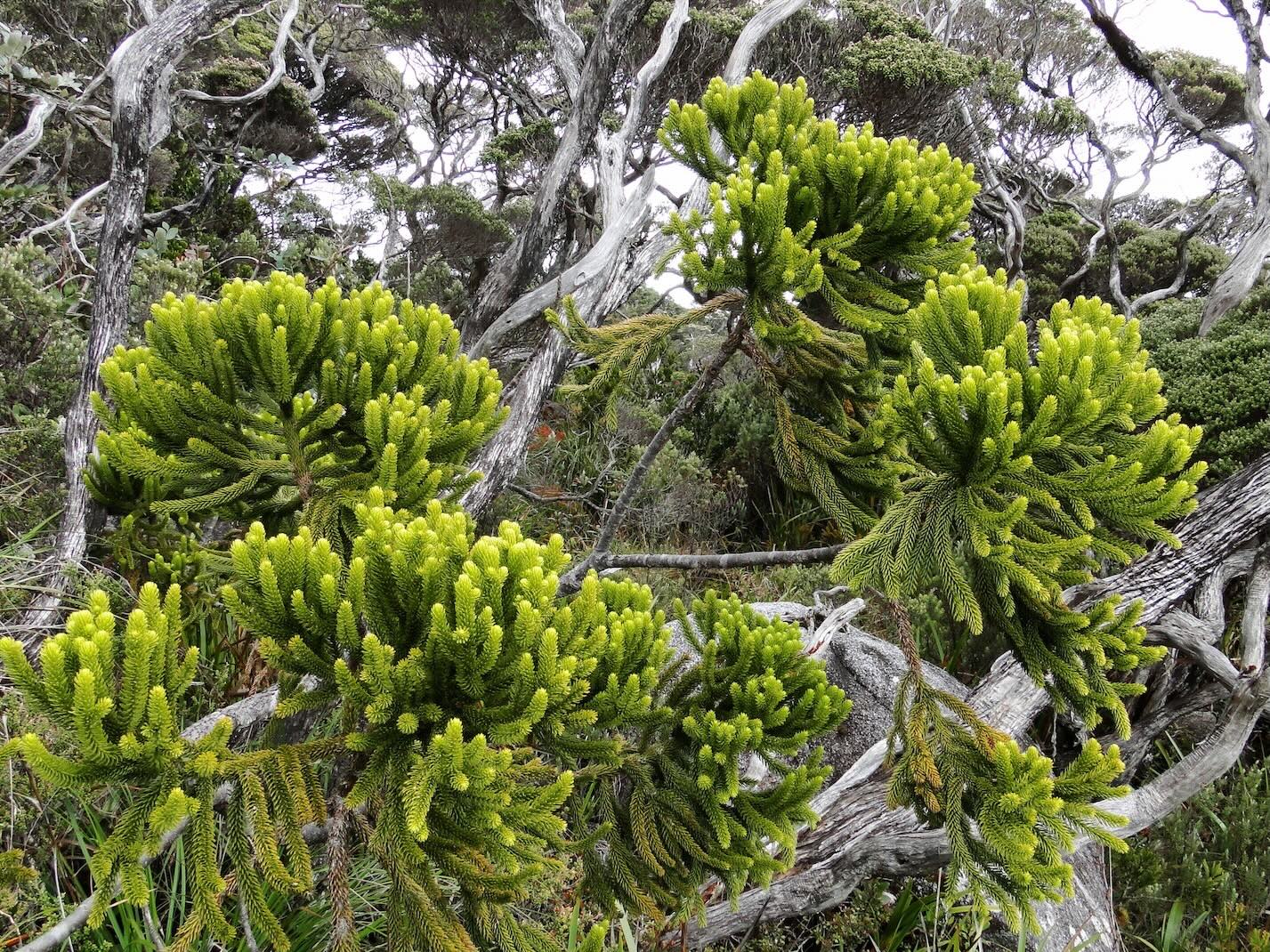
"Small tree, 2-12 m tall. Juvenile leaves spreading widely, slightly curved forward towards the apiculate tip, at least 12 mm long, slightly wider than thick. Adult leaves robust, the acute tip bent to be parallel to the branch or even curved slightly inward, crowded, linear or linear-lanceolate, 5-8 mm long, concave on the axial side, strongly keeled on the dorsal side, 0.8 to at least 1 mm wide, 0.2-0.3 mm thick. Fertile structures terminal, often on a short lateral branch. Pollen cones 20-25 mm long and 4.5-7 mm diam.; microsporophyll lanceolate, 5-6 mm long, 1.5 mm wide at the base. Seed-bearing structure consisting of bracts slightly narrower than ordinary foliage leaves and increasing slightly in length towards the apex where one or two may be fertile, spreading slightly and completely covering the epimatium but surpassed by the apex of the mature seed which is 4.5 mm long" (de Laubenfels 1988).
Distribution and Ecology
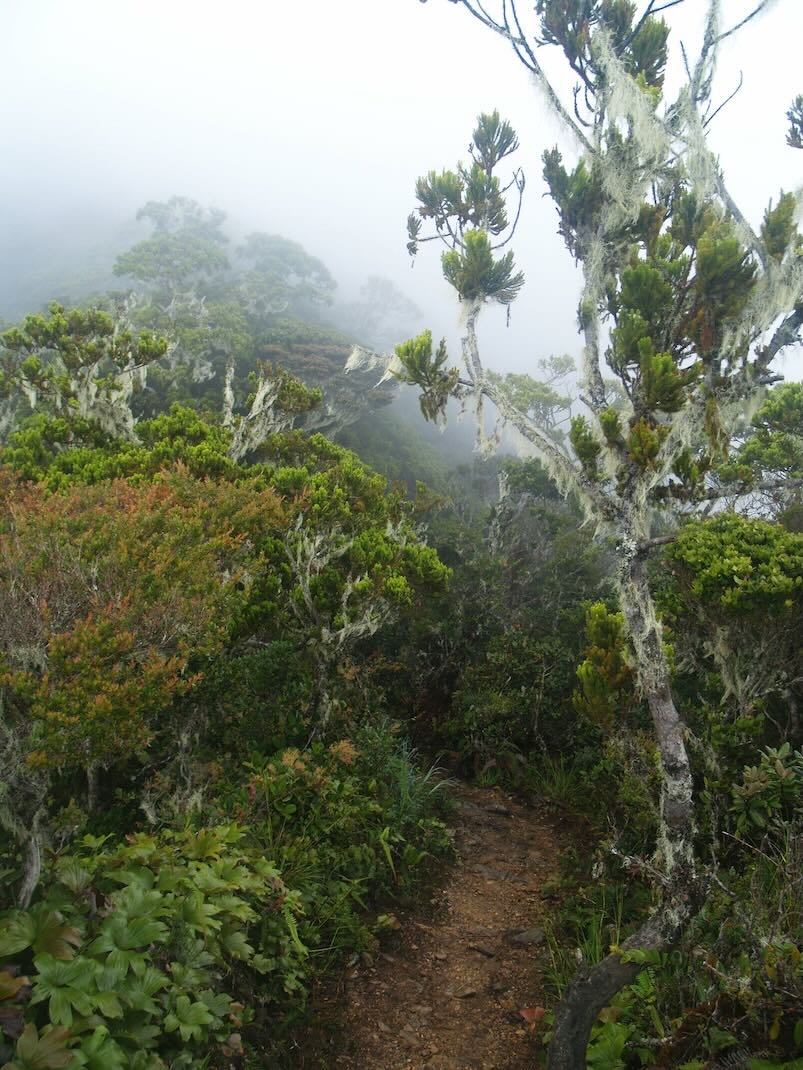
Malaysia: Sabah (Borneo), endemic to Mt. Kinabalu at elevations of 1500-3600 m (this is 600 m higher than any other species of Dacrydium except D. leptophyllum, another high mountain endemic). Substrates vary, but for the most part it occurs on soils derived from ultramafic parent materials; near the summit of Kinabalu it grows as a low shrub on granite. At lower elevations it can be found in swampy, mossy forest, but mostly it occurs on high rocky ridges and slopes where the vegetation is more or less low and open, all of which suggests it is relatively shade-intolerant. Associated conifers at lower elevations include Dacrycarpus imbricatus, Phyllocladus hypophyllus, and Podocarpus gibbsiae, and at higher elevations Phyllocladus hypophyllus, Dacrycarpus kinabaluensis, and Podocarpus brevifolius. The dominant vegetation on these sites includes Myrtaceae, e.g. Leptospermum recurvum, Tristaniopsis spp., Ericaceae and various small oaks (Quercus) as codominants. "At high altitudes the common ericaceous shrub Rhododendron ericoides has an uncanny resemblance to Dacrydium gibbsiae until one sees the red tubular flowers" (Farjon 2010).
Distribution data for all species, from GBIF Occurrence Download https://doi.org/10.15468/dl.yvmru2 accessed 2025.12.08. D. gibbsiae color is dark olive green. Click on any point for more info.
Zone 10 (cold hardiness limit between -1°C and +4.4°C) (Bannister and Neuner 2001).
In 2011 the IUCN assessed this species as of "Least Concern" for conservation because it is endemic to Mt. Kinabalu and occurs almost entirely within the national park. No population declines have been reported and there are no reported threats apart from the presence of tourists in a formerly very isolated environment.
Remarkable Specimens
No data as of 2026-01-10.
Ethnobotany
No data as of 2026-01-10.
Observations
Dacrydium gibbsiae is said to be quite common at the higher elevations on Mt. Kinabalu, which is a popular tourist destination.
Remarks
The epithet honors Lilian Suzette Gibbs (1870-1925), a botanist with the British Museum who intensively studied mountain floras worldwide, was the first known woman to ascend Mt. Kinabalu, and collected the type specimen. Podocarpus gibbsiae is also named for her.
Citations
de Laubenfels, David J. 1988. Coniferales. P. 337-453 in Flora Malesiana, Series I, Vol. 10. Dordrecht: Kluwer Academic. Available: Biodiversity Heritage Library, accessed 2025.12.11.
Gibbs, Lilian Suzette. 1914. A contribution to the flora and plant formations of Mount Kinabalu and the highlands of British North Borneo. The Journal of the Linnean Society. Botany 42:192-193, t. 4. Available: Biodiversity Heritage Library, accessed 2021.12.24.
See also
Dallimore et al. (1967).
de Laubenfels, D. J. 1969. A revision of the Malesian and Pacific rainforest conifers, I. Podocarpaceae, in part. Journal of the Arnold Arboretum 50:292-295. Available: Biodiversity Heritage Library, accessed 2021.12.24.
Gaussen, Gymn. Act. & Foss. fasc. 13, ch. 20 (1974) 34, f. 681.
Kitayama, Kanehiro, Shin-ichiro Aiba, Masayuki Ushio, et al. 2011. The ecology of podocarps in tropical montane forests of Borneo: distribution, population dynamics, and soil nutrient acquisition. Pp. 101-117 in B. L. Turner and L. A. Cernusak (eds.), Ecology of the Podocarpaceae in Tropical Forests. Smithsonian Contributions to Botany no. 95. Smithsonian Institution, Washington, DC. Excellent overview of Mt. Kinabalu conifer ecology.


 Back to top