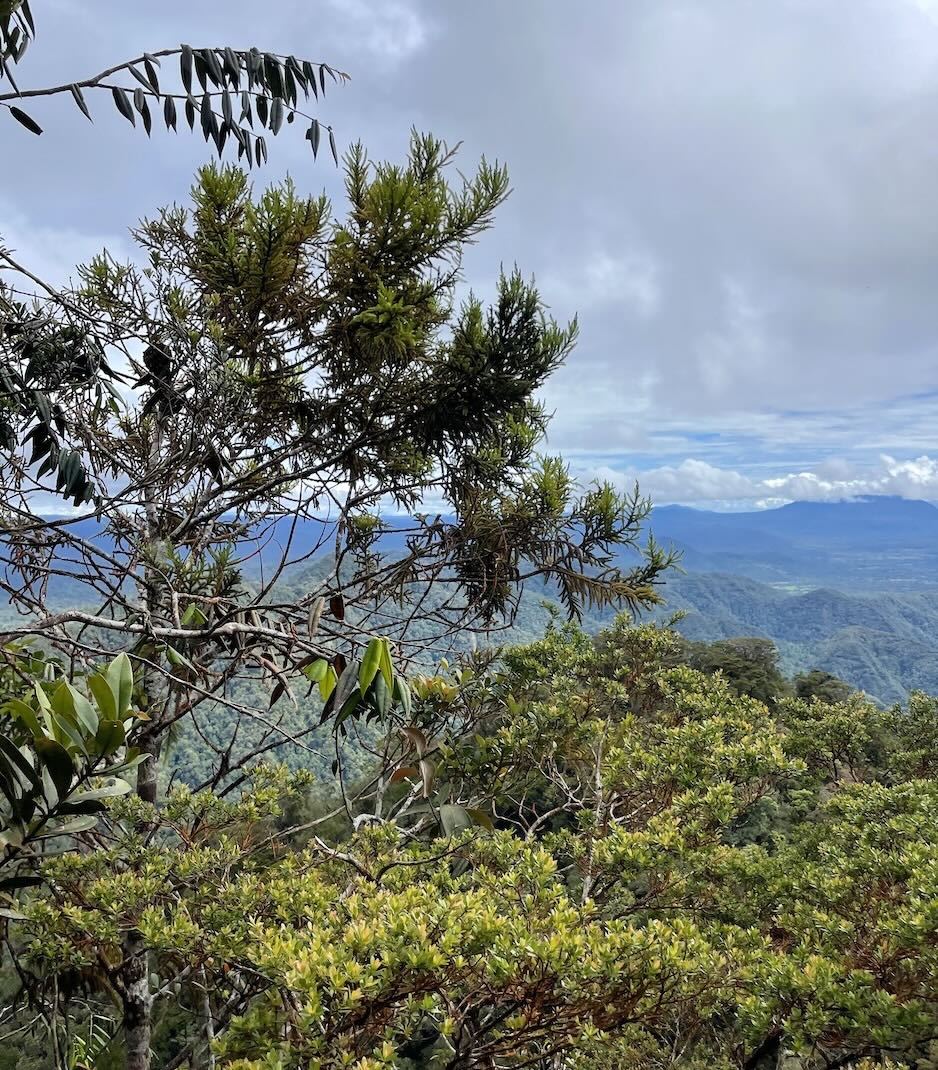
A tree in habitat, Sumatra; iNaturalist observation 257705891 [adenophora, 2025.01].
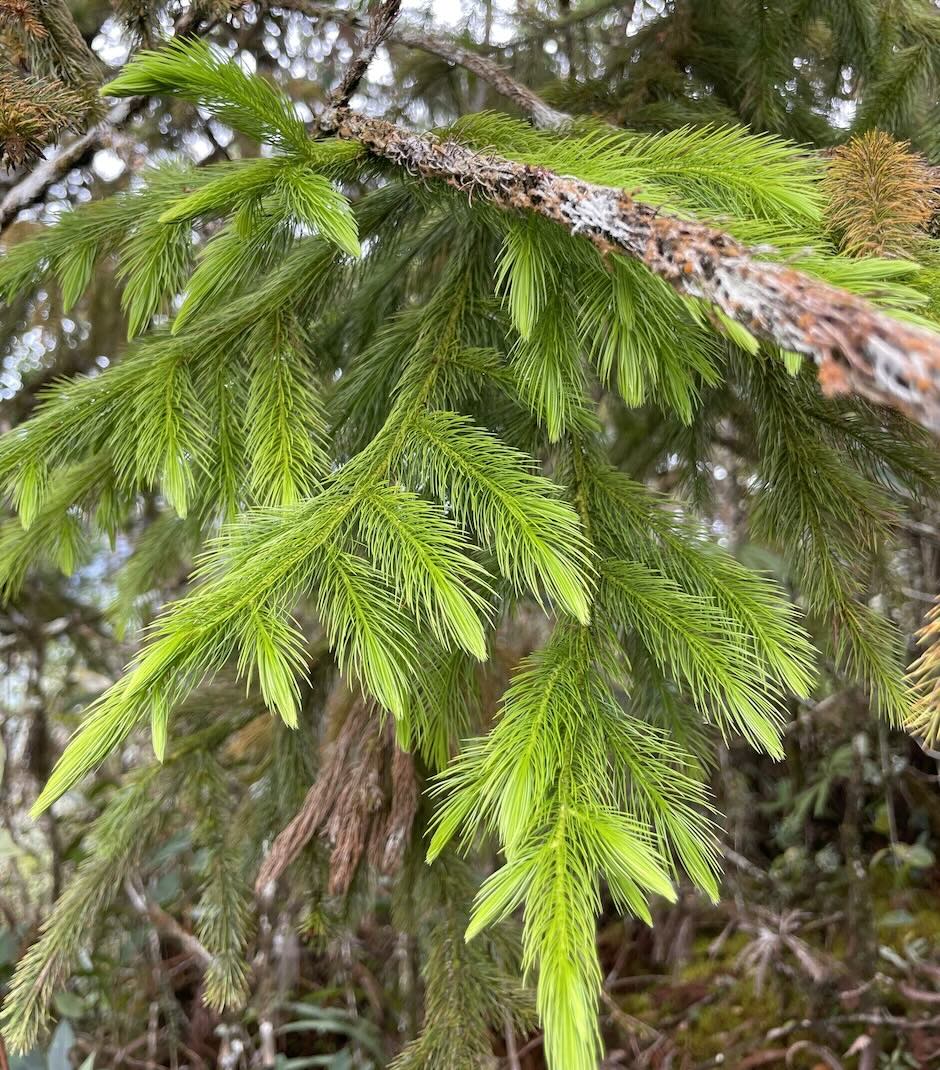
Juvenile foliage on the above tree, iNaturalist observation 257705891 [adenophora, 2025.01].
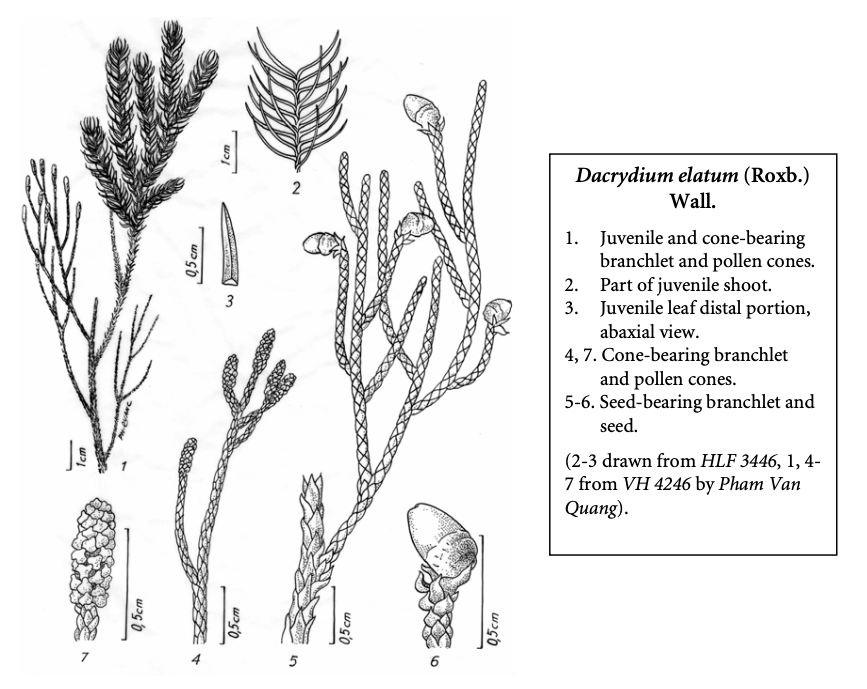
Descriptive illustration from Hiep et al. (2004).

A tree in habitat, Sumatra; iNaturalist observation 257705891 [adenophora, 2025.01].
Juvenile foliage on the above tree, iNaturalist observation 257705891 [adenophora, 2025.01].
Descriptive illustration from Hiep et al. (2004).
Conservation Status

Dacrydium elatum
In Malaysia it is mountain ru, ekor kuda, or ru bukit (Corner 1988). In Viet Nam it is Hoàng dàn giå (FIPI 1996). In Borneo it is ouk [Kayan], or on the Merurong Plateau, sempilor (de Laubenfels 1988). In Papua New Guinea it is belitzi (Lane-Poole 1924); in the Philippines, it is lokinai (Seeber et al. 1979).
Type: Malaysia, Penang Island, Penang Hill, Dr. Cantor s.n. (holotype K000287592). Synonymy: see POWO. D. elatum shares a clade within Dacrydium with D. beccarii, D. magnum, and D. xanthandrum (Khan et al. 2023). Earlier analyses based on morphology also found a close similarity to D. beccarii, and in fact this taxon was first described as Dacrydium beccarii var. subelatum. "Corner thought that this variety was somehow transitional, even suggesting that D. beccarii - of which he made it a part - might be a hybrid between D. comosum and D. elatum. Indeed, the individuals on high mossy ridges may well be hybrids between D. beccarii and D. elatum as they seem always to occur where the ranges of these two species approach one another. In any case, all such plants can be distinguished by much shorter leaves on vigorous shoots than for D. beccarii and generally variable leaf size" (de Laubenfels 1988).
Dioecious tree 8-40 m tall and 10-100 cm dbh, with straight bole, many slender, more or less erect branches, and crowds of branchlets forming tufts which together comprise a dome-shaped crown. Bark gray-brown, fissured, scaly with thin oblong flakes concealing pale, warm brown young bark. Juvenile leaves linear-lanceolate, spreading but curved forward parallel to the branch, keeled on four sides, to at least 14 mm long, 0.3 mm wide and 0.2 mm thick, gradually becoming shorter and slightly broader with the leaves at the bases of ultimate shoots and on more vigorous shoots noticeably smaller and less spreading. Transitional forms which are sometimes fertile have spreading leaves slightly bent forward towards the acute tip, triangular in cross section, 0.3-0.4 mm wide, 0.2 mm thick, and 2-4 mm long, the leaves on vigorous shoots more nearly scale-like. Adult foliage shoots cord-like, 1-2 mm diam., leaves in the form of imbricate triangular scales 1-1.5 by 0.4-0.6 mm, sharply keeled on their exposed surface. Juvenile shoots sometimes mix with adult shoots thus giving a false impression that leaves change abruptly as the tree matures. The fertile structures are terminal. Pollen cones small, 4-8 mm long and 1-1.2 mm in diam. Apex of microsporophyll 0.5-0.8 mm long. The seed-bearing structure, even when produced on needle-bearing branches, is subtended by a scaly peduncle several mm long with scales about 1 mm long. The seed cones solitary or arranged in small groups, consisting of about a dozen slightly elongated bracts 1.5-2 mm long. The solitary seed is 4-4.5 mm long 3 mm wide, 1/3 of base covered with pseudopericarp (Corner 1988, de Laubenfels 1988, FIPI 1996). See García Esteban et al. (2004) for a detailed characterization of the wood anatomy.
This species is characterized by juvenile foliage of spreading needle-like leaves and adult foliage of imbricate scale leaves. However, the transition between these forms is not abrupt; "in fact, there is a gradual change as a plant matures to shorter more adpressed leaves and different individuals mature at different rates. Trees with mature leaves, however, frequently bear occasional shoots with juvenile leaves making possible the collection of both juvenile and mature leaves attached on the same specimen" (de Laubenfels 1976).
Corner (1988) details the tree's appearance: "Saplings of the Mountain Ru have dense, conical crowns with wide base that are supported by numerous, obliquely upright branches: they are bushy because they bear only twigs with [juvenile] needle-leaves. Mature trees have thinner crowns because their twigs are less crowded and have adopted the cord-like form with tiny [adult] scale-leaves: most of the branches stand upright on the steeply ascending limbs and have posses of cord-twigs at their ends but the lower branches may sag and have drooping twigs with upturned ends. Old trees have ragged crowns as they die back. Even on full-grown trees, especially those in the open, the lower branches may continue to produce the drooping bushy twigs with needle-leaves; and such trees have crowns that are bushier at the base than at the top." He also notes "The Mountain Ru may be mistaken for the Malayan Yellow-Wood (Podocarpus imbricatus). But the Yellow-Wood has a darker green, irregular crown more like that of the Mountain Agathis (Agathis dammara) and it always has, on some branches, a few short comblike twigs on which the flat needle-leaves are set in two rows: it never has cord-twigs."
Brunei; Cambodia; China (Hainan Island); Indonesia (Sumatra); Laos; Malaysia (very common in Malay Peninsula, incl. Penang I.; rare in Sarawak and Sabah); Philippines; Thailand; Viet Nam (de Laubenfels 1988). Within its range, mean annual temperature is 21.2°C, with an average minimum in the coldest month of 12.7°C, and a mean annual precipitation of 2095 mm (Biffin et al. 2011).
Distribution data for all species, from GBIF Occurrence Download https://doi.org/10.15468/dl.yvmru2 accessed 2025.12.08. D. elatum color is green. Click on any point for more info.
In Malesia, it is "scattered in moist rain-forest, from sea-level but mostly above several hundred m to 1,700 m, growing most abundantly in open situations indicating a preference for disturbed conditions. It also appears to prosper on difficult soils (sandstone, granite, kerangas). Hardy and popular under cultivation in fully exposed sites. Does not enter into high mountain scrub" (de Laubenfels 1988). Corner (1988) adds "It is planted in the plains and, though not common, there are specimens in the parks and big gardens of most towns. On Penang Hill it is planted and encouraged in great abundance and nowhere is it more picturesque than in the grounds of Bel Retiro. On looking down on the forest, whether from the Crag Hotel or from the mountain slopes of Cameron Highlands and Fraser's Hill, it is distinguishable from other trees by its conical, grey green crown without foliage leaves but with posses of short, upright, green twigs." Morley (2011) describes a pollen analysis of a coastal peat swamp in Brunei where a mangrove swamp changed rather suddenly to dominance by D. elatum and Gymnostoma sp., and notes that D. elatum is also dominant on peats located elsewhere in Borneo.
In Viet Nam, it occurs usually at elevations of 700-2000 m on silicate soils or atop limestone ridges; mean annual temperature is 16-22°C and precipitation at least 1700 mm. The habitat is primary closed evergreen tropical seasonal mixed forest, mainly submontane, sometimes lowland or montane forests. However it has been recorded close to sea level on Phu Quoc island, where annual mean temperature is 26°C and annual rainfall over 3000 mm. In submontane and montane areas, associated conifers include Pinus krempfii, Pinus dalatensis, Podocarpus neriifolius, Chamaecyparis hodginsii and Dacrycarpus imbricatus (Hiep et al. 2004). Natural regeneration is good in open places. Flowers in March, fruits in October-November (FIPI 1996).
In the Philippines, it is a tree of the mountains, usually found at 1000-2000 m elevation (Seeber et al. 1979).
In 2011 the IUCN assessed this species as of "Least Concern" for conservation because, although some populations are in decline due to threats such as habitat loss (mainly conversion to plantations of more profitable species) and timber harvest, still it remains a widespread species.
Zuidema et al. (2011) do not provide age data, but their Figure 1 indicates a maximum age for D. elatum of about 165 years, which is a crossdated age developed with a tree-ring chronology. They estimate the species can achieve ages of over 200 years. This is for a forest in the mountains of Viet Nam.
Timber yellowish with fine and straight grain, light (density 0.6-0.66), soft and slightly perfumed, resistant to bending and pressing. Used in bridges, boats, shipbuilding, construction and fine art making. Also used in distillation of essential oils or in joss stick making (FIPI 1996).
Lane-Poole (1924) reported that "young trees are in demand for the various stations of the Lutheran Mission for Christmas trees." Generally, though, it is seldom seen in cultivation. Zone 10 (cold hardiness limit between -1°C and +4.4°C) (Bannister and Neuner 2001).
As noted above, the species has been the subject of an exploratory dendrochronological study, which established the formation of annual rings, showed positive correlations between growth and precipitation, and provided some life history insights (Zuidema et al. 2011).
In Viet Nam, this species has been recorded from Na Hang Nature Reserve, Pu Mat National Park, Bach Ma National Park, Ba Na Nature Reserve and Nui Chua National Park (Hiep et al. 2004).
The epithet elatum means "tall", referring to the height attained by some trees.
The type specimen bears only the words "Dr. Cantor" and "Penang". Theodore Edward Cantor (1809–1860) was a Danish physician, zoologist and botanist who lived in and collected specimens around the Penang area. He likely collected the type specimen in about 1835-37.
Biffin, Ed, Timothy J. Brodribb, Robert S. Hill, Philip Thomas and Andrew J. Lowe. 2011. Leaf evolution in Southern Hemisphere conifers tracks the angiosperm ecological radiation. Proceedings of the Royal Society B, doi.org/10.1098/rspb.2011.0559. Data from Table S5.
Corner, E. J. H. 1988. Wayside Trees of Malaya, 3rd ed. Malayan Nature Society.
de Laubenfels, David J. 1976. The genus Dacrydium in Malaya (Gymnospermae). Blumea 23:97-98.
de Laubenfels, David J. 1988. Coniferales. P. 337-453 in Flora Malesiana, Series I, Vol. 10. Dordrecht: Kluwer Academic. Available: Biodiversity Heritage Library, accessed 2025.12.11.
Hiep, N. T., P. K. Loc, N. D. T. Luu, P. I. Thomas, A. Farjon, L. V. Averyanov, and J. C. Regalado Jr. 2004. Vietnam Conifers: Conservation Status Review 2004. Fauna & Flora International, Vietnam Programme, Hanoi.
Khan, Raees, Robert S. Hill, Jie Liu, and Ed Biffin. 2023. Diversity, distribution, systematics and conservation status of Podocarpaceae. Plants 12(5):1171. https://doi.org/10.3390/plants12051171.
Loudon. 1838. Arboretum et Fruticetum Britannicum 4:2102. Available: Google Books, accessed 2025.12.09.
Lane-Poole, C. E. 1924. The Forest Resources of the Territories of Papua and New Guinea. Commonwealth of Australia (pp. 72-74). Available: Biodiversity Heritage Library, accessed 2023.01.23.
Morley, R.J. 2011. Dispersal and paleoecology of tropical podocarps. Pp. 21-41 in B. L. Turner and L. A. Cernusak (eds.), Ecology of the Podocarpaceae in Tropical Forests. Smithsonian Contributions to Botany no. 95. Smithsonian Institution, Washington, DC.
Seeber, G., H.-J. Weidelt, and V. S. Banaag. 1979. Dendrological Characters of Important Forest Trees From Eastern Mindanao. German Agency for Technical Cooperation, 440 pp.
Zuidema, Pieter A., Mart Vlam, and Pham D. Chien. 2011. Ages and long-term growth patterns of four threatened Vietnamese tree species. Trees 25:29-38. https://doi.org/10.1007/s00468-010-0473-2.
Luu and Thomas 2004 provide a description, range map, conservation status, drawings and photos, and a wealth of additional information.
Back | Home | Contact us
Copyright 2026 The Gymnosperm Database
Edited by Christopher J. Earle
This page accessed on Friday, October 23, 2026
Last Modified 2026-01-10
 Back to top