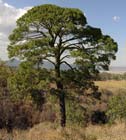
A mature tree in grassy woodland on the lower north slopes of Nevado de Colima in Michoacán [R. Van Pelt, 2005.02.14].
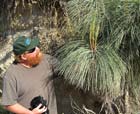
Dr. Van Pelt with a sapling, same location as above, showing the remarkably long shoots and needles of this species [C.J. Earle, 2005.02.14].
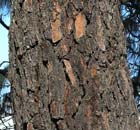
Bark on a tree 80 cm dbh, same location as above [C.J. Earle, 2005.02.14].
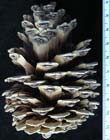
Cone collected along the highway between Cuernavaca and Chalma, México [C.J. Earle, 2005.02.12].
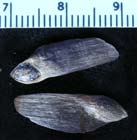
Seeds with wings, collected from the cone shown above [C.J. Earle, 2005.02.12].
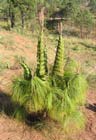
The long needles may provide diversion for idle souls; we found this sapling near the highway east of Uruapan [C.J. Earle, 2005.02.13].

Ripe pollen cones [C.J. Earle, 2007.02.11].

Recently germinated seedlings [Facebook post by Victor Hugo Garza Guajardo, 2020.03.15].
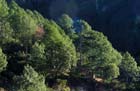
Forest along Mex-40 in Sinaloa [C.J. Earle, 2007.02.11].

Conservation Status

Pinus maximinoi
H.E.Moore (1966)
Common names
Pino candelillo, ocote, pino canis, pinabete, pino llorón [Spanish].
Taxonomic notes
Syn: Pinus tenuifolia Benth. 1842 non Salib. 1796; P. escandoniana Roezl 1857; P. hoseriana Roezl 1857; P. tzompoliana Roezl 1857. Although Roezl was the first to describe this species (as 3 distinct species), his herbarium material was lost until the 1990s, and in the meantime most of his names could not be connected with any known species. In the interim, the species was known as P. tenuifolia. However, in 1966 it was discovered that P. tenuifolia was a homonym for an earlier name, and P. maximinoi was established to correct the problem. The new name won quick acceptance, as this tree is widely used in plantation forestry (e.g., in Africa). In order to avoid a disruptive and relatively pointless name change, the binomial P. maximinoi was conserved over Roezl's names (as proposed by Farjon and Frankis 1998). For more on Roezl's role in the systematics of Mexican pines, see P. montezumae and Farjon and Styles (1997).
P. maximinoi is in Pinus subsect. Ponderosae, within which it shares a clade with P. gordoniana and P. yecorensis. The three species are morphologically extremely similar as well, and where they are sympatric, many individuals may not be confidently identifiable to species.
Description
Trees to 20-35(-50) m tall and 70-90(-100+) cm dbh. Trunk straight, round, usually single. Branches horizontal, often whorled, developing into an open pyramidal and, at maturity, a thick, rounded open crown, with typical crown depth about 50% of tree height. Bark first smooth, gray-brown, later becoming rough and deeply fissured into large gray-brown plates. Branchlets long, slender, flexible, slightly drooping, with prominent decurrent pulvini. Leaves persisting 2-2.5 years, in fascicles of 5 (rarely 4 or 6), very slender, drooping, 20-35 cm long, 0.6-1.1 mm wide, light to glaucous green; margins serrulate under a 10X lens; stomata in 2-3 lines on all three surfaces; (2-)3(-4) medial resin canals; diploxylon; fascicle sheaths orange-brown fading to gray, 15-25(-30) mm long, persistent. Pollen cones crowded near the proximal end of new leading (sometimes lateral) shoots, cylindrical, 30-40 × 5-8 mm, pink-brown, subtended by subulate-lanceolate brown bracts. Seed cones borne in groups of 3-4, light brown in first year, maturing in second year on 10-15 mm long peduncles, ovoid to long-ovate, asymmetrical, oblique, red-brown, (4-)5-10(-12) × 4-8 cm when open. Peduncle oblique to cone axis; cones mature in winter, shed seeds, and soon fall. Seed scales (100-)120-160, thin, flexible, weak; apophyses flat with a light transverse keel; umbo small, flattish, with a small early-deciduous prickle. Seeds dark brown, 4-6 × 3-4 mm, wing pale yellow-brown, articulate, 16-20 × 4-8 mm. Cotyledons 6-8 (Perry 1991, Farjon and Styles 1997). See García Esteban et al. (2004) for a detailed characterization of the wood anatomy.
P. maximinoi is extremely similar to its sister species P. gordoniana, and the two taxa may co-occur throughout most of the range of P. maximinoi, though P. gordoniana is mostly known from the Trans-Mexican Volcanic Belt. Lopez-Reyes et al. (2015) found that "the two taxa share many characters and we were unable to identify any that were consistently diagnostic." Stead (1983) had greater success but in order to do so he had to sample large numbers of individuals and to consider microscopic characters; in short, there is no reliable and convenient way to distinguish these taxa in the field.
Distribution and Ecology
Mexico: Chiapas, Colima, Durango, Guerrero, Hidalgo, Jalisco, México, Michoacán, Morelos, Nayarit, Oaxaca, Puebla, Sinaloa, Tlaxcala, Veracruz; Guatemala; Honduras; El Salvador; NW Nicaragua. The Sinaloa population is disjunct. Mainly occurs in mountains, but has wide ecological amplitude that includes an early seral or gap-pioneer role in wet subtropical forest, canopy species in cloud forests, or as a member of drier pine-oak forests and woodlands. Occurs at elevations of (450-)900-1800(2800) m, paradoxically occurring at the highest elevations near its northwest range limits. Occurs on widely varying but usually well-drained soils in areas with 900-2500 mm annual precipitation (summer maximum). On more mesic sites it commonly occurs with P. tecunumanii and Liquidambar styraciflua, and at lower altitudes with P. oocarpa, and on woodland sites it may be joined by P. devoniana and P. pseudostrobus with an understory of grasses or Pteridium aquilinum. Farther north in it is found with Abies religiosa, P. ayacahuite, P. patula, P. pseudostrobus, P. gordoniana and Quercus spp. on somewhat drier sites that are subject to occasional frosts (Farjon and Styles 1997).
Zone 10 (cold hardiness limit between -1°C and +4.4°C) (Bannister and Neuner 2001).
Remarkable Specimens
No data as of 2026-05-12.
Ethnobotany
The species is logged along with associated hard pines for use as firewood and to produce hewn timbers (Perry 1991).
Observations
Perry (1991) notes that the species is very common and easily seen along many major highways. He notes particularly fine trees along highway Mex-15 from Toluca to Morelia, Patzcuaro and Uruapan. He also mentions trees along Mex-190 near San Cristobal de las Casas in Chiapas; in Guatemala along highway CA-1 near Guatemala City; in Honduras a few kilometers east of Tegucigalpa on Highway 4; and in El Salvador near the towns of La Palma and Chalatenango, near the Honduras border.
I have seen it to very good advantage on the eastern slopes of Nevado de Colima on the road to Ciudad Guzman; near Uruapan in Michoacán; and on highway Mex-40 between Mazatlan and Durango on the western ramparts (at about 2,500-3,000 m elevation) of the Sierra Madre Occidental.
In El Salvador, it occurs with Pinus oocarpa var. oocarpa on Cerro el Pital in La Palma town and above, at 900-1500 m elevation. While you're there, from 1500 to 2500 the forest is mixed with Pinus tecunumanii and Pinus pseudostrobus var. apulcensis, and above 2000 m it is easy to find pure and mixed forests of Pinus ayacahuite. Also in El Salvador, on Cerro Montecristo, there natural forests of Pinus maximinoi mixed with Pinus oocarpa var. oocarpa on the lowest peaks (Fernando Tobar email 2008.11.12).
Remarks
In southern Mexico and Guatemala, this species is a host to the dwarf mistletoe Arceuthobium globosum subsp. grandicaule (Hawksworth and Wiens 1996).
Citations
Farjon, Aljos and Michael P. Frankis. 1998. Proposal to conserve the name Pinus maximinoi (Pinaceae) against three competing binomials. Taxon 47:733-734.
Moore, H. E. 1966. Nomenclatural notes on the cultivated conifers. Baileya 14:1-11 (p. 8).
Stead, J. W. 1983. Studies of variation in Central American pines V: A numerical study of variation in the Pseudostrobus group. Silvae Genetica 32(3-4):101-105.
See also
Dvorak, W.S., E.A. Gutiérrez, W.J. Gapare, G.R. Hodge, L.F. Osorio, C. Bester and P. Kikuti. 2000. Pinus maximinoi. Pp. 106-127 in Conservation & Testing of Tropical & Subtropical Forest Tree Species by the CAMCORE Cooperative. Raleigh, NC: College of Natural Resources, NCSU.
López-Upton, Javier, and Jeffrey K. Donahue. 2003. Pinus maximinoi. Species description in the Tropical Tree Seed Manual. Available http://www.rngr.net/Publications/ttsm/Folder.2003-07-11.4726 (accessed 2007.08.31).


 Back to top