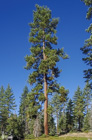
Mature tree in forest near Jackson Meadows, California [C.J. Earle, 2026.09.12].

Strongly windformed tree near timberline on Mt. San Antonio, California [C.J. Earle, 2019.05.24].

P. jeffreyi growing with P. quadrifolia in the Laguna Mountains, California [C.J. Earle, 2022.11.25].
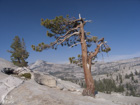
A tree seemingly growing out of granite at Olmstead Point, Yosemite National Park, California [C.J. Earle, 2008.06.30].
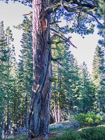
A mature forest tree that suffered a lightning strike, which illuminates the spiral grain of the trunk; near Jackson Meadows, California [C.J. Earle, 2026.09.13].
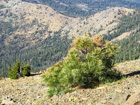
A tree high on Mt. Eddy, California. It's growing above all other conifers except a few P. albicaulis, and the substrate is serpentine [C.J. Earle, 2023.07.23].

A seedling showing both juvenile and mature foliage; Plumas National Forest, California [C.J. Earle, 2010.10.20].

The Huntington Lake Giant with its discoverers, Carl Casey and Martin Crawford. Note the platy orange bark [C.J. Earle, 2025.06.17].

This 30 cm diameter tree with its branches shows a very different bark, rough and gray; this is a tree growing on serpentine in SW Oregon [C.J. Earle, 2007.02.03].
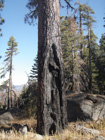
A tree bearing a large and complex fire scar recording multiple burns; Plumas National Forest, California [C.J. Earle, 2010.10.19].
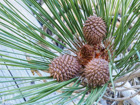
Conelets near summer's end in their first year; near Sierra City, California [C.J. Earle, 2026.09.12].
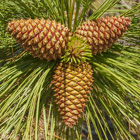
Rapidly-maturing cones in their second summer; Sequoia National Forest, California [C.J. Earle, 2025.06.13].
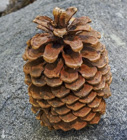
Mature, recently-fallen cone; Sierra National Forest, California [C.J. Earle, 2025.06.13].
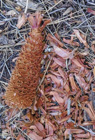
Cone gleaned by a squirrel; Tahoe National Forest, California [C.J. Earle, 2025.06.13].
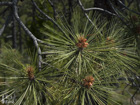
Foliar units with mature pollen cones; Horse Mountain Botanical Area, California [C.J. Earle, 2025.06.13].
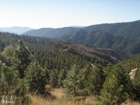
Forest plantation of Jeffrey Pine near Plumas National Forest, California [C.J. Earle, 2025.06.13].
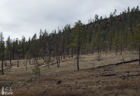
Serpentine barren forested with Jeffrey pine; Rough and Ready Botanical Area, Oregon [C.J. Earle, 2025.06.13].

Conservation Status

Pinus jeffreyi
A.Murray bis (1853)
Common names
Jeffrey, bull, western black, Truckee or sapwood pine (Peattie 1950); pino [Spanish], wexet [Cahuilla], hellykaay [Kumeyaay] (display at Anza-Borrego State Park).
Taxonomic notes
Syn: Pinus deflexa Torrey 1859; P. jeffreyi var. deflexa (Torrey) Lemmon 1888; P. ponderosa var. jeffreyi (Balfour) Vasey 1876; P. ponderosa ssp. jeffreyi (Balfour) Murray 1982; P. jeffreyi var. baja-californica Silba 1990 (Farjon and Styles 1997).
Generations of young botanists have had difficulty distinguishing P. ponderosa and P. jeffreyi, and it was always assumed that the two taxa were closely related; however, the truth lay in the presence of natural hybrids where Pinus coulteri occurs, such as in the Laguna, San Jacinto and San Bernardino Mountains of California, producing cones with intermediate characteristics. Analysis of nuclear and plastid DNA by Willyard et al. (2021) has now clearly shown that P. jeffreyi is in Pinus subsection Sabinianae, sister to the other species in that subsection, including P. coulteri.
Description
Trees 24-61 m tall, 60-250 cm dbh, usually with a single straight bole; crown conic to rounded. Bark usually yellow-brown to cinnamon, sometimes gray, thick, deeply furrowed, usually cross-checked to form large irregular scaly plates, with odor of lemon and vanilla. Branches spreading-ascending; twigs stout (to 2 cm thick), purple-brown, often glaucous, aging rough. Buds ovoid, tan to pale red-brown, 2-3 cm, not resinous; scale margins conspicuously fringed. Needles 3 per fascicle, spreading-ascending, persisting (2-)4-6(-7) years, 12-25 cm × 1.5-2 mm, slightly twisted, gray- to yellow-green, all surfaces with fine stomatal lines, margins finely serrulate, apex acute to acuminate; sheath 1.5-2.5 cm, base persistent. Pollen cones lance-cylindric, 20-35 mm, yellow to yellow- or purple-brown or yellow. Seed cones maturing in 2 years, shedding seeds and falling soon thereafter, nearly terminal, spreading, slightly asymmetric at base, ovoid-conic before opening, cylindro-ovoid when open, (10)15-30 cm, light red-brown, nearly sessile or on stalks to 0.5 cm, abaxial surface of scales not darker than or sharply contrasting in color with adaxial surface, scales in low spirals (as compared to Pinus ponderosa) of 8 or more per row as viewed from side, those of cones just prior to and after cone fall not so spreading and deflexed, thus not so much separated from adjacent scales; apophyses slightly thickened and raised, not keeled; umbo central, slightly raised, with short, slender, reflexed prickle. Seeds ellipsoid-obovoid; body ca. 1 cm, brown or gray-brown, mottled darker; wing to 2.5 cm. 2n=24 (Little 1980, Kral 1993). See García Esteban et al. (2004) for a detailed characterization of the wood anatomy.
It is often challenging to distinguish P. jeffreyi from P. ponderosa. If seed cones are available, P. jeffreyi cones have recurved umbos, so they are not prickly to the touch; except, in parts of southern California, both species have fairly prickly cones. P. jeffreyi also generally has larger cones with many more scales per cone. P. jeffreyi has more glaucous, less yellow-green foliage that is slightly thicker and less acute, compared to P. ponderosa. Vegetative buds of P. jeffreyi are non-resinous, while those of P. ponderosa are extremely resinous. Ecologically, P. jeffreyi is characteristic of higher elevation, slightly more mesic sites in areas where both species occur. Other characters that are often cited for distinguishing the species, such as bark characters or odor, have been found to be highly variable and/or inconsistent. However, for a very thorough discussion, see Chester and Strong (2022).
Distribution and Ecology
US: SW Oregon, S through the Klamath Mtns. and Sierra Nevada of California and far W Nevada into Mexico: N Baja California Norte, at (1000-)2000-3100(-3858) m on dry mountain slopes (Little 1980, Kral 1993, Safford 2025). This species has a surprising affinity for high elevations; the 3858 m elevation record established it as the highest conifer in California and, with P. contorta, one of the two highest pines in the U.S. Hardy to Zone 8 (cold hardiness limit between -12.1°C and -6.7°C) (Bannister and Neuner 2001). It is a characteristic species of serpentine and other nutrient-poor soils, environments in which it grows slowly but outcompetes other trees.
Point data based on GBIF Occurrence Download https://doi.org/10.15468/dl.u47x3k, retrieved 2023.08.05, with duplicates and erroneous observations removed.
Jeffrey pine has one of the heaviest seeds found among pines whose seeds are normally dispersed by wind (rather than by birds); however, its seeds can be carried and cached by the yellow pine chipmunk, Tamias amoenus, and thus it is commonly a mammal-dispersed pine (Johnston 1994).
This species is one of the primary hosts for the dwarf mistletoe Arceuthobium campylopodum (Hawksworth and Wiens 1996).
Remarkable Specimens
The current champion is 241 cm dbh, 56.08 m tall, with a 21.0 m crown spread; photo at right. I have an older record of an even larger tree in the Morris Meadows, Trinity Alps, California; it was discovered in December 2010 and measured at 245 cm dbh and 63.09 m tall. The tree has an estimated wood volume (including the big reiteration shown in the photo) of 118.16 cubic meters(Michael Taylor email 2010.12.19). I presume it has since died. The second largest known tree is "Smoky Jack" on the Tioga Pass Road in Yosemite National Park, California; it was last measured as 56.7 m tall and 227 cm dbh with a wood volume of 116 m3. If still alive, it may rank as the tallest specimen. An even larger tree died in 2002-2003 from bark beetle attack: the "Eureka Valley Giant" was 58.5 m tall and 247 cm dbh with a wood volume of 129 m3 (Van Pelt 2001, Van Pelt pers comm. 2003.12). With the death of that tree, Pinus ponderosa assumed the title of the largest tree in subgenus Pinus.
The oldest tree known, 626 years, is recorded in a tree-ring chronology collected near Truckee, California (Brown 2026). There was also a chronology collected in 1964 at Tioga Pass, California by C. W. Ferguson and M. L. Parker (ITRDB CA505). A sample from tree 048052 covered 813 years, and it was alive at the time; but it was crossdated as dying in the year 2294. No explanation has been found, but it seems reasonable to think that the 813 years was a ring count, and the sample could not be reliably crossdated.
Ethnobotany
Historically, P. ponderosa was used for turpentine extraction in late 19th century California. In the absence of cones, P. ponderosa and P. jeffreyi resemble each other rather closely and occur in mixed stands. Occasionally workers would try to distill turpentine from Jeffrey rather than ponderosa sap, with explosive and sometimes tragic consequences (Mirov and Hasbrouck 1976).
Commercially, this remains an important timber species, largely interchangable with Pinus ponderosa for all practical purposes ("but the sweetish odor of the fresh-cut wood contrasts sharply with the turpentine odor of ponderosa pine" [Kral 1993]); in habitat it mainly occurs on poorer sites than ponderosa and grows more slowly, but in plantation forestry it can outgrow ponderosa, making it an attractive investment. It is primarily used in construction, because the wood is strong but soft, and can be hard to work (Farjon 2010). The resin chemistry of the two species is significantly different, though. The sap contains heptane, a highly flammable hydrocarbon that was at one point used in developing the octane scale for grading gasolines (Mirov and Hasbrouck 1976).
In dendrochronology, Brubaker and Graumlich have developed a number of chronologies from the Siskyou area, and Holmes et al. (1986) have published several chronologies from the Sierra Nevada. Jeffrey pine tree-ring data have been used in studies of climate variability, fire history, paleoseismology, air pollution (ozone), and riparian ecosystem change.
Observations
There are some fine stands in the Sierra Juárez of Baja California Norte, but I think the Sierra San Pedro Martír stands are even more memorable. An extraordinarily extensive old-growth forest cloaks the upper elevations (above about 2000 m) of this Mexican National Park, with extensive open stands of Jeffrey and sugar (P. lambertiana) pine interspersed with white fir (Abies concolor). Locally the forest opens out into parks fringed by lodgepole pine (P. contorta), and rocky, exposed outcrops have specimens of the endemic Hesperocyparis montana. The park is readily accessed from the west by a good gravel road that leaves the Transpeninsular Highway 140 km S of Ensenada and services an astronomical observatory situated near the summit of the Sierra.
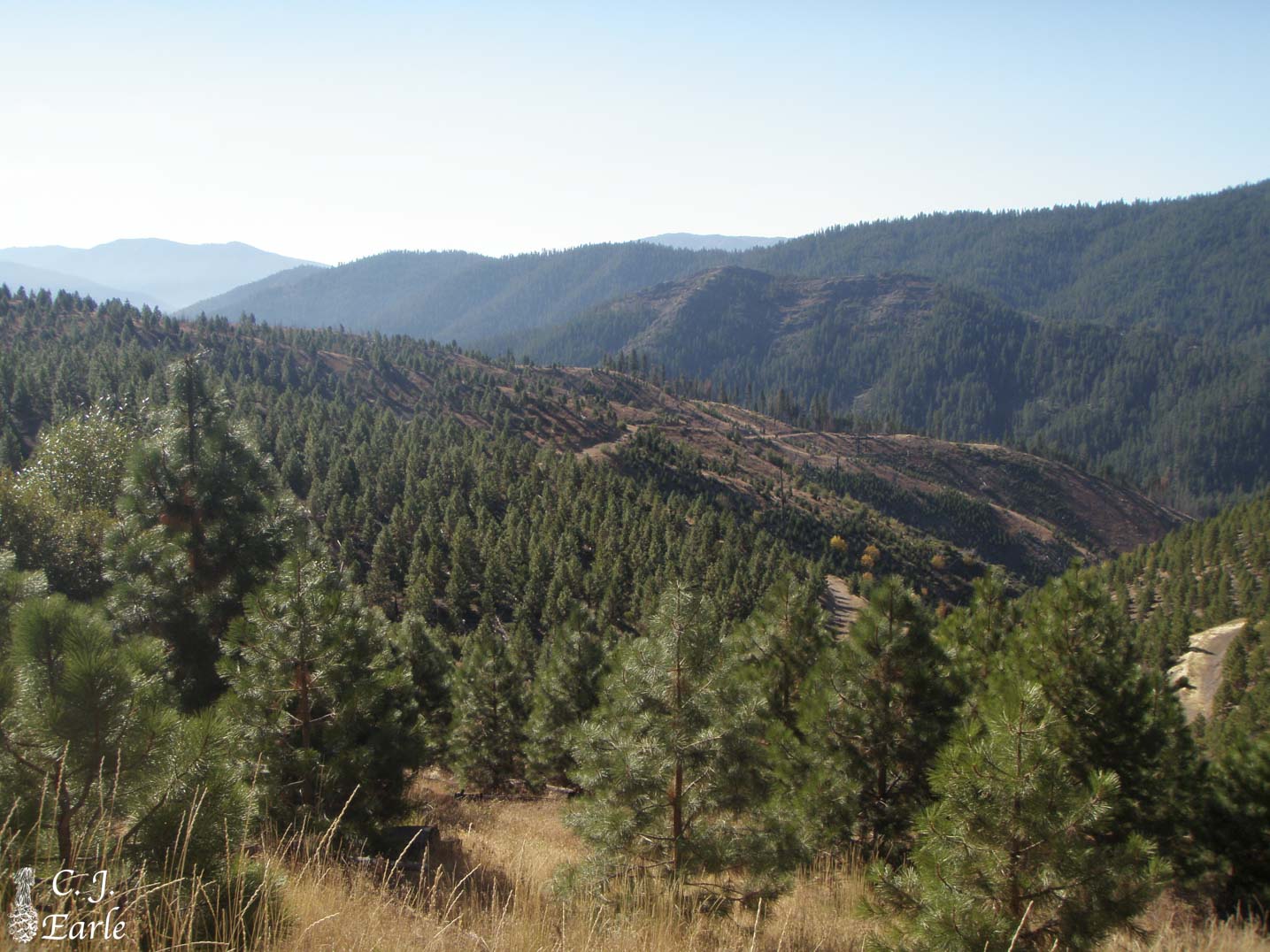
In California, Jeffrey pine is commonly a dominant element of the forest in the Mt. San Jacinto area, throughout the Transverse Ranges, throughout the entire Sierra Nevada, and in the Siskiyou and Klamath Mountains. See photos at right for some examples. There are also some noteworthy occurrences in the Coast Ranges northwards from Clear Lake, and in the Warner Mountains. It is also local in SW Oregon; the Rough and Ready Botanical Wayside near Cave Junction is particularly interesting as a readily-accessible spot where Jeffrey pine grows on serpentine-derived soils.
Remarks
Named for its discoverer, John Jeffrey, a 19th century Scots botanist who traveled in Oregon and California and who found the tree in the Shasta Valley of California (Little 1980). See P. balfouriana (which he also discovered) for some of Jeffrey's story.
As early as 1919, Schorger discovered that P. jeffreyi and P. sabiniana were the only two pines to contain a significant amount of n-heptane, but no terpenes, in their oleoresins (Mirov 1967), yet it took until 2021 for most taxonomists to be persuaded that the two are sister species, and genetically distant from P. ponderosa (Willyard et al. 2021).
Jeffrey pines in California have been found to be quite sensitive to air pollution, and ozone in particular causes needle death and defoliation. See the additional sources below for more information.
Citations
Brown, Peter. 2026. OLDLIST, a database of old trees. https://www.rmtrr.org/oldlist.htm, accessed 2026.10.18.
Chester, Tom and Jane Strong. 2022. Plants of Southern California Pinus jeffreyi and P. ponderosa var. pacifica. http://tchester.org/plants/analysis/pinus/jeffreyi_ponderosa.html, accessed 2023.08.05.
Holmes, Richard L., Rex K. Adams, and Harold C. Fritts. 1986. Tree-ring chronologies of western North America: California, eastern Oregon and northern Great Basin. Tucson: University of Arizona Laboratory of Tree-Ring Research.
Johnston, Verna R. 1994. California Forests and Woodlands. University of California Press. Los Angeles.
Murray, A. 1853. Botanical Expedition to Oregon. 8:2, no. 731. Edinburgh.
Safford, Hugh D. 2025. New elevation records for Jeffrey pine (Pinus jeffreyi A.Murray bis & al.). Madroño 72(1):25-36.
Willyard, Ann, David S. Gernandt, Blake Cooper, Connor Douglas, Kristen Finch, Hassan Karemera, Erik Lindberg, Stephen K. Langer, Julia Lefler, Paula Marquardt, Dakota L. Pouncey, and Frank Telewski. 2021. Phylogenomics in the hard pines (Pinus subsection Ponderosae; Pinaceae) confirms paraphyly in Pinus ponderosa, and places Pinus jeffreyi with the California big cone pines. Systematic Botany 46:538–561.
See also
Arno, Stephen F. and Jane Gyer. 1973. Discovering Sierra trees. Yosemite Natural History Association. 89pp.
Burns and Honkala 1990.
FEIS database.
Haller, John R. 1959. Factors affecting the distribution of ponderosa and Jeffrey pines in California. Madrono 15:65-71. Available: Biodiversity Heritage Library, accessed 2021.12.18.
Haller, John R. 1962. Variation and hybridization in ponderosa and Jeffrey pines. Univ. of CA Pub. in Bot. 34:123-166.
Lanner 1999.
Miller, P.R. 1992. Mixed conifer forests of the San Bernardino Mountains, California. Ecological Studies: Analysis and Synthesis 97:461-497. [Discusses ozone damage]
Peterson, D.L. and M.J. Arbaugh. 1992. Mixed conifer forests of the Sierra Nevada. Ecological Studies: Analysis and Synthesis 97:433-459. [Discusses ozone damage]
Salardino, David H. and John J. Carroll. 1998. Correlation between ozone exposure and visible foliar injury in Ponderosa and Jeffrey Pines. Atmospheric Environment 32:3001-3010.
Schoenherr, Allan A. 1992. A Natural History of California. University of California Press. Los Angeles.
Vasek, Frank C. 1978. Jeffrey pine and vegetation of the southern Modoc National Forest. Madroño 25:9-30.



 Back to top