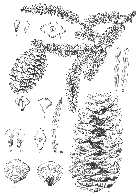
Line drawing; for full size image go to the Flora of China (Wu and Raven 1999).

Conservation Status

Picea neoveitchii
Veitch spruce, Hubei spruce (Farjon 1990); 大果青扦 daguo qingqian [Chinese] (Wu and Raven 1999).
No data as of 2026-10-22.
Trees to 15 m tall and 50 cm dbh, with a broadly conical crown. Bark gray, scaly, flaking. Branchlets pale yellow turning gray or yellow-gray in 2nd and 3rd years, finally gray or dark gray; stout, glabrous. Leaves spreading radially, curved and directed forward on upper side of branchlets, spreading and ascending on lower side, rhombic in cross section, 15-25×2 mm, with 4-7stomatal lines along each surface, apex acute. Seed cones green, maturing brown, ovoid-cylindric, 8-14 × 5-6.5 cm. Seed scales rhombic-ovate, 2.7 × 2.7-3 cm, apex broadly rounded or obtuse. Seeds obovoid, 5-6 × 3.5 mm, with a 10 mm wing. Pollination May, seed maturity September-October (Wu and Raven 1999). See García Esteban et al. (2004) for a detailed characterization of the wood anatomy.
China: S Gansu, SW Henan (Weixing Xian), W Hubei, S Shaanxi, NE Shanxi (Wutai Shan), Sichuan; at 1300-2000 m elevation (Wu and Raven 1999). Hardy to Zone 5 (cold hardiness limit between -28.8°C and -23.3°C) (Bannister and Neuner 2001).
Distribution of all species in the Picea asperata complex; data from GBIF (2026). P. neoveitchii shown in orange. Data have been edited to remove location duplicates, remove collections with coordinate uncertainty >10 km, and remove obvious extralimital occurrences. Specimens have not been checked and some may be misidentified. Click on any point for more info.
"The species is very rare and scattered within its range in montane coniferous forest on the southern slopes of the Qinling Range. The forest has experienced large reductions in extent and the entire population has declined in numbers, especially at Neixiang. A good stand is apparently still found in Xinja Shan" (WCMC 1998).
Potential impacts of climate change on this species are unclear, with two analysis giving very different results. In one, potential effects were assessed by applying species distribution models based on IPCC (2014) climate change scenarios and evaluating the outcomes under IUCN (2019) listing criteria. Results indicate the total disappearance of habitat, resulting in the species' extinction. The primary factors driving this change are increased temperature seasonality and temperature increases in the warmest months of the year (Dakhil et al. 2021). The second analysis took the same general form (species distribution models run for IPCC scenarios), but concluded a small increase in suitable habitat, with about 65% of existing habitat remaining suitable and habitat increases exceeding losses by about a 2:1 ratio (Xie et al. 2022).
No data as of 2026-10-22.
No data as of 2026-10-22.
No data as of 2026-10-22.
The epithet refers to James Veitch, a prominent British nurseryman who funded E. H. Wilson's plant collecting work in China (Wilson ended up naming quite a few discoveries for his patron, among them Abies veitchii). The "neo" was added on because at the time "Picea veitchii" was in use in the horticultural trade, although no species had been described under that name (Masters 1903).
Dakhil, M. A., M. W. A. Halmy, Z. Liao, et al. 2021. Potential risks to endemic conifer montane forests under climate change: integrative approach for conservation prioritization in southwestern China. Landscape Ecology 36:3137-3151.
Farjon, Aljos. 1990. Pinaceae: drawings and descriptions of the genera Abies, Cedrus, Pseudolarix, Keteleeria, Nothotsuga, Tsuga, Cathaya, Pseudotsuga, Larix and Picea. Königstein: Koeltz Scientific Books.
IPCC. 2014. The Physical Science Basis. Working Group I Contribution to the Fifth Assessment Report of the Intergovernmental Panel on Climate Change—Summary for Policymakers. IPCC, Geneva.
IUCN. 2019. Guidelines for Using the IUCN Red List Categories and Criteria, Ver. 14. IUCN Standards and Petitions Subcommittee, IUCN, Gland, and Cambridge.
Masters, M. T. 1903. Chinese Conifers. Gardeners Chronicle ser. 3. 33:116. Available: Biodiversity Heritage Library, accessed 2020.11.26 (includes photo and drawing).
World Conservation Monitoring Centre - Trees [WCMC]. 1998. Database at http://www.wcmc.org.uk/cgi-bin/SaCGI.cgi/trees.exe, accessed 1998.10.01, now defunct.
Xie, Dan, Hong Du, Wei-Hua Xu, et al. 2022. Effects of climate change on richness distribution patterns of threatened conifers endemic to China. Ecological Indicators 136:108594. doi:10.1016/j.ecolind.2022.108594.
The species account at Threatened Conifers of the World.
Back | Home | Contact us
Copyright 2026 The Gymnosperm Database
Edited by Christopher J. Earle
This page accessed on Friday, October 23, 2026
Last Modified 2026-10-22
 Back to top