Conservation Status

Picea brachytyla
(Franch.) E.Pritz. (1901)
Common names
Sargent spruce (Farjon 1990); 麦吊云杉 mai diao yunshan [Chinese] (Wu and Raven 1999).
Taxonomic notes
Type: China, Sichuan, Kangding, Farges 806. Synonymy: lengthy, see POWO. The most noteworthy historical synonym was P. sargentii, widely used until the earlier name by Pritzel was recognized. For a long time a var. complanata was also recognized, until genomic studies revealed that plants formerly assigned to var. complanata in NW Yunnan, and likely also in neighboring parts of Sichuan and Xizang, are not P. brachytyla, but instead fall within the P. likiangensis species complex (Lyu et al. 2020). However the type of var. complanata was from far to the N, near Daxiangling in Ya'an County, Sichuan, and that specimen is now established as being P. brachytyla, so the name complanata becomes a synonym. The NW Yunnan plants are left without a name, and study of available collections has not resolved the issue, nor have they verified the continued existence of an extant population. Further genomic studies will likely be needed to ascertain whether those plants can be assigned to a recognized species (e.g. P. farreri or P. likiangensis), or if they represent a new taxon entirely (Ru et al. 2016, Shao et al. 2019, Lyu et al. 2020, Christian 2025).
A new variety, P. brachytyla var. argyroderma T.B.Chao, Zhi X.Chen & X.K.Li was described in 2021. The type was collected in Henan at the Zhengzhou Botanical Garden and the description was published in the Selected Papers of Zhao Tianbang No. 14, an extremely obscure publication that I haven't been able to locate a copy of. Its origin in a botanical garden is suspicious, though; it may well be a hybrid or obscure forma.
Picea brachytyla belongs to Clade II B of Ran et al. (2006), which primarily includes species from northeast Asia and the Himalaya-Hengduan mountains. However, see Picea for discussion of the general level of ambiguity regarding phylogenetic relationships in the genus.
Description
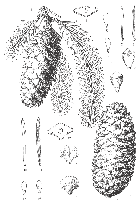
Trees to 30(-50) m tall and 100(-200) cm dbh, with a pyramidal crown that becomes cylindrical and somewhat irregular with age. Bark gray-brown, longitudinally fissured into thick, square plates. Branchlets pendulous, pale yellow or brownish yellow, turning brownish yellow or brown, finally gray. Leaves directed forward and closely appressed on upper side of branchlets, spreading and almost pectinate on lower side, linear, slightly curved or straight, flattened, 10-25×1-1.5 mm, slightly keeled on both sides, stomatal lines 5-7 in each of 2 white or pale bands adaxially, apex acute or mucronate. Seed cones green, maturing dull brown or brown tinged purplish, ovoid-oblong, 6-10(-12)×3-4 cm. Seed scales obovate-oblong or rhombic, 1.4-2.2×1.1-1.3 cm, base cuneate, distal margin usually recurved, sometimes elongate. Seeds ca. 12 mm including wing. Pollination April-May, seed maturity September-October (Wu and Raven 1999). See García Esteban et al. (2004) for a detailed characterization of the wood anatomy.
Distribution and Ecology
China: S. Gansu, S Shaanxi, NW Hubei, W Sichuan, NW Yunnan & SE Xizang; N Burma; the Assam Himal in India (Farjon 1990). This species forms a prominent forest belt in moist mountains of SW China at 2600-3100 m (Liu 1971). Across its broad range, it can be found at 1300-3800 m elevation, typically growing in a cold and wet monsoonal climate with annual precipitation of 1000-2500 mm (wetter to the S) on grey-brown mountain podzols. It is commonly found with Abies spp., Picea likiangensis, Tsuga spp. and Larix potaninii (Farjon 1990). In W Sichuan I found it and var. complanata in association with Betula albosinensis, a shrubby bamboo, and many species of Rhododendron.
Hardy to Zone 8 (cold hardiness limit between -12.1°C and -6.7°C) (Bannister and Neuner 2001).
Where I saw P. brachytyla growing in Sichuan on the eastern flanks of Gongga Shan, it occupied an ecological role similar to that of Picea sitchensis in forests of the Pacific Northwest. The climate was very wet, supporting dense growths of moss and a thick forest understory; the trees grew to large size and formed a closed canopy; seedlings primarily grew on nurse logs derived from fallen overstory trees; understory trees grew old as advance regeneration, with umbrella-shaped crowns and slender stems; and the understory was dominated by ericaceous shrubs.
Both the type and var. complanata are listed by the WCMC as vulnerable. It is "a widespread species [that] is experiencing increasing rates of logging and deforestation throughout the species' range. Population declines are not documented but are believed to be considerable" (WCMC 1998).
Remarkable Specimens
The largest I have encountered was ca. 50 m tall and 203 cm dbh, a double-butted tree sampled at Hailuogou Glacier Park, Sichuan, China. Diameters exceeding 180 cm are fairly common in this area. The oldest I found, also at Hailuogou Glacier Park, had 606 rings in the measured, crossdated core (collected 1989).
Ethnobotany
An important timber species within its native range, it is also cultivated for afforestation (Wu and Raven 1999).
I made an exploratory dendrochronology collection in April 1989 at Hailuogou Glacier Park in Sichuan, but it did not yield any publications.
Observations
The main trail to the glacier at Hailuogou Glacier Park, Sichuan, China, passes through several impressive stands of this species. The park is served by bus service from Chengdu to Moxi (a two-day ride when I did it in 1989). In Moxi one can acquire guides for the hike into the mountains. It is about a one-day trip to the area of the big trees and another day to the timberline and glacier. Cabins and food service are available within the park.
Remarks
The epithet is from the Greek for short, brachy-, and "having lumps or projections," -tyla.
Citations
Christian, Tom. 2025. Picea brachytyla (Franch.) Pritz. Trees and Shrubs Online, www.treesandshrubsonline.org/articles/picea/picea-brachytyla/, accessed 2026.01.08.
Farjon, Aljos. 1990. Pinaceae: drawings and descriptions of the genera Abies, Cedrus, Pseudolarix, Keteleeria, Nothotsuga, Tsuga, Cathaya, Pseudotsuga, Larix and Picea. Königstein: Koeltz Scientific Books.
Franchet, A. 1899. Plantarum sinensium ecloge tertia. Journal de Botanique 13:258. Available: Biodiversity Heritage Library, accessed 2020.11.26.
Lyu Le‐Ke, Wang Dong‐Lei, Li Long, Zhu Ying‐Ying, Jiang De‐Chun, Liu Jian‐Quan, and Xu Xiao‐Ting. 2020. Polyphyly and species delimitation of Picea brachytyla (Pinaceae) based on population genetic data. Journal of Systematics and Evolution 59(3):515-523. doi.org/10.1111/jse.12584.
Pritzel, E. 1901. Bot. Jahrb. Syst. 29:216. Available: Biodiversity Heritage Library, accessed 2020.11.26.
Ru Dafu, Mao Kangshan, Zhang Lei, Wang Xiaojuan, Lu Zhiqiang, and Sun Yongshuai. 2016. Genomic evidence for polyphyletic origins and interlineage gene flow within complex taxa: a case study of Picea brachytyla in the Qinghai-Tibet Plateau. Molecular Ecology 25(11):2373-2386. doi.org/10.1111/mec.13656.
Shao Cheng-Cheng, Shen Ting-Ting, Jin Wei-Tao, Mao Han-Jie, Ran Jin-Hua, and Wang Xiao-Quan. 2019. Phylotranscriptomics resolves interspecific relationships and indicates multiple historical out-of-North America dispersals through the Bering Land Bridge for the genus Picea (Pinaceae). Molecular Phylogenetics and Evolution 141:106610. doi.org/10.1016/j.ympev.2019.106610.
World Conservation Monitoring Centre - Trees [WCMC]. 1998. Database at http://www.wcmc.org.uk/cgi-bin/SaCGI.cgi/trees.exe, accessed 1998.10.01, now defunct.
See also
The species account at Threatened Conifers of the World.




 Back to top