Conservation Status

Abies neodurangensis
Debreczy, Rácz & Salazar (1995)
Common names
None have been reported.
Taxonomic notes
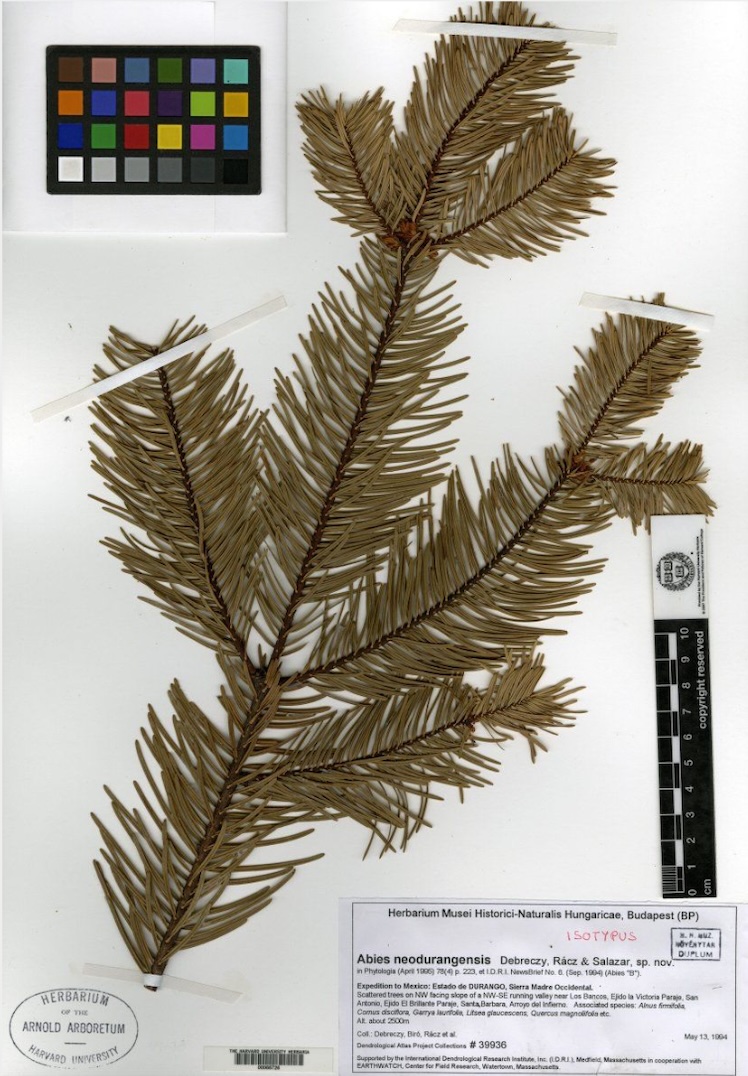
Type: Mexico, southwestern Durango near Los Bancos (Ejodi la Victoria Parajé, San Antonio, Ejido El
Brillante Parajé, Santa Barbara, Arroyo del Infierno), elevation 2,500 m, 1994.05.13;
Debreczy, Rácz, Biró et al. 39936 (Holotype BP; Isotypes A, CHAP, E, MEXU, NA).
This is a member of Abies section Grandis. Farjon (2010) and other authorities treat it as a synonym of A. durangensis var. durangensis, but as noted below in the "Description", it differs from that taxon in a number of morphological characters. Moreover, a number of authorities have contacted me over the years who have seen the trees and find them distinctive in morphology and general appearance. However, over 30 years after its discovery this remains an extremely obscure taxon known only from a small number of trees at a few locales. It does not appear to have been subjected to molecular analysis and little can be said of its systematics except that it joins the 10 other species in section Grandis, 9 of which occur in Mexico or Mesoamerica. As such it remains a taxonomic oddity, possibly an isolated and unique taxon, but more likely a variety or subspecies of a more widespread Mexican fir. Molecular studies will be needed to resolve this question. Also see Abies religiosa for general notes on the Mexican and Mesoamerican firs.
Description
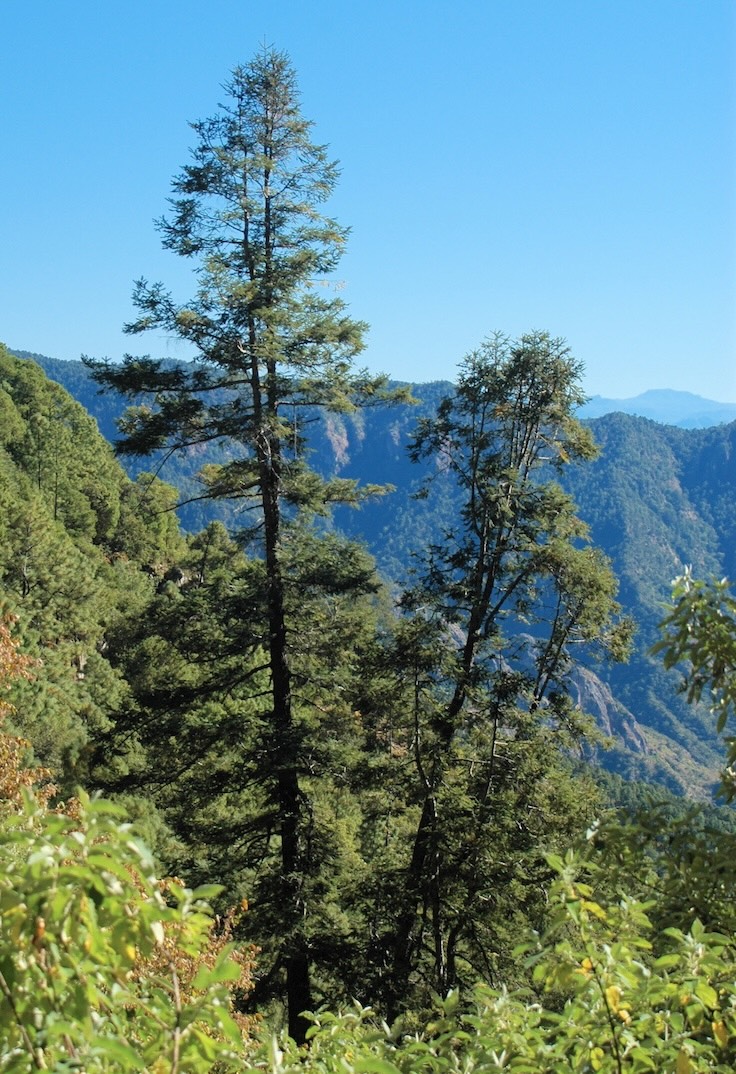
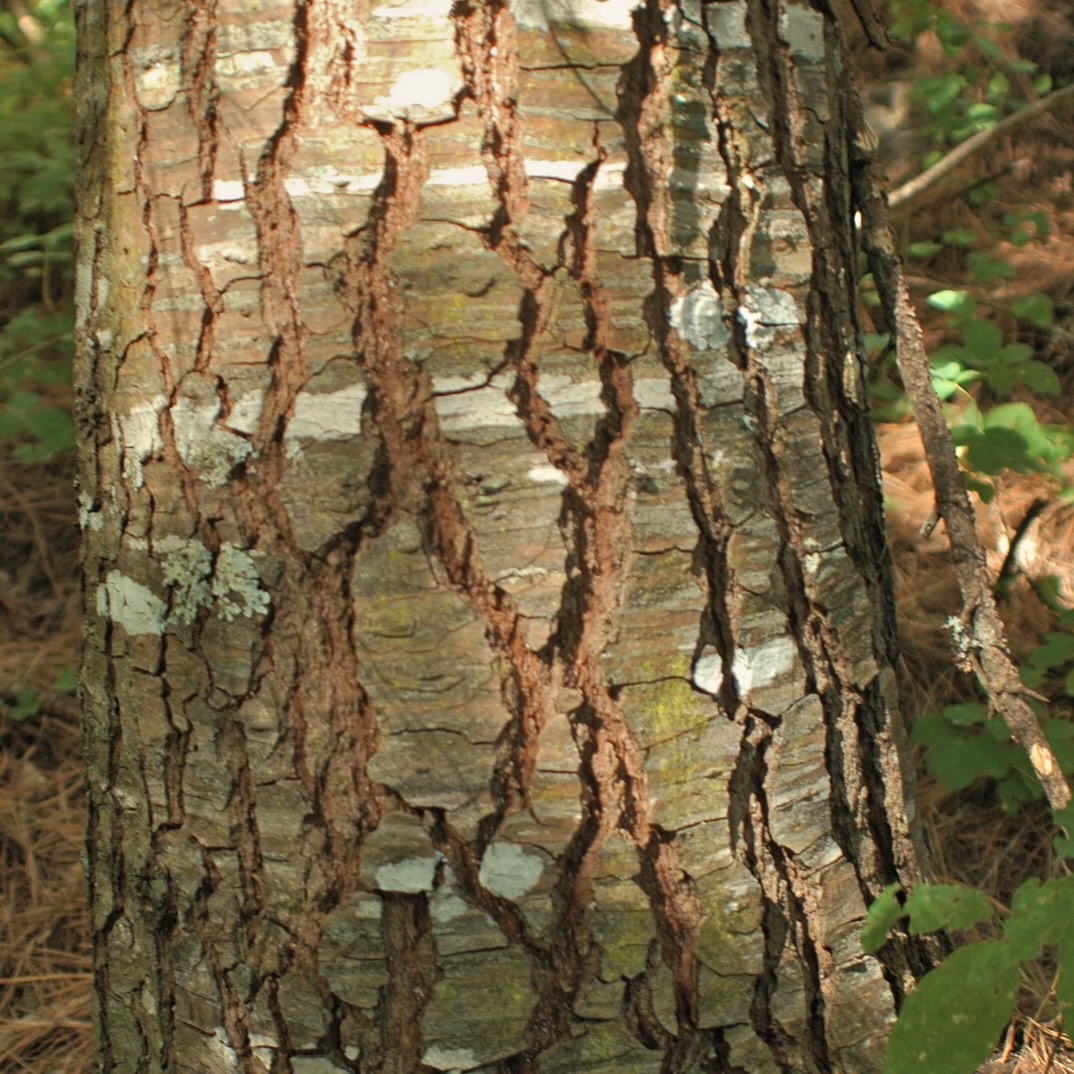
Monoecious evergreen trees to 40 m tall, typically with a single trunk and an initially open conical crown that grows dense and rounded with age. Bark first pale gray, scaly, with age thick and broken into large irregular plates; inner bark scarlet. Twigs in first year pale green to grayish brown, densely or sparsely pubescent with clear hairs 0.1–0.15 mm long; later reddish brown, sporadically hairy with fine clear hairs that persist for up to 6 years.
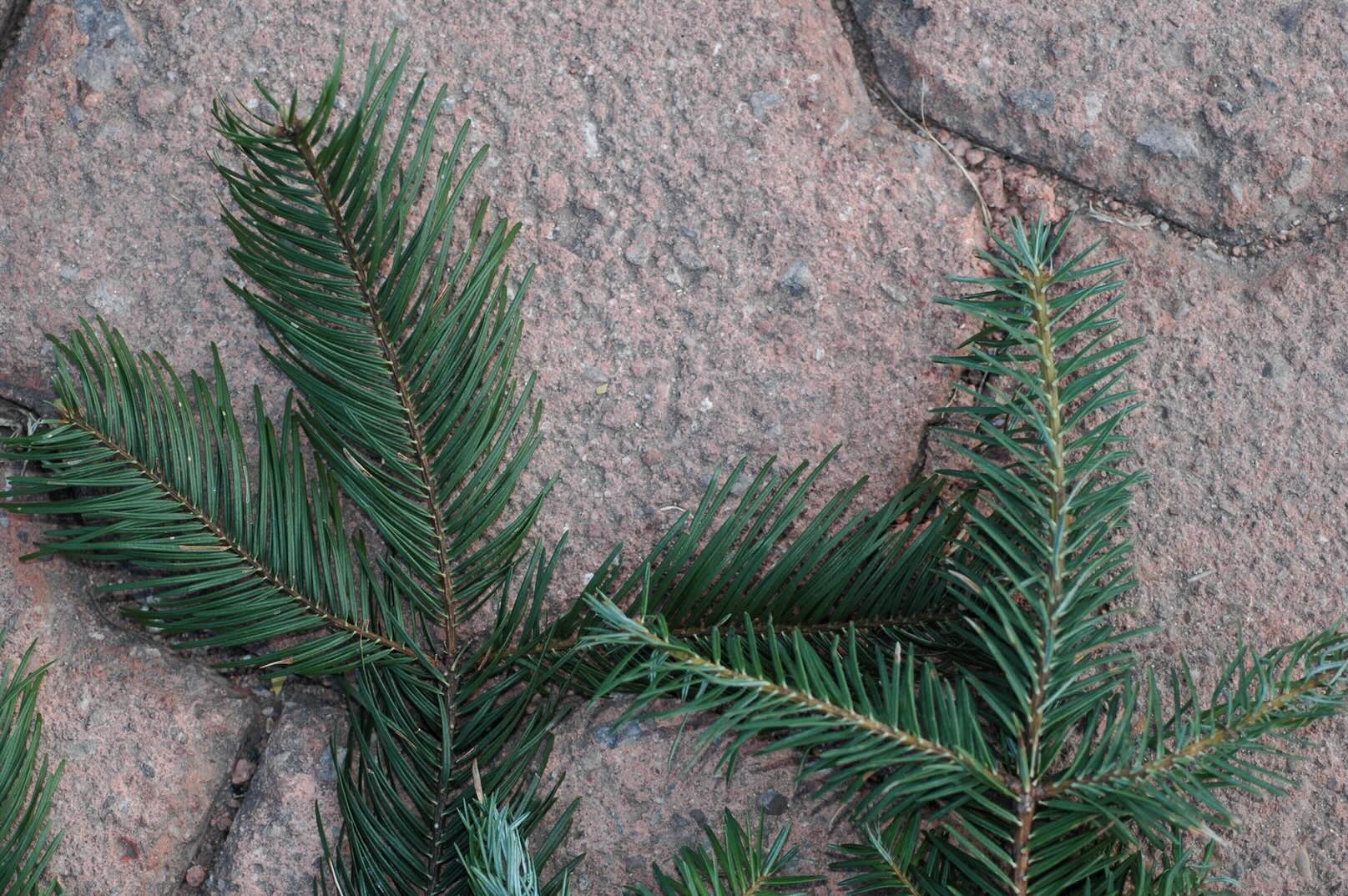
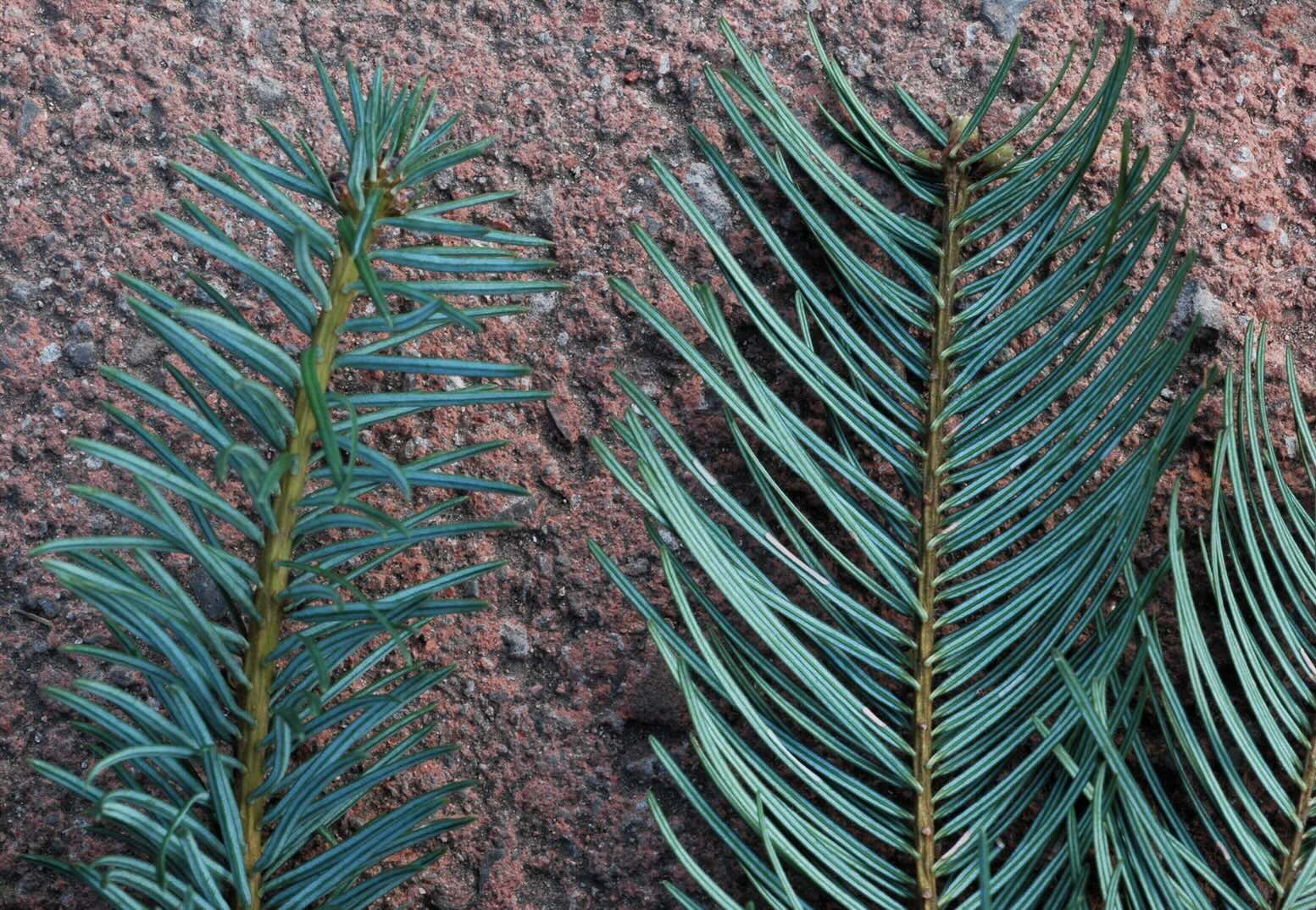
Buds on vegetative twigs subglobose, 2–3 mm diameter, non-resinous; buds on terminal twigs flat (6–7 × 3 mm) with 12-18 3 mm long shiny brown triangular scales having prominent ribs and and an erose margin. Leaves spreading on either side of shoot, widely spaced, slightly ascending, forward curving on the upper side of the shoot, flexible, linear, 3-5 cm long, 1.5–2.2 mm wide, apex obtuse or emarginate. Upper leaf surface shiny dark green with up to 7 stomatal lines near the apex and a few lines down near the base of the leaves along the impressed midrib. Lower leaf surface silvery white with green margins (0.1 mm wide) and midrib (0.25 mm wide) flanked by two silvery stripes of (6–)9(–10) stomatal lines; stomata 0.03 mm diameter, ovate. Leaves on fertile shoots are often asymmetrically (on one side) acute, more succulent with a 0.2 mm wide pruinose stripe on the upper surface comprised of up to 8 stomatal lines; midrib prominent, up to 0.7 mm wide; and stomatal stripes on lower side narrow (0.35 mm) with 6-8 lines of stomata. Leaves with 2 latero-ventral resin canals. Pollen cones not described. Seed cones short, columnar, 6.5-8.5 × 3.0-3.6 cm, initially green, later greenish-brown, comprised of 150-200 cone scales in 30–40 whorls; scales flabellate, pubescent with hairs 0.10–0.13 mm long; bracts 5-8 mm long, enclosed. Seeds 8-10 x 8 mm with a 10-14 mm long, rounded-triangular wing (Debreczy and Rácz 1995, 2003).
According to Debreczy and Rácz (2003), "it can readily be distinguished from A. durangensis by its densely hairy, dark purplish brown (not subglabrous-glabrous yellow or pruinose) branchlets, glabrous (not thickly resinous), straight (not curved), green (not gray pruinose), rounded-emargianate (not pointed) leaves with medial (not marginal) resin canals, cones with very short, enclosed (sessile) bracts with prominent laminal wings forming a "V" exceeding the shortly protruding tip (not subsessile), nearly reaching the "exposure line" (the inner limit of the exposed part, "scale head" of the cone scale) and triangular-acute at end. It has cones almost fully developed in size by the time A. durangensis "blooms"." The authors also provide illustrations relevant to this description.
Distribution and Ecology
Mexico: Durango, Sinaloa. GBIF (2026) records collections from 9 localities, all near the Durango-Sinaloa border. The type specimen was found at 2500 m elevation
"in the margin and upper part of deep canyons associated with the dominating Hydrangea seemannii Riley and 12 other species such as Alnus firmifolia Fern., Cornus disciflora DC., Garrya laurifolia Hartw., Litsea glaucescens H., B. et K. and Quercus magnoliifolia Nee" (Debreczy and Rácz 1995, 2003).
Debreczy and Rácz (1995) state that "we found only a few mature trees. Although the difficult site seems to secure the species, the preservation of the habitat(s) is immediately necessary. Young plants are present, but not many ... the population is critically endangered." The taxon has not been assessed under IUCN criteria, but in view of the small population size and extremely limited area of occupancy, an assessment of "Endangered" or "Critically Endangered" appears warranted.
Remarkable Specimens
No data as of 2026-04-06.
Ethnobotany
No data as of 2026-04-06.
Observations
See the descriptions given by Debreczy and Rácz (1995, 2003), and the observation records on iNaturalist.
Remarks
The epithet refers to the Mexican state of Durango, where the species was first collected; the prefix "neo" added to distinguish it from the widespread related species Abies durangensis (Debreczy and Rácz 1995, 2003).
Citations
Debreczy, Z. and I. Rácz. 1995. New species and varieties of conifers from Mexico. Phytologia 78(4):217-243. Available: Biodiversity Heritage Library, accessed 2026.04.05.
Debreczy, Z., and I. Rácz. 2003. A re-assessment of the new taxa of firs (Abies Mill.) reported from Mexico in 1995. Studia Botanica 34:81–110.
See also

 Back to top