Conservation Status

Abies marocana
Trab. (1906)
Common names
Moroccan fir, Sapin du Maroc [French], Pinsapo marroquí [Spanish].
Taxonomic notes
Type not designated. See POWO for full synonymy. This taxon is commonly treated as a variety or subspecies of A. pinsapo, and molecular evidence indicates they are likely sister species; however they have been reproductively isolated by the Strait of Gibraltar for at least 6 million years, in which time sufficient genetic, morphological and ecological differences have accumulated to warrant recognition at species rank. See Ben-Said (2022) for a review of the many studies contributing to this conclusion; to give an example, 85% of the variance in chloroplast DNA is attributable to differences between African vs. European populations (Terrab et al. 2007). A third taxon, A. tazaotana (endemic to Mt. Tazaot in the Rif Mountains), is synonymous with A. marocana because neither morphology nor molecular evidence indicate any consistent differences between the two (Sánchez-Robles et al. 2014, Balao et al. 2020).
This is one of 9 species in Abies section Abies, the Mediterranean firs. A. marocana was first recognized as distinct by Louis Charles Trabut (1906) based on material he received from Franck(?) Joly, who collected it in the Rif Mountains in January 1906. Trabut described it as "exactly intermediate between A. pinsapo and A. numidica", species native to Spain and Algeria, respectively.
Description
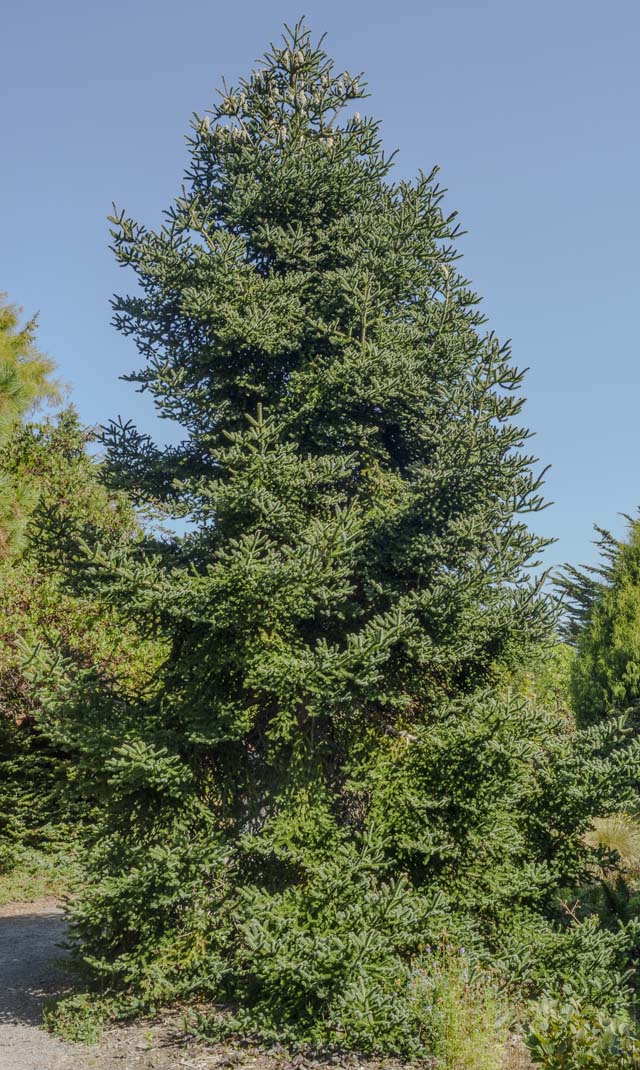
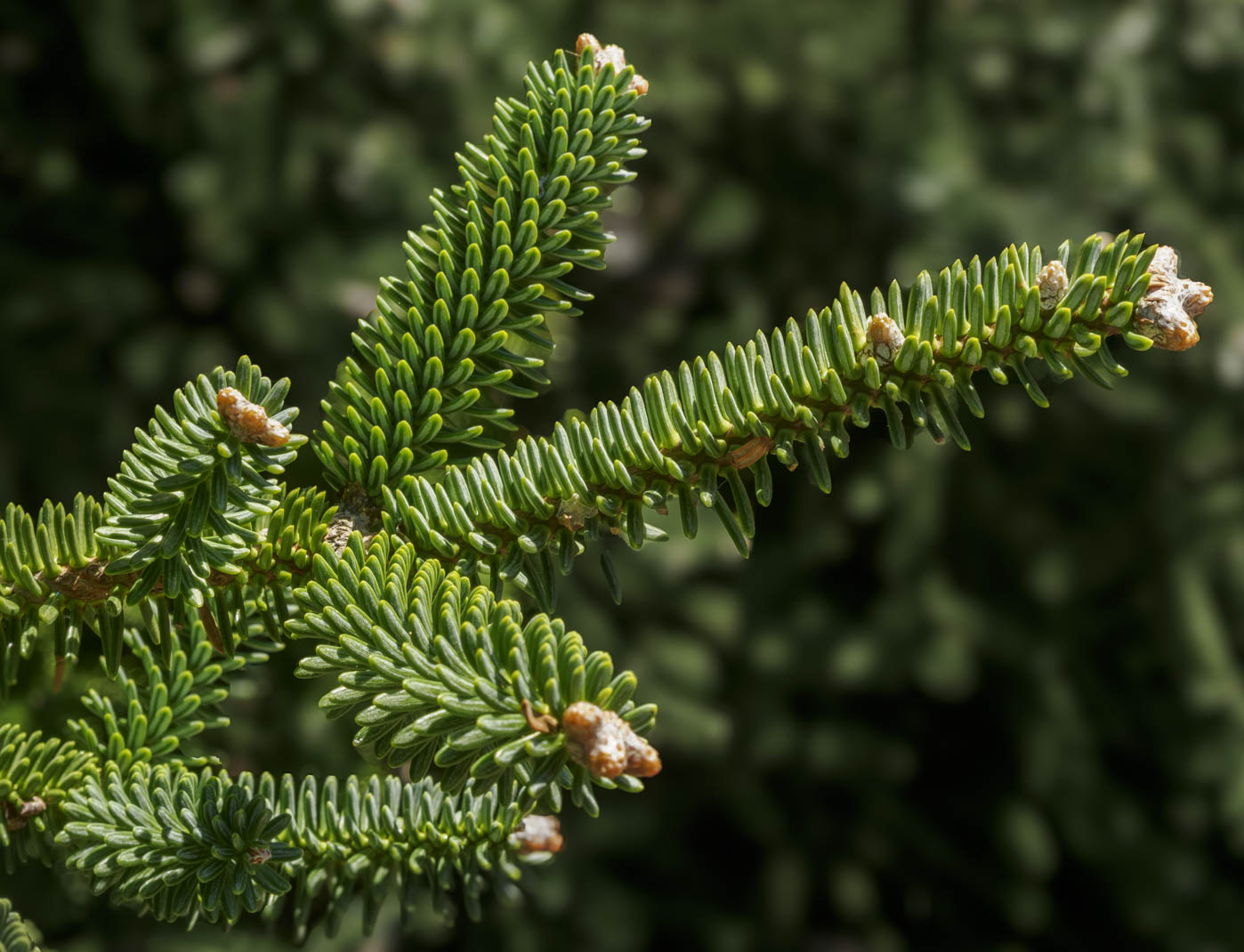
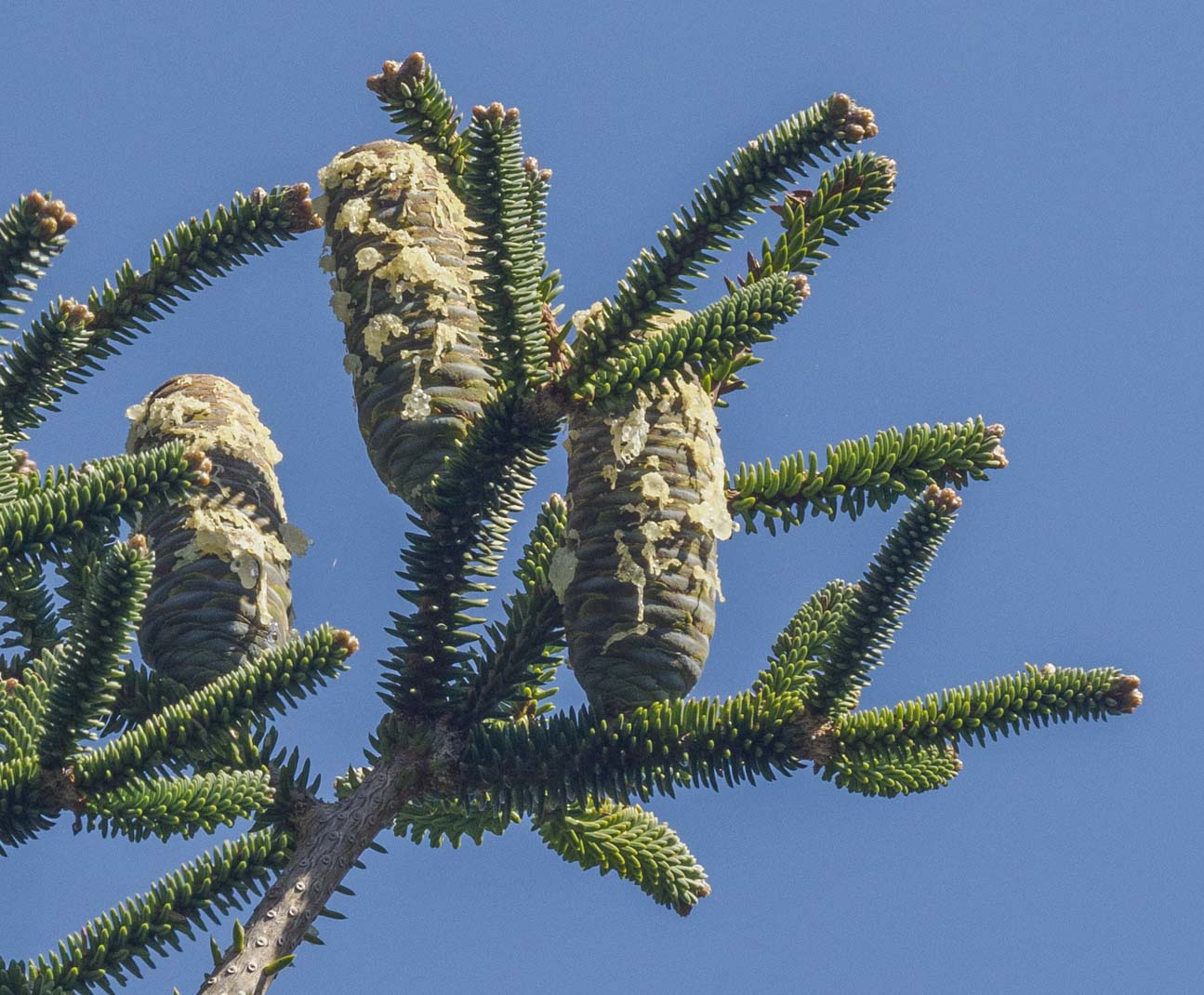
Trees to 30 m tall and 100 cm dbh, usually with a single, round, straight or forked trunk and a deep crown that is narrowly conical in young trees but irregular in older trees, comprised of long branches that ascend in the upper crown and curve downward in the lower. Trees in exposed sites may have very irregular form. Bark smooth, dark gray, with age becoming rough and scaly. Twigs stout, very stiff, red-brown or green-brown turning gray, glabrous, faintly ridged; leaf scars large, purple-gray. Foliage buds globose, 5 × 4 mm, variably resinous; scales red-brown, triangular, keeled, free at the apex. Leaves more or less pectinately arranged, particularly on shaded lower branches; 6-20 × 2-3 mm, not or slightly twisted at base, round or slightly flattened, rigid, apex acute to acuminate, stomatal bands on all surfaces, color from dark green to highly glaucous; resin canals marginal. Pollen cones lateral, crowded on twigs, 5-7 mm long, yellow with red or violet microsporophylls. Seed cones lateral, erect, on short peduncles, cylindrical, with obtuse apex, 10-18 × 3.5-5 cm, green-purple ripening to brown; rachis persistent, narrowly conical, purple-brown. Seed scales triangular, 25-28 × 22-25 mm, smooth, slightly striated, upper margin entire, undulate, incurved. Bract scales 10-13 mm long, entirely included, oblong, the apex with a tiny cusp. Seed obovate, 6-10 mm long, light brown; the wing is twice this size, light brown (Farjon 2010).
Differences from A. pinsapo include marginal rather than medial leaf resin canals; predominantly pectinate rather than spiral phyllotaxis; resin bud scales obtuse, less keeled, but acuminate; and cone scales wider than long and kidney-shaped rather than cuneiform, with the included bracts about 25% shorter than in A. pinsapo (Ben-Said 2022 and sources therein). Also, the leaves have an acute to acuminate apex (Farjon 2010).
Distribution and Ecology
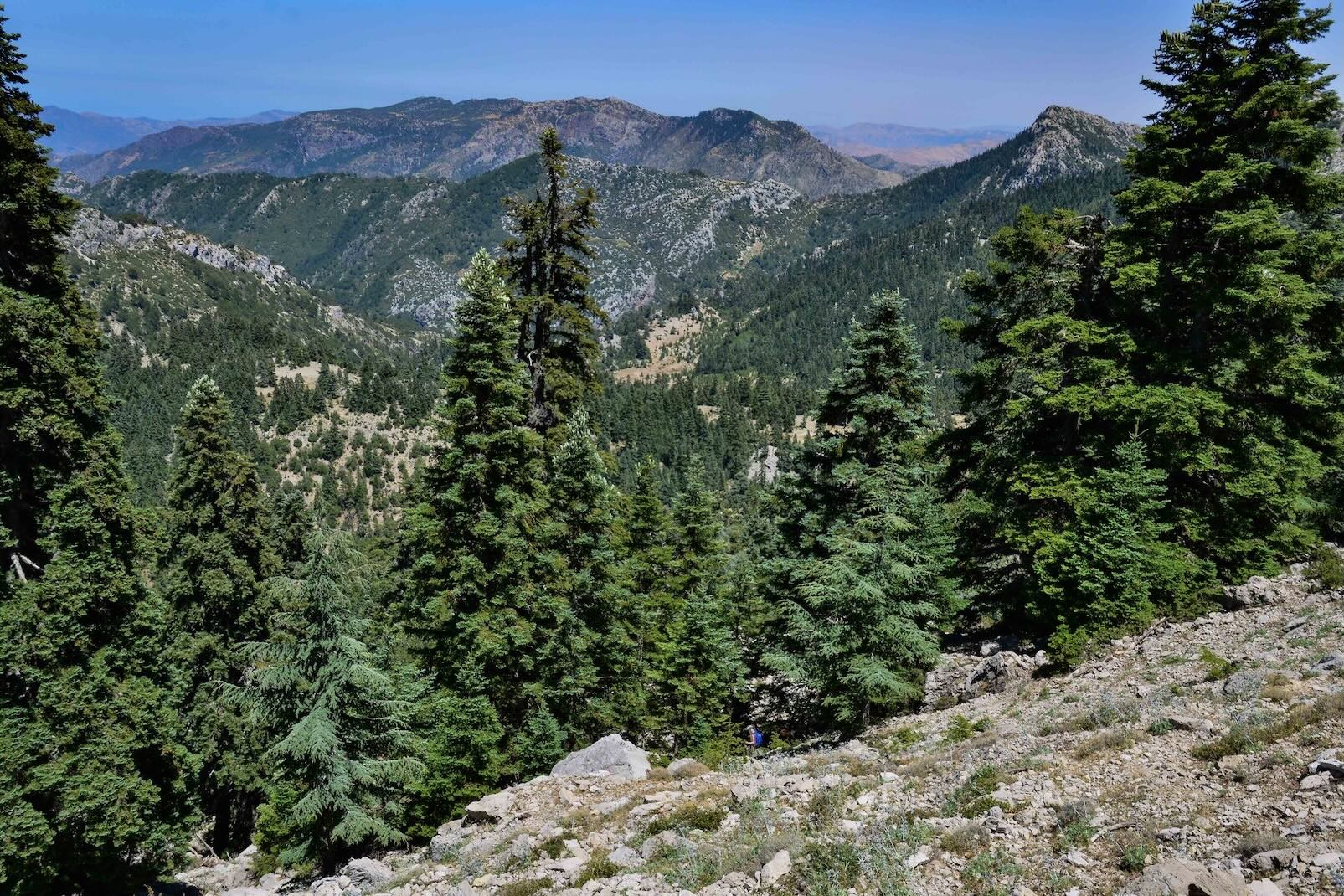
Morocco, in the Rif Mountains (Mts. Tissouka, Mago, Kraa, Tazaot, and Bab Rouida) at 1400-2100 m elevation (Farjon 2010).
Distribution of Abies in the Mediterranean region. Data from Conifers of the World BRAHMS database, downloaded 2017.11.05. Taxa are color coded; see pull-out menu at left of map for details. Click on each occurrence for further information.
A. marocana grows on N-facing slopes on rocky soils derived from dolomitic limestone or serpentine, with deep drainage. The climate is montane Mediterranean: dry, warm summers and cool, moist winters, with annual precipitation around 1000 mm. The trees grow in pure, scattered stands or mixed with Cedrus atlantica. Other associates include broad-leaved trees such as Quercus ilex, Q. lusitanica, and Q. canariensis, and sclerophyllous shrubs such as Ulex baliticus, Cistus spp., Pistacia lentiscus, Daphne laureola and Berberis hispanica (Farjon 1990).
Remarkable Specimens
No data as of 2026-10-06.
Ethnobotany
A. marocana was formerly exploited for timber, but reduced abundance and the creation of preserves have largely eliminated that. It remains popular in horticulture, particularly in areas of Mediterranean climate. There are many cultivars, with glaucous and dwarf forms particularly popular; other cultivars are based upon hybrids with firs of section Abies and also with A. pindrow (Farjon 2010).
Observations
Talassemtane National Park is said to have most of the remaining stands, particularly on Jebel Tissouka, where it occurs with Cedrus atlantica and Pinus nigra ssp. salzmannii. See Madern (2024) for a detailed account of a visit to various locales; the account includes photos, location coordinates, and a reasonably detailed map. Nicholson (1986) also gives an engaging account of traveling to see the trees in habitat.
Remarks
The epithet marocana refers to Morocco.
Citations
Balao, F., M. T. Lorenzo, J. M. Sánchez-Robles, et al. 2020. Early diversification and permeable species boundaries in the Mediterranean firs. Annals of Botany 125: 495–507. doi:
10.1093/aob/mcz186.
Ben-Said, M. 2022. The taxonomy of Moroccan fir Abies marocana Trab. (Pinaceae): Conceptual clarifications from phylogenetic studies. Mediterranean Botany 43: e71201. https://doi.org/mbot.71201.
Farjon, Aljos. 1990. Pinaceae: drawings and descriptions of the genera Abies, Cedrus, Pseudolarix, Keteleeria, Nothotsuga, Tsuga, Cathaya, Pseudotsuga, Larix and Picea. Königstein: Koeltz Scientific Books.
Madern, T. 2024. Voyages through conifer landscapes, Abies pinsapo subsp. marocana, an expedition to study the firs from Morocco. Bulletin of the Cupressus Conservation Project 13(2):71-99.
Nicholson, R. 1986. Collecting rare conifers in North Africa. Arnoldia 46(1):20-29. Available: arnoldia.arboretum.harvard.edu/pdf/articles/678.pdf, accessed 2010.02.12.
Sánchez-Robles, J. M., F. Balao, A. Terrab, J. L. García-Castaño, M. A. Ortiz, E. Vela, and S. Talavera. 2014. Phylogeography of SW Mediterranean firs: Different European origins for the North African Abies species. Molecular Phylogenetics and Evolution, 79: 42–53.
Terrab, A., S. Talavera, M. Arista, O. Paun, T. F. Stuessy, and K. Tremetsberger. 2007. Genetic diversity at chloroplast microsatellites (cpSSRs) and geographic structure in endangered West Mediterranean firs (Abies spp., Pinaceae). Taxon 56(2):409-416.
Trabut, Louis Charles. 1906. Sur la présence d'un Abies nouveau au Maroc (Abies marocana). Bulletin de la Société botanique de France 53:154. Available: Biodiversity Heritage Library, accessed 2025.09.10.
See also
Dering, M., Sękiewicz, K., Boratyńska, K., Litkowiec, M., Iszkuło, G., Romo, A. and Boratyński, A. 2014. Genetic diversity and inter-specific relations of western Mediterranean relic Abies taxa as compared to the Iberian A. alba. Flora - Morphology, Distribution, Functional Ecology of Plants 209:367–374.
Jaramillo-Correa, J.P., Grivet, D., Terrab, A., Kurt, Y., de Lucas, A.I., Wahid, N., Vendramin, G.G. and González-Martínez, S.C. 2010. The Strait of Gibraltar as a major biogeographic barrier in Mediterranean conifers: A comparative phylogeographic survey. Molecular Ecology 19: 5452–5468.
Maerki, D. 2024. Taxonomic note on the Moroccan fir. Bulletin of the Cupressus Conservation Project 13(2):100-115. Detailed discussion of the nomenclature and taxonomy of the Abies taxa pinsapo, marocana and tazaotana.
Méndez-Cea, B., García-García, I., Sánchez-Salguero, R., Lechuga, V., Gallego, F.J., Linares, J.C. 2023. Tree-level growth patterns and genetic associations depict drought legacies in the relict forests of Abies marocana. Plants 12:873–873.

 Back to top