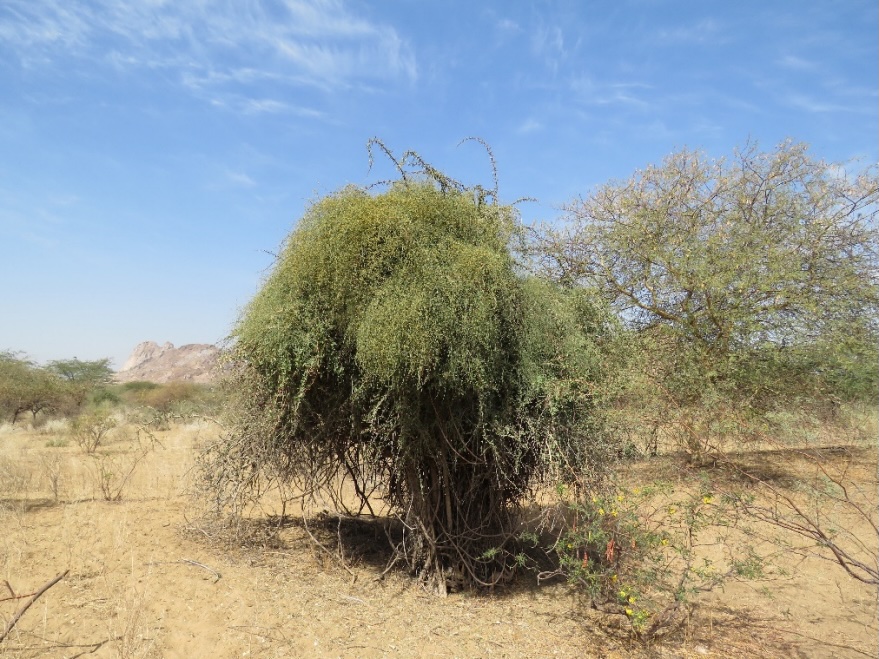
A plant in habitat, Rajasthan; Fig. 2 from Choudhary et al. (2025).

A plant in habitat, Rajasthan; Fig. 2 from Choudhary et al. (2025).
Conservation Status

Ephedra karumanchiana
None have been recorded.
Type: India, Banaskantha district, Ramsan, elev. 135-160 m, Patel et al., 2015.03.08; holotype CAL, isotypes BARO, K, SUK (IPNI).
This species was published in 2021 in an Indian journal so obscure it is not found online, and so escaped notice until 2025 when its status was updated (Choudhary et al. 2025); this remains the sole documentation, so it is difficult to assess the validity of the taxon, and little information is available, although the paper's abstract asserts that the species' distinction is supported by rbcL, psbA-trnH and trnL-trnF molecular data (Patel et al. 2021). Choudhary et al. (2025) refer to the existence of herbarium specimens but do not cite any specifics, and no collections are recorded by GBIF, the Indian Virtual Herbarium, JSTOR, or Kew, which are the primary relevant online data sources. Both CAL (catalogued on the Indian Virtual Herbarium) and Kew are cited in the protologue as holding type specimens; evidently the E. karumanchiana type specimens have not yet been databased.
Plant dioecious, terrestrial, scandent shrub, up to 5 m in height; stems 5 m height, 3-5 cm(rarely 10 cm) thick, greenbrown when young, dark-brown at maturity, woody, branched, having distinct nodes and internodes; branchlets arranged in whorls, scabrous, green, having ridges and furrows; Leaves 2-4 cm long, 1- 2 mm broad, 2-4 per node, scaly, whorled, greenpale green, sheath white-yellow, linearlanceolate or connate, apex narrow, acute, base broad; Male strobili compound, like biparous- multiparous cyme, pedunculate; Single male strobilus 1.5-2 cm x 3 mm, green when young, strobili 6-12 per node in 2-4 groups, whorled, ovate-lanceolate, bracteate, bract 10-24 per strobilus, binate, bi-colours, centre dark green, margin hyaline, ciliate; male flowers 3-8mm, 6-12 pairs per strobilus; sporangiophores 1-3 mm long, pinkish-brown, with synangia, synangia usually 3-6; pollen grains golden yellow, dimorphic, ellipsoidal or widely ellipsoidal; Female strobili 1 cm x 5 cm, 4-14, stalked, terminal, sometimes on nodal branches, bracteate, bract 3-6 pairs, opposite, pink, non-mucronate, obtuse, median bracts sub-acute, base connate; ovules 5 x 3 mm, 1-2 , ovate, green-black; seeds 1-2, covered with fleshy white/pink colour bract, ovate, black with persistent micropyle. Figure 3 shows the male (A) and female plant (B), Male strobilanthus (C,D) and Female strobilanthus (E,F). Flowering: January to February and Fruiting: April to May (Choudhary et al. 2025).
India: Gujarat and Rajasthan. Broadly speaking, it occurs in the arid Thar Desert. In Gujarat, it has been found in arid parts of northern Gujarat, including the Banaskantha District, Ramsan, Dhroba, Dhakha, and Vasan. In Rajasthan it is known from the Jalor District, Panseri, Pooran, and the Beer Jhunjhunu Conservation Reserve near Jhunjhunu city. At the latter location the elevation is about 320 m; the climate is semiarid with temperatures varying from winter lows near 0°C to summer (May-June) highs of 48°C. Annual precipitation is 300-400 mm with most falling during the July-September monsoon (Choudhary et al. 2025).
No data as of 2026-04-03.
No data as of 2026-04-03.
Choudhary et al. (2025) provide some information on the species' location at the Beer Jhunjhunu Conservation Reserve in Rajasthan, which appears to cover only a few square kilometers and to be fairly easy to access from the nearby town of Jhunjhunu. I have no information on other locales.
The epithet honors botanist Karumanchi Sambhasiva Rao of Sardar Patel University in Gujarat state, India (Patel et al. 2021 as quoted by IPNI).
Patel, S. K., S. M. Patil, R. S. Patel, R. S. Kachhiyapatel, V. M. Raole, and K. S. Rajput. 2021. Ephedra karumanchiana (Ephedraceae) sp. nov. from Gujarat State, India. Phytotaxonomy 19:14-22.
Choudhary, Papita, Pooja Mangal, Deepanshu Kumawat, Jai Singh, Shikha Gupta and Amit Kotiya. 2025. Ephedra Karumanchiana S. K. Patel, S. M. Patil, Raole & K. S. Rajput sp. nov.,: A new distributional record in Jhunjhunu District of Rajasthan, India. J. Phytol. Res. 38(2):139-143.
Back | Home | Contact us
Copyright 2026 The Gymnosperm Database
Edited by Christopher J. Earle
This page accessed on Friday, October 23, 2026
Last Modified 2026-04-03
 Back to top