Conservation Status

Xanthocyparis vietnamensis
Farjon & T.H.Nguyèn (Farjon et al. 2002)
Common names
Golden Vietnamese cypress.
Taxonomic notes
Type: Vietnam, Ha Giang; Quan Ba. Bat Dai Son, Bat Dai Son Provincial Protected Area, 10 Feb 2001, D. K. Harder, N. T. Hiep, P. K. Loc, L. V. Avervanov, G. E. Shatz & S. Bodine DKH 6091 (holotype, HN: isotypes, HN, K, LE, MO) (Farjon et al. 2002).
Syn.: Callitropsis vietnamensis (Farjon & T.H.Nguyèn) D.P.Little, Cupressus vietnamensis (Farjon & T.H.Nguyèn) Silba.
In 1999, a new conifer was discovered in Viet Nam by two Vietnamese botanists who described it that year as Thuja quanbaensis. Unfortunately they did not provide a Latin diagnosis, thus the name was invalid under contemporary rules of botanical nomenclature (Maerki 2017). A valid description was published in 2002 by a different group of botanists (Farjon et al. 2002). The new plant was assigned, along with a species then widely known as Chamaecyparis nootkatensis, to a new genus, Xanthocyparis, with X. vietnamensis as the type species. See also Xanthocyparis.
Description
A tree, 10-15 m tall, with a round, straight trunk monopodial up to 50 cm dbh. Bark is purplish to red-brown, smooth and thin on branches, exfoliating in thin flakes and strips; on the trunk of larger trees it is brown to gray-brown, soft and fibrous, exfoliating in numerous thin strips. Branches are long, spreading more or less horizontally; foliage branches are numerous, spreading mostly in plagiotropic overlapping sprays or slightly drooping, forming a pyramidal crown in young trees but a spreading, irregular or flat-topped crown in old trees (Farjon et al. 2002).
Foliage in mature trees is predominantly composed of mature leaves, but also includes juvenile leaves and, often, with transitional leaves. Foliage sprays having juvenile leaves are bushy, sparsely branched, with ultimate branchlets 20–50 mm long, and are not flattened. Foliage sprays having mature leaves are flattened, with a rounded outline; the leading foliage branches are quadrangular to round, with ca. 4 orders of branching, and are still covered with green leaves in the 3rd to 4th year of growth. The subultimate branchlets are pinnate, and the ultimate branchlets are of unequal and irregular length, spreading at 30°–45°, measuring 5–20×1.5–3 mm, and distinctly flattened (Farjon et al. 2002).
The mature leaves occur on (sub)ultimate branchlets and are decussate, short decurrent, imbricate and dimorphic, measuring 1.5–3 × 1–1.3 mm, the laterals slightly longer than the facials. The facials are narrowly ovate-rhombic, keeled, more or less appressed, with the margins minutely denticulate to entire toward the acute or acuminate and free apex. The laterals are conduplicate, with the proximal part decurrent and the distal part spreading free from the leaf above at ca. 30°, straight or falcate, the margins minutely denticulate except toward the acute or pungent apex. Stomata on mature leaves are inconspicuous, mostly adaxial with a few scattered on the proximal abaxial faces, covered with a layer of cuticular wax. Glands are inconspicuous, occurring in a depression below the keeled distal part of some of the facials. The transitional leaves are similar to mature leaves but longer (5–7 mm), lanceolate, the laterals spreading at 45°. The juvenile leaves are in whorls of four, decurrent, the distal part spreading at nearly 90° from the branchlet, the proximal decurrent part 4-5 mm long, the distal free parts 15-20 × 1.5-2 mm, linear, margins entire, tapering to a fine point. Stomata are in two whitish bands on the abaxial side only, with ca. 6-7 irregular rows in each band (Farjon et al. 2002).
Pollen cones are 2.5-3.5 × 2-2.5 mm, oval-terete; there are 10-12 microsporophylls, each ca. 1 mm diameter, with cross-denticulate margins and mucornate apex. They are green turning yellow-brown, and each bears abaxially two large, subglobose yellow microsporangia containing spherical pollen. The seed cones are sparse but sometimes grouped with 2 or 3 together at the outer margins or nearer the base of foliage sprays with mature leaves, initially consisting of the 2 upper pairs of green leaves (bracts) with axillary ovules. Mature cones develop in two years and are first green, turning dark or dull brown, and are subglobose, 9-11 × 10-12 mm when open. Some cones are persistent after seed dispersal. Bract-scale complexes are formed in 2 (sometimes 3) decussate pairs in normally developed cones (irregular or underdeveloped cones are found), valvate to subpeltate (the third pair if present ± peltate and 4-5 angled), the lower pair oblong, all widest distally, with a rounded but irregular upper margin. The outer surface is smooth, becoming rugose or radiately furrowed from a prominent, 1-2.5 mm long umbo (including the bract apex); the inner surface is red-brown marked proximally with white or gray seed scars. A small columella may be present or absent at the shoot apex. There are 1 to 3 ovules per fertile bract (the upper bracts in 6-scaled cones are sterile), with up to 8 or 9 seeds per cone. Seeds are ovoid or irregular, flattened (1.5-2 mm thick), measuring 1.5-6 × 4-5 mm including two lateral wings. The seed body is more or less pustulate, light brown or red-brown, with a white hilum at the base and a micropylar beak often persistent at the apex; seed wings are 0.5-1 mm wide, thinly membranous, and lighter colored. Seedlings have not been seen (Farjon et al. 2002).
Distribution and Ecology
China: S Guangxi and Viet Nam: Ha Giang Province. It occurs at elevations of 1100-1400 m in primary forest on limestone karst mountain ridges. Occurrences in China are extremely localized, in populations of fewer than 50 trees (Jiang et al. 2024). In Viet Nam, which accounts for the majority of the known occurrences, X. vietnamensis occurs very locally in the Bat Dai Son mountain system near the Chinese border, at elevations of 1060-1180 m; and in neighboring extreme S Guangxi; in total it is known from approximately 13 locales (Averyanov et al. 2015). It grows in mixed angiosperm-conifer cloud forest with the conifers Amentotaxus argotaenia, Calocedrus rupestris, Nageia wallichiana, Pinus tabuliformis, Pinus wangii, Pseudotsuga brevifolia, Podocarpus pilgeri, Taxus sumatrana, and Tsuga chinensis. Dominant angiosperms in this forest include species of Acer, Carpinus, Lithocarpus, Quercus and Ulmus, as well as frequent Pistacea weinmannifolia and Platycarya strobilacea. In a second forest stratum beneath the ca. 20 m tall canopy are species of Elaeocarpus, Eriobotrya, Sorbus, Schefflera, and many other trees (Farjon et al. 2002, Averyanov et al. 2015).
"Shrubs and herbs abound; among the latter are numerous species of Orchidaceae, terrestrial as well as epiphytic, sometimes determining the aspect of the ground cover vegetation. Ferns and especially bryophytes are similarly abundant both as lithophytes and as epiphytes. The limestone ridges on which [the trees] occur are extremely eroded, composed of resistant, marble-like rock outcrops interspersed with thin soil pockets. The climate is subtropical but damp and wet much of the year" (Farjon et al. 2002).
"Newly discovered X. vietnamensis is restricted to a few localities in close proximity, mostly now in inaccessible sites on steep limestone ridges. Logging has increased in recent years and is estimated to have caused serious decline in numbers of larger, well-growing trees. This practice may have had negative effects on genetic diversity. Regeneration is poor due to heavy competition in remaining populations" (Farjon et al. 2002).
"Only a few semi-mature and coppiced trees survive... At a meeting of the World Conservation Union (IUCN) in Taiwan.. the Vietnamese scientists, backed up by Kew and Missouri scientists, will propose that its mountain habitat should be established as a conservation area. The Missouri Botanical Garden is currently working on cultivation and propagation techniques aimed at the long-term survival of this new conifer" (Kew 2002).
Remarkable Specimens
No data as of 2026-04-03.
Ethnobotany
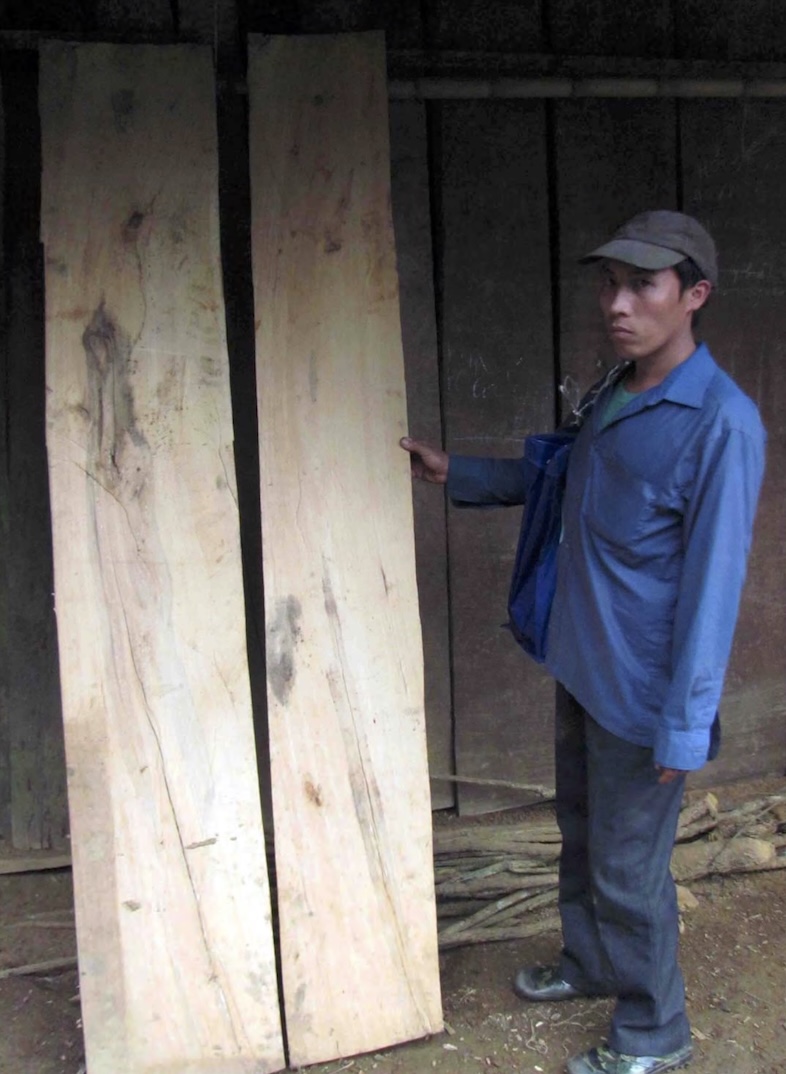
"This species produces fine, yellow-brown, very hard, fragrant timber. The superb quality of the wood, in conjunction with the widespread desirability of cupressaceous wood in traditional uses of many kinds in eastern Asia, combined with slow growth, has made it a highly prized timber. Due to lack of transport facilities and other factors, most of the timber has been traded locally" (Farjon et al. 2002).
Field investigations in 2014 revealed abundant evidence of illegal exploitation. Averyanov et al. (2015) cite "High activity of illegal exploration and illegal exploitation of Golden Cypress by international traders and dealers having often unlimited budget to purchase of any parts of this plant (including everything items, from whole trees or cuttings, till pieces of timber, bark or roots); see photo at right.
Observations
To see this tree in habitat would require a great deal of effort, money, patience and diplomacy; for details, see Averyanov et al. (2015) regarding their difficulties. It can, however, be seen in some large botanical gardens and arboreta.
Remarks
The generic name is from the Greek for "yellow cypress", referring to the color of the wood. The epithet refers to the type locality, in Vietnam (Farjon et al. 2002).
Citations
Averyanov, L. V., N. T. Hiep, and N. S. Khang. 2015. Mapping and assessment of Xanthocyparis vietnamensis subpopulations in Cao Bang, Ha Giang and Lang Son provinces (Vietnam). Rufford Small Grants Foundation.
Farjon, A., Nguyen Tien Hiep, D. K. Harder, Phan Ke Loc, and L. Averyanov. 2002. A new genus and species in Cupressaceae (Coniferales) from Northern Vietnam, Xanthocyparis vietnamensis. Novon 12:179-189.
Jiang, Yu‐Liang, Jia‐Liang Li, Richard Ian Milne, Khang Sinh Nguyen, Zhi‐Tong Han, Yu‐Song Huang, Wei‐Bin Xu, Yan Liu, and Kang‐Shan Mao. 2024. Biogeographic, climatic, morphological, cytological and molecular data reveal a new diploid species from China in the genus Xanthocyparis (Cupressaceae)." Taxon 73(5):1170-1186. https://doi.org/10.1002/tax.13246.
[Kew] Royal Botanic Gardens, Kew. 2002. New tree found in Vietnam. http://www.rbgkew.org.uk/press/newconifer.html, accessed 2002.03.28, now defunct.
Maerki, D. 2017. Recent developments in the taxonomy of the genus Cupressusand consequences for their conservation. Bulletin of the Cupressus Conservation Project 6(1):3-24.
Terry, Randall G., Matthew I. Pyne, Jim A. Bartel, and Robert P. Adams. 2016. A molecular biogeography of the New World cypresses (Callitropsis, Hesperocyparis; Cupressaceae). Plant Systematics and Evolution 302:921–942. https://doi.org/10.1007/s00606-016-1308-4.
Yang, Yong, David Kay Ferguson, Bing Liu, Kang-Shan Mao, Lian-Ming Gao, Shou-Zhou Zhang, Tao Wan, Keith Rushforth, and Zhi-Xiang Zhang. 2022. Recent advances on phylogenomics of gymnosperms and a new classification. Plant Diversity 44(4):340-350.
See also
The species account at Threatened Conifers of the World (as Xanthocyparis).
The December, 2017 issue of the Bulletin of the Cupressus Conservation Project is devoted to C. vietnamensis, with articles on pollen and seed cones, and some good photographs.
Farjon, Aljos. 2002. Rare and possibly threatened conifers in Vietnam. Available: ]http://www.fauna-flora.org/docs/hoang_en/G1_EN.PDF, accessed 2006.03.08, now defunct. An appended special report on "Xanthocyparis vietnamensis Farjon et Hiep a new conifer genus and species in Vietnam" addresses the species' taxonomy, conservation status and distribution, with relevant field observations. Highly recommended.
Farjon (2005) provides a detailed account (under the name Xanthocyparis vietnamensis), with illustrations.
Hiep et al. 2004 (as X. vietnamensis).
Kirby, Alex. 2001.11.25. Kew scientists involved in the discovery of new conifer in remote forests of northern Vietnam. http://news.bbc.co.uk/hi/english/sci/tech/newsid_1672000/1672745.stm, accessed 2002.03.28.
Luu and Thomas 2004 provide a description, range map, conservation status, drawings and photos, and a wealth of additional information.
Royal Botanic Gardens, Kew. 2002. New tree found in Vietnam. http://www.rbgkew.org.uk/press/newconifer.html, accessed 2002.03.28, now defunct



 Back to top