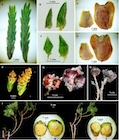
Jiang et al. (2024) present several photographs.

Jiang et al. (2024) present several photographs.
Conservation Status

Xanthocyparis guangxiensis
None have been recorded. Guangxi has only two cypresses (the other is Cupressus funebris) and this is the only endemic one, so it could reasonably be called Guangxi cypress, which is also a transliteration of the scientific name.
Holotype: China, Guangxi Zhuang Autonomous Region: Mulun National Nature Reserve, 25.1167° N, 107.9500° E, elevation 850 m, 2021.06.21, Yu-Liang Jiang and Jin-Quan Huang ML062108 (IBK barcode IBK00456528; isotype: IBK barcode IBK00456529).
This species closely resembles X. vietnamensis in both morphology and habitat, but the species' distributions are disjunct by over 200 km and occur in areas with distinctly different climate. Even more importantly, X. guangxiensis (like almost all conifers) is a diploid species, whereas X. vietnamensis is tetraploid (Jiang et al. 2024). Speciation most likely occurred in response to this ploidy event and the two taxa have since evolved to their current level of differentiation.
Evergreen monoecious trees up to 15 m tall and 50 cm dbh. Foliage branches numerous, spreading mostly in plagiotropic overlapping sprays, forming a pyramidal crown in young trees but a spreading, irregular crown in old trees. Bark smooth and thin, red-brown to brown, with age becoming soft, brown to gray-brown, exfoliating in numerous thin strips. Sub-ultimate twigs pinnate, ultimate twigs of unequal and irregular length, 5–15 × 1–2.5 mm, flattened. Leaves include juvenile, transitional, and adult types, with adult foliage dominating on mature trees; but all three types are found on trees older than seedlings. Juvenile leaves in whorls of four, decurrent, monomorphic, the distal part spreading at nearly 90°, linear, about 10 mm long, margins entire, tapering to a fine point. Mature leaves decussate, shortly decurrent, imbricate, dimorphic, on (sub)ultimate branchlets, 0.9–2.6 × 0.7–1 mm (the laterals slightly longer than the facials); the laterals conduplicate, the facials narrowly ovate-rhombic, keeled, leaf margins minutely denticulate except toward the acute apex; glands inconspicuous, in a depression below the keeled distal part of some of the facials. Pollen cones 2–2.8 × 1.5–2 mm, oval, microsporophylls 10–12, each bearing abaxially two large, yellow microsporangia containing spherical pollen. Seed cones sparse but sometimes with 2 or 3 grouped together at the outer margins or nearer the base of foliage sprays with mature leaves. Mature cones developing in two years, green, turning brown, globose, 6–10(–11) mm in diameter; bract-scale complexes in 2(-3) decussate pairs, valvate to subpeltate. Ovules 1-3 per fertile bract (upper bracts in 6-scaled cones sterile). Seeds up to 12 per cone, ovoid or irregular, flattened (1–1.8 mm thick), 3–5 × 2–4 mm including two lateral wings, body of seed pustulate, light brown or yellow-brown, with pale yellow hilum at base and a micropylar beak often persistent at the apex; seed wings 0.4–1.5 mm wide, thinly membranous, lighter colored. Seedlings rarely seen (Xiang et al. 2024).
Compared to X. vietnamensis, the ultimate branchlets are narrower (2.0 mm vs. 2.7 mm) and thinner (0.7 mm vs. 0.8 mm), facial leaves are shorter (1.5 mm vs. 1.9 mm), lateral leaves are shorter (1.9 mm vs. 2.6 mm), seeds are shorter (4.1 mm vs. 5.3 mm), seed width is less (3.4 mm vs. 4.1 mm), seeds are thinner (1.4 mm vs. 1.9 mm), seeds are lighter (2.7 mg vs. 7.0 mg), and there are more seeds per cone (10.7 vs. 8.9). The bract-scales are nearly even in width, resulting in a more regular shape of cone, whereas X. vietnamensis seed cones are often irregular in shape (Xiang et al. 2024).
China: N Guangxi (Mulun National Nature Reserve) at elevations of 700-900 m in karst mountains with a conifer-hardwood primary forest. "The climate is subtropical and with seasonal drought. It prefers partial shade with a certain humidity, especially in northern slopes and saddle backs near mountaintop" (Jiang et al. 2024).
The conservation status of the species has not yet been assessed, but it is even more rare and in even smaller populations than its sister species X. vietnamensis, which is assessed by the IUCN as "Endangered". Thus X. guangxiensis likely warrants an assessment of "Endangered" or "Critically Endangered".
No data as of 2026-04-03.
No data as of 2026-04-03.
Jiang et al. (2024) provide precise locations of their voucher samples, but I suspect that to see this tree in habitat would require a great deal of effort, money, patience and diplomacy. It has not yet appeared in botanical gardens but will likely do so within a few years.
The epithet refers to the type locality, in Guangxi, a province of far southern China.
Jiang, Yu‐Liang, Jia‐Liang Li, Richard Ian Milne, Khang Sinh Nguyen, Zhi‐Tong Han, Yu‐Song Huang, Wei‐Bin Xu, Yan Liu, and Kang‐Shan Mao. 2024. Biogeographic, climatic, morphological, cytological and molecular data reveal a new diploid species from China in the genus Xanthocyparis (Cupressaceae)." Taxon 73(5):1170-1186. https://doi.org/10.1002/tax.13246.
Back | Home | Contact us
Copyright 2026 The Gymnosperm Database
Edited by Christopher J. Earle
This page accessed on Friday, October 23, 2026
Last Modified 1969-12-31
 Back to top