Conservation Status
 (subsp. lucayana)
 (subsp. barbadensis)
Juniperus barbadensis
L. (1753)
Common names
Barbados cedar, pencil cedar, red cedar, Bahaman juniper, Lucayan juniper; cèdre [French]; sabina [Spanish].
Taxonomic notes
There are two subspecies:
- J. barbadensis subsp. barbadensis. Syn: J. virginiana var. barbadensis (L.) Gordon, Sabina barbadensis (L.) Small.
- J. barbadensis subsp. lucayana (Britton) Greuter & R.Rankin. Syn: J. lucayana Britton.
Both terpenoid and molecular data support a very close relationship between the two subspecies, and morphology is almost identical; however they have disjunct distributions and show ecological differences, factors consistent with distinction at subspecies rank. The species shares a clade within Section Sabina with J. bermudiana, J. gracilior, and J. horizontalis, within a larger clade that includes J. virginiana, J. scopulorum and J. maritima (Adams 2014, Farjat et al. 2019). The smaller clade is biogeographically questionable for including J. horizontalis, but the larger clade is quite plausible and these taxa have long been seen as closely allied on morphological grounds. Adams et al. (2008) provide a good summary of relationships between the Caribbean junipers; subsequent work has largely confirmed their findings about taxonomic relationships in the group.
The type, LINN 1198.1, was recorded by Linnaeus as being from Barbados; however that provenance is uncertain, the date, collector and source of the collection being unknown. See Adams et al. (1987) regarding the neotype. The species has long been extirpated from Barbados; the habitat was converted to sugar cane fields more than 280 years ago (Adams 2014).
Description
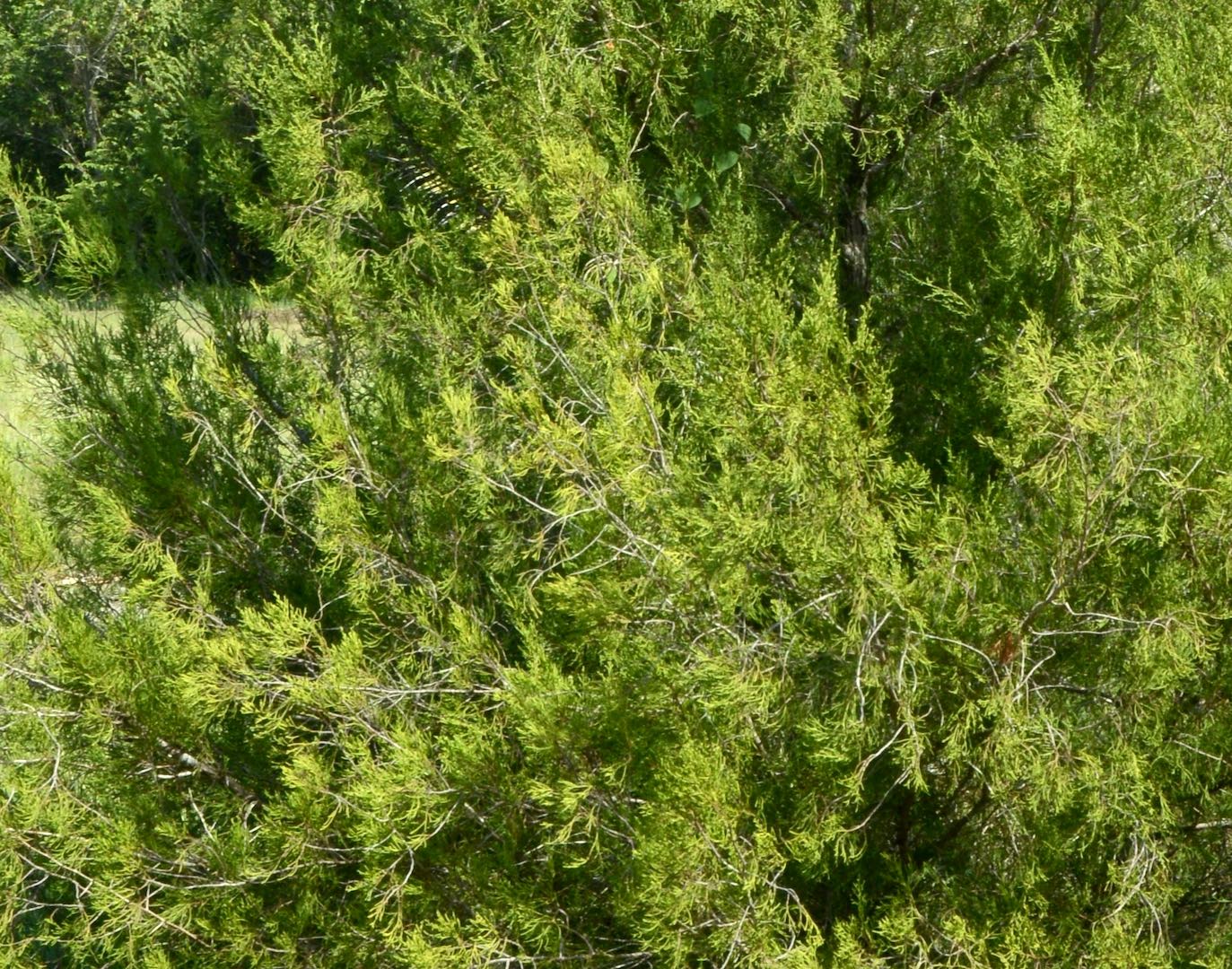
Dioecious evergreen trees to 12 m tall. Bark thin, separating in strips. Twigs 5-20 mm long, 0.8-0.9 mm thick, slender, opposite, thus twigs 4-angled. Leaves light green, decurrent on young plants and rapidly growing shoots, otherwise scale-like, 1 mm long, abaxially rounded with an inconspicuous gland, tightly appressed, apex acute to obtuse. Pollen cones fertile January to March. Seed cones reniform to subglobose, glaucous reddish-blue at maturity, somewhat flattened, 4-5 mm long, 6-8 mm wide, bearing 2-4 seeds (Adams 2014).
Adams (2014) provides the following key to the two subspecies:
- J. barbadensis subsp. barbadensis: Glands on old, brown, persistent whip leaves conspicuous, sunken, extending almost to the leaf apex.
- J. barbadensis subsp. lucayana: Glands on old, brown, persistent whip leaves not conspicuous, if visible then neither sunken nor extending almost to the leaf apex.
Distribution and Ecology
The two subspecies are disjunct and differ in habitat as well.
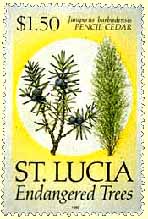
Subsp. barbadensis occurs only on Saint Lucia, where it is endemic to the summit area on Petit Piton. It grows on outcrops of volcanic rock in deciduous seasonal forest about 30 m below the summit at an altitude of 700 m. Associated species include the endemic Bernardia laurentii (sole location) and occasional small gnarled trees bent by the wind such as Capparis indica, Casearia decandra, Daphnopsis americana, Erithalis odifera, Krugiodendron ferreum, and Tabebuia heterophylla. Non-woody species include Agave caribaeicola, Peperomia magnoliifolia, Pitcairnia angustifolia, Tillandsia fasciculata, and T. utriculata. The IUCN has assessed this subspecies as "Critically Endangered", noting that only a single population exists, it has only about 50 reproductively mature individuals, and its area of occupancy is less than 4 km2. Such a small and isolated population is under continuous threat from fire, pathogen attack and frequent hurricanes. The population is clearly declining; a century ago it was common on the southwest coast of Santa Lucia. Moreover, the habitat continues to decline, largely due to fire suppression; the greatest threat is now catastrophic wildfire (Gardner et al. 2013, accessed 2022.12.26).
Subsp. lucayana is found in the Bahamas (Andros, Grand Bahama, and Great Abaco islands on limestone near sea level), Jamaica (near Clydesdale in St. Andrew Parish at elevations of 1100-1200 m), and Cuba (the Sierra de Nipe, and in swamps in the south-central portion of the Isla de la Juventud); it was formerly reported in Hispaniola (Haiti and the Dominican Republic) but is thought to have been extirpated there (Farjon 1998, Adams 2014). It occurs at elevations of up to 1,600 m in a range of forest types. In Cuba on the Sierra de Nipe it is found in "bosque aciculifolio" forest, which has about 30% forest cover dominated by Pinus sp. with evergreen trees and associated shrubs and herbaceous plants but very few epiphytes and climbers. In contrast, on the Isla de la Juventud, off the south coast of Cuba, it grows in forest swamps. In the Bahamas it is found in coppices on limestone slopes. It is still fairly common in the Bahamas, although the Cuba and Jamaica populations are small. The IUCN has assessed this subspecies as "Vulnerable". The total population size is about 10,000 reproductively mature individuals, with no population having more than 1,000 individuals. Logging and related risks historically depleted the Cuba and Jamaica stands, which are now severely isolated with only 5 to 30 individuals in each stand. The great majority of mature trees occur in the Bahamas. Those stands are at high risk from urbanization; in recent years, for example, the best stands at the west end of Grand Bahama have almost all disappeared due to the construction of apartments, a golf course and a marina. Overall, population declines are ongoing. However, there are also some significant conservation measures in place; some stands in the Bahamas are within national parks admninistered by the Bahamas National Trust, and the Jamaica stands are within the Blue and John Crow Mountains national parks (Gardner et al. 2013, accessed 2022.12.26).
A bark beetle endemic to Jamaica, Phloeosinus neotropicus, is host specific on J. barbadensis (Garraway and Freeman 1981).
Zone 10 (cold hardiness limit between -1°C and +4.4°C) (Bannister and Neuner 2001).
Remarkable Specimens
No data as of 2026-06-04.
Ethnobotany
In Jamaica, the attractive wood was formerly used to make furniture (Gardner et al. 2013, accessed 2022.12.26).
Observations
No data as of 2026-06-04.
Remarks
The epithet barbadensis refers to the species' original occurrence on Barbados, where it has now been extirpated. The epithet lucayana refers to its occurrence in the Lucayan Archipelago of the Bahamas.
Citations
Adams, Robert P. 2008. Junipers of the World: The Genus Juniperus. Bloomington, Indiana: Trafford Publishing.
Adams, R. P., Morris, J. A., and Schwarzbach, A. E. 2008. The evolution of Caribbean Juniperus (Cupressaceae): terpenoids, RAPDs and DNA SNPs data. Phytologia 90:103-120.
Adams, Robert P. 2014. Junipers of the World: The Genus Juniperus. Fourth edition. Bloomington, Indiana: Trafford Publishing.
Adams, R.P., Jarvis, C.E., Slane, V. and Zanoni, T.A. 1987. Typification of Juniperus barbadensis L. and J. bermudiana L. and rediscovery of J. barbadensis from St Lucia, BWI (Cupressaceae). Taxon 36: 441-445.
Farhat, P., O. Hidalgo, T. Robert, S. Siljak-Yakovlev, I. J. Leitch, R. P. Adams, and M. Bou Dagher-Kharrat. 2019. Polyploidy in the Conifer Genus Juniperus: An Unexpectedly High Rate. Frontiers in Plant Science 10, doi: 10.3389/fpls.2019.00676.
Garraway, Eric, and B. E. Freeman. 1981. Population dynamics of the juniper bark beetle Phloeosinus neotropicus in Jamaica. Oikos 37(3):363-368.
Linné, Carl von. 1753. Species Plantarum, t. 2, p. 1039. Available: Biodiversity Heritage Library, accessed 2026.01.29.
See also
The species account at Threatened Conifers of the World.
Adams, R.P. 1995. Revisionary study of Caribbean species of Juniperus (Cupressaceae). Phytologia 78(2):134-150.
Farjon (2005) provides a detailed account, with illustrations.


 Back to top