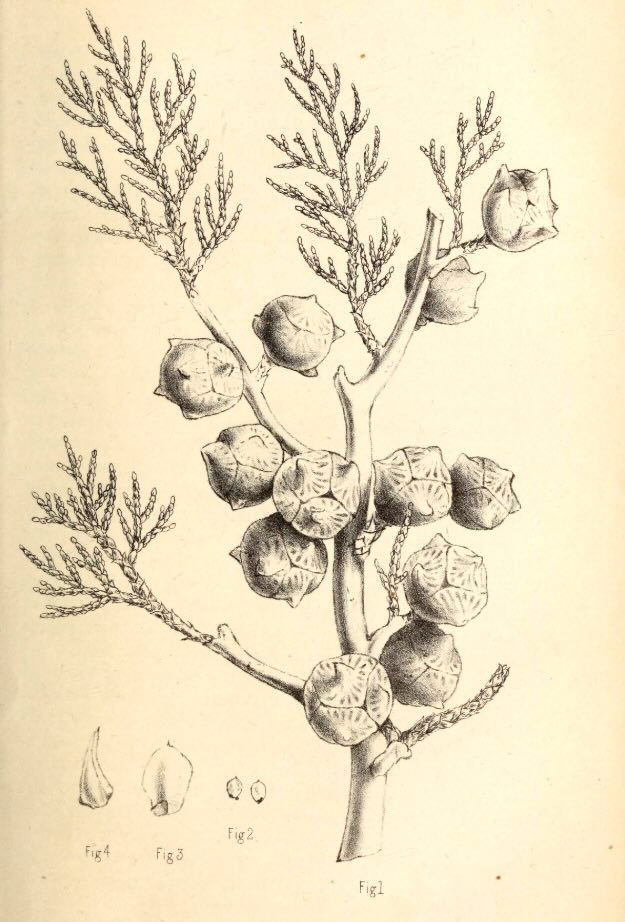
The original illustration (Murray 1855).

Foliage, pollen cones and seed cones of a tree in habitat [Tim Ives ©2002].

Tree, Ash Creek grove [Tim Ives ©2002].

The largest known specimen [Frank Callahan 2010].

The original illustration (Murray 1855).
Foliage, pollen cones and seed cones of a tree in habitat [Tim Ives ©2002].
Tree, Ash Creek grove [Tim Ives ©2002].
The largest known specimen [Frank Callahan 2010].
Conservation Status

Hesperocyparis macnabiana
McNab cypress (often incorrectly spelled MacNab or Macnab).
Type: California, about 41°N, W. Murray & A. F. W. Beardsley s.n., September 1854 (holotype E). Clues in the report by Murray (1855) indicate it was likely one of the groves E of Redding, California. Synonymy: see POWO (accessed 2023.12.16). The species was originally named Cupressus mcnabiana. "In the inner north Coast Ranges H. macnabiana and H. sargentii produce the only known natural hybrids in Hesperocyparis (Lawrence et al. 1975)" (Eckenwalder 1993). Molecular genetic analyses to date place H. macnabiana sister to a large clade that includes all of the Arizona species, and also all other species in Hesperocyparis having a distribution S of 35°N.
Large shrubs, or trees to 100 cm dbh, 15 m tall, usually with a short trunk forking near the ground and numerous densely-arrayed long, slender, spreading branches forming a spreading, rounded crown. Bark first rough and comprised of dead leaves, with age becoming thick, fissured, and hard, and eventually gray and fibrous. Highest-order twigs more or less in one plane, mostly ascending and stiff, the ultimate twigs ca. 3-7 × 1 mm. Leaves decussate, slightly imbricate, rhombic to oblanceolate, abaxially rounded or keeled, 1-1.5 × 1 mm, with a central depression, apex obtuse; leaves on thicker branches and whip shoots up to 12 × 3 mm, linear-lanceolate, distally reflexed, apiculate or acute. Abaxial stomata mostly basal, adaxially scattered from base to apex; gland usually present, active, consipicuous; color gray-green or green, sometimes yellow-green when first formed. Pollen cones terminal, solitary, numerous, angular-ovoid, 3-4 × 2-2.5 mm. Seed cones terminal, appearing sessile, often clustered, taking two growing seasons to mature, dark brown aging gray, subglobose, serotinous, persistent, 15-25 × 13-20 mm. Seeds 70-100 per cone, 3-4 × 2-3 mm, slightly flattened, with 2 wings forming narrow strips around the seed (Farjon 2010). See García Esteban et al. (2004) for a detailed characterization of the wood anatomy.
"Among all the true Cypresses of North America this one is unique in having flattened branchlets always lying all in one plane, to form a 'spray' ... instead of bristling all around the twig as in most other species of Hesperocyparis" (Eckenwalder 1993).
USA: California at 300-1200 m elevation in chaparral and foothill woodland, often on serpentine-derived soils (Eckenwalder 1993); also at two locations in southwest Oregon (F. Callahan email 2010.09.28; both locations supported by herbarium collections). Although its area of occupancy is only about 20,000 ha, this is enough to make it the most common and widespread of the California species of Hesperocyparis. Commonly associated conifers include Pinus attenuata and P. sabiniana (Farjon 2010). See also (Thompson et al. 1999).
Data from USGS (1999).
Frank Callahan (email 2010.10.22) reports seeing western gray squirrels (Sciurus griseus) collecting the cones of this species, eating a portion of the outer cone, and discarding the rest. He also observed numerous seedlings in the area where this activity was occurring. I believe this is the first report of Hesperocyparis seed being disseminated by squirrels.
The species is reasonably widely-distributed and there is no evidence of progressive population declines, so it is of "Least Concern" for conservation.
Frank Callahan (email 2010.1.17) reports a tree in Aukum, CA that is about 116 cm diameter and 13.7 m tall; photo at right. This is bigger than the largest specimen as reported by American Forests (2000), which Frank also discovered, in 1981.
I have found no records of aboriginal use, but some other California species of Hesperocyparis have been used, primarily for medicinal purposes; the Kawaiisu used a decoction of the dried seeds to treat colds, coughs, and related ailments; an infusion of the cones for backache and for kidney and menstrual problems; and the Costanoan and Miwak peoples used a decoction of the foliage to treat rheumatism and colds (NAEB 2025). These are common uses for many species of conifers in many parts of the world, so it is plausible that H. macnabiana was used similarly by the people familiar with it.
MacNab cypress has not really been commercially exploited due to its rarity, but it was early introduced to the U.K. and is occasionally used as an ornamental; there are eight recorded cultivars (Conifers Garden 2025). It is hardy to Zone 8 (cold hardiness limit between -12.1°C and -6.7°C) (Bannister and Neuner 2001).
Peattie (1950) noted its occurrence "Irregularly scattered on the west slopes of the Sierra Nevada (Aukum in Amador County, Grass Valley in Nevada County at about 2500 feet; Texas Hill and Indiana Creek in Yuba County) and ... in the inner northern Coast Ranges at Hough Springs and Reiff in Lake County, and at Aetna Springs, Napa County; also near Ukiah in Mendocino County." Tim Ives (email, 2002.11.17) also notes that it formerly occurred at Whiskeytown, California, at a site since submerged beneath the Whiskeytown reservoir; and near the former Betty May mine in the Clear Creek mining district of Shasta Co. just west of the Whiskeytown grove, near the Shasta/ Trinity Co. line. He adds (e-mail, 2008.10.02) that trees grown from seed from the Whiskeytown grove can be found in the vicinity. One is at the Whiskeytown National Recreation Area visitor center on CA-299, between the visitor center and the highway on a short little trail that goes around behind the visitor center. It is marked with a sign. He also reports that the park botanist has been involved in efforts to outplant seedlings from the original, now submerged Whiskeytown grove at locations throughout the park, and that the area contains several mature trees that were transplanted in the early 1960s from the Whiskeytown grove to homesteads in the vicinity.
The epithet honors James McNab (1810-1878), Curator of the Edinburgh Botanic Garden at the time the species was described (Murray 1855, Jepson 1923). McNab is now remembered chiefly for his 1834 Mexican collecting trip, from which he successfully introduced the poinsettia. Although the species was described by Andrew Murray, a Scots politician who also made a name for himself studying insects and conifers, it was actually collected by his brother William Murray and by Mr. A. F. Beardsley, a professional seed collector working for Mr. Murray. Rogers (1998) provides an engaging sample of some of Beardsley's writing.
Adams, R. P., J. A. Bartel and R. A. Price. 2009. A new genus, Hesperocyparis, for the cypresses of the western hemisphere. Phytologia 91(1):160-185 (p. 179). Available: Biodiversity Heritage Library, accessed 2026.01.29.
American Forests 2000. The National Register of Big Trees 2000. Washington, DC: American Forests.
Eckenwalder, James E. 1993. Cupressus. Flora of North America Editorial Committee (eds.): Flora of North America North of Mexico, Vol. 2. Oxford University Press.
Jepson, W. L. 1923. The Trees of California, ed. 2. Description of C. macnabiana reproduced HERE, courtesy of the Cupressus Conservation Project website.
Murray, A. 1855. Description of new coniferous trees from California. Edinburgh New Philosophical Journal, ser. 2 1:284-295 (p. 293). Available: Biodiversity Heritage Library, accessed 2025.12.02.
[NAEB] Native American Ethnobotany Database. 2025. Results of searches for "Cupressus" and "Hesperocyparis". Available: http://naeb.brit.org/, accessed 2025.12.02.
Rogers, David. 1998. An addendum on the botanical history of Santa Lucia fir, Abies bracteata, with excerpts from the notes and letters of early collectors. Double-Cone Quarterly 1(3). http://www.ventanawild.org/news/ws98/slfirs2.html, accessed 2007.01.01.
Elwes and Henry 1906-1913 at the Biodiversity Heritage Library. This series of volumes, privately printed, provides some of the most engaging descriptions of conifers ever published. Although they only treat species cultivated in the U.K. and Ireland, and the taxonomy is a bit dated, still these accounts are thorough, treating such topics as species description, range, varieties, exceptionally old or tall specimens, remarkable trees, and cultivation. Despite being over a century old, they are generally accurate, and are illustrated with some remarkable photographs and lithographs.
Farjon (2005) provides a detailed account, with illustrations.
Back | Home | Contact us
Copyright 2026 The Gymnosperm Database
Edited by Christopher J. Earle
This page accessed on Friday, October 23, 2026
Last Modified 2026-01-29
 Back to top