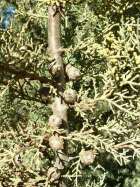
Tree in habitat [Tim Ives ©2002].
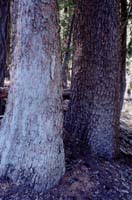
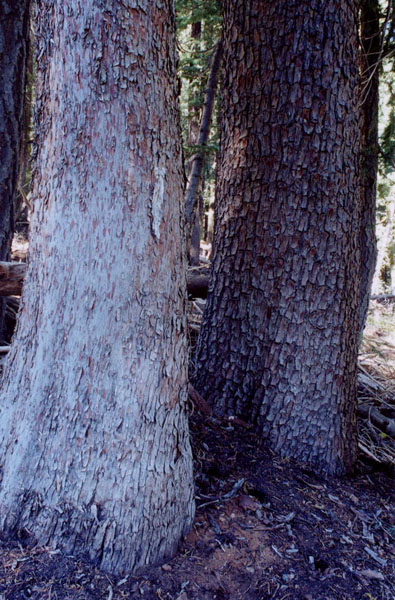
Trees near Mud Lake, Plumas National Forest, California [Jeff Bisbee].
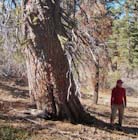
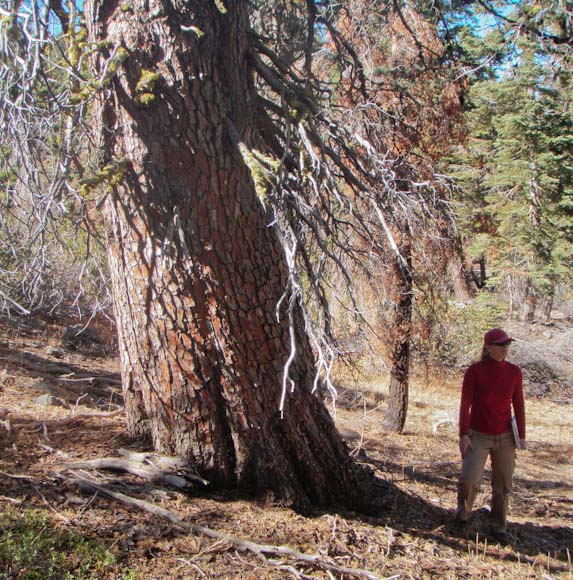
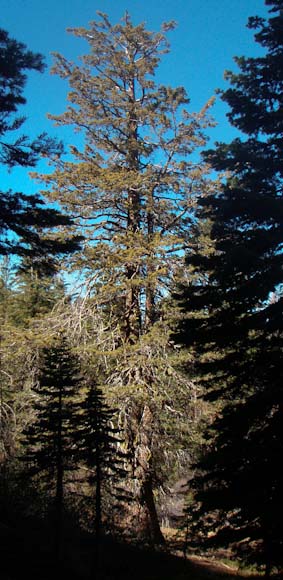
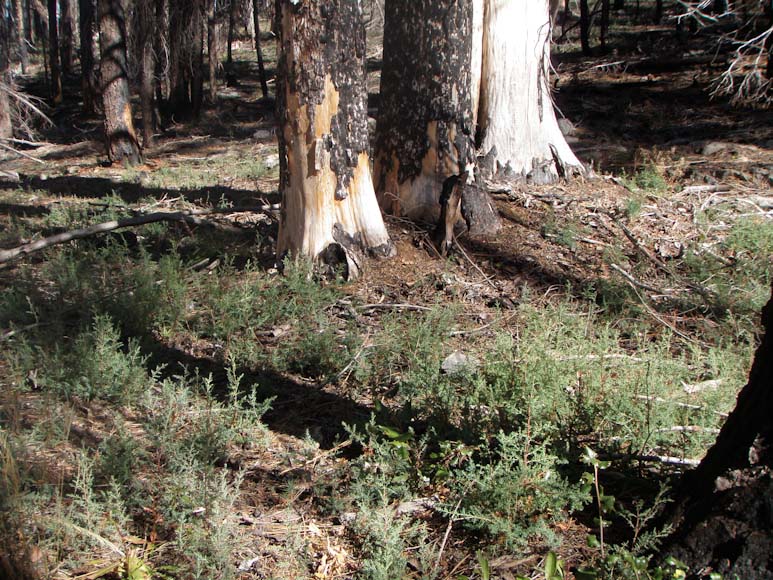
Large tree at Mud Lake RNA stand, which experienced a fire in 2007 [C.J. Earle, 2010.10.19].
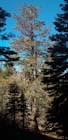
Same tree, seen from a distance [C.J. Earle, 2010.10.19].
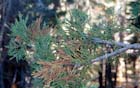
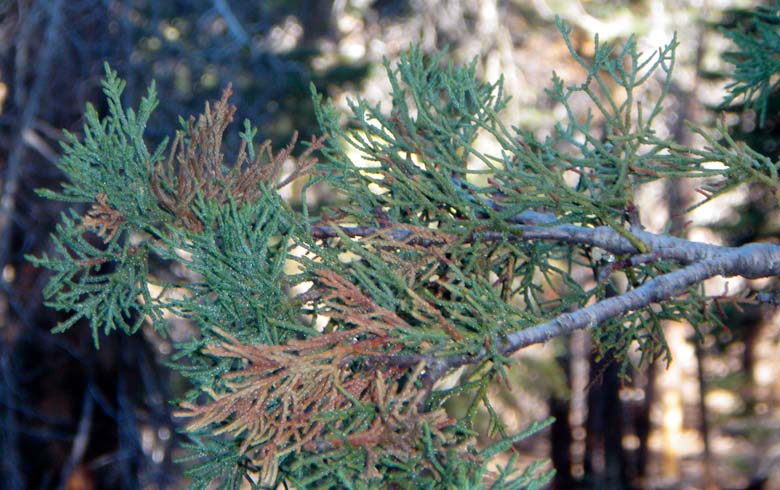
Foliage [C.J. Earle, 2010.10.19].
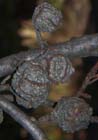
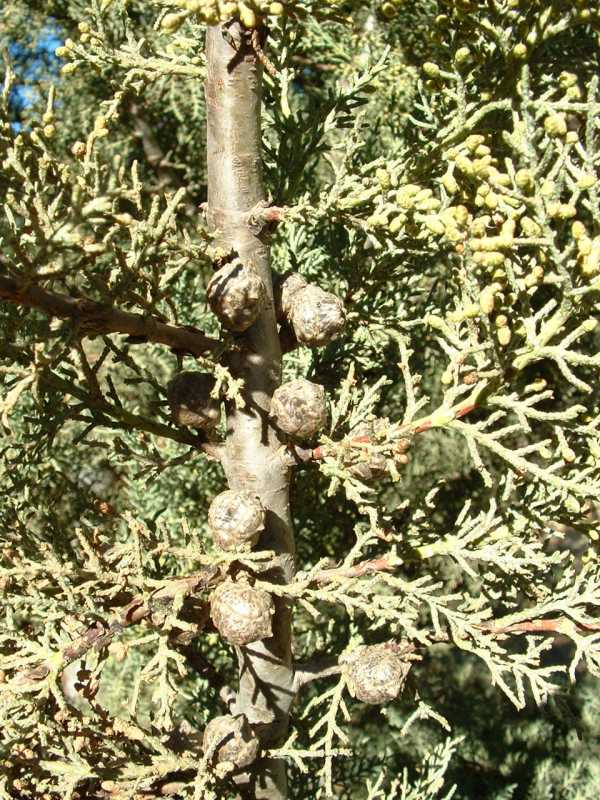
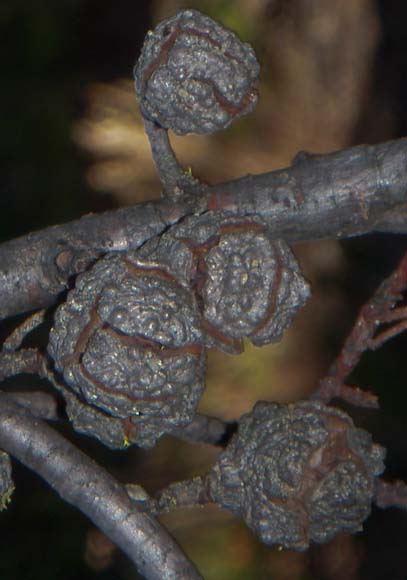
Seed cones [C.J. Earle, 2010.10.19].
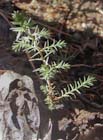
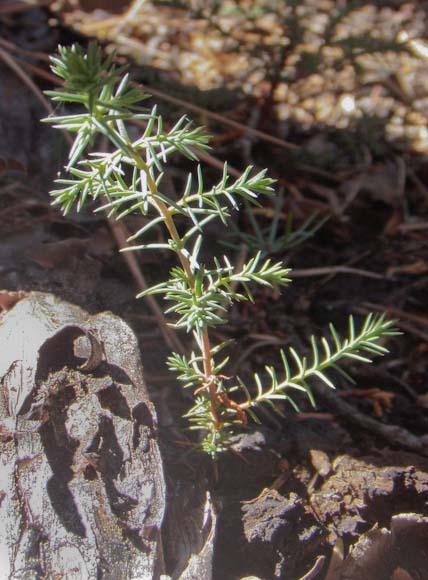
Seedling about 5 cm tall, probably 2 years old [C.J. Earle, 2010.10.19].
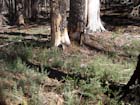
Seedlings were very abundant 3 years after the fire [C.J. Earle, 2010.10.19].
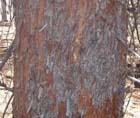
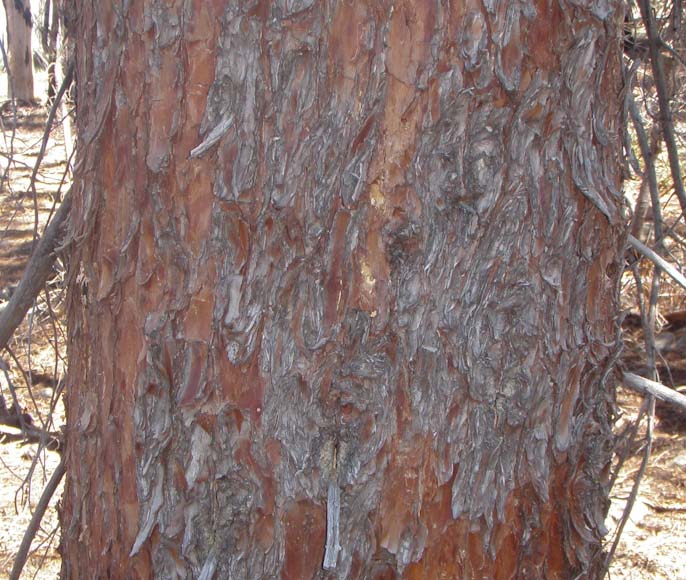
Bark on 50 cm diameter tree [C.J. Earle, 2010.10.19].

Conservation Status

Hesperocyparis bakeri
(Jeps.) Bartel (Adams et al. 2009)
Common names
Modoc, Baker or Siskiyou cypress (Peattie 1950). Subsp. matthewsi, if recognized, is the Siskiyou cypress.
Taxonomic notes
Type: California, Siskiyou County, Timbered Crater, between Hills Farm (near Dana) and Little Hot Springs Valley, M. S. Baker s.n. (holotype JEPS). Synonymy: see POWO (accessed 2023.12.16). Wolf (1948) segregated the groves in the Siskiyou Mountains and the Goosenest Mountain stand as ssp. matthewsii. Wolf did not know about the Prospect, Elk Creek, or Plumas County populations, in the context of which the former groves appear substantially less isolated (Griffin and Critchfield 1972). Little (1970) asserts that "the characters in the key (p. 72-73 [Wolf 1948]) seem scarcely sufficient for division of the species into 2 varieties."
Molecular evidence supports treatment of this as the basal taxon in Hesperocyparis, its most recent common ancestor with the rest of the genus dating to about the Oligocene/Miocene transition 23 million years ago. In contrast, all the other species radiated in late Miocene times. Both were periods of generalized cooling and drying in global climates (Terry et al. 2016).
Description
"Trees to 30 m; crown broadly columnar, sparse. Bark smooth at first, later building up in layers. Branchlets decussate, 0.5-1.3 mm diam. Leaves with conspicuous, pitlike, abaxial gland that produces drop of resin, slightly glaucous. Pollen cones 2-3 × 2-2.5 mm; pollen sacs 3-5. Seed cones globose, mostly 1-2 cm, silvery, not glaucous; scales 3-4 pairs, usually covered with resin blisters, umbos often prominent, those of distal scales erect, to 4 mm. Seeds mostly 3-4 mm, light tan to medium brown, not glaucous to slightly glaucous" (Eckenwalder 1993). See García Esteban et al. (2004) for a detailed characterization of the wood anatomy.
Distribution and Ecology
USA: Oregon and California at 1100-2000 m elevation in mixed evergreen forests (Peattie 1950, Eckenwalder 1993). See also Thompson et al. (1999). As with other California cypresses, it is segregated into discrete stands separated, in most cases, by fairly long distances, and usually presumed to represent discrete populations. A largely-complete inventory of the stands is given below in "Observations."
Data from USGS (1999).
"The Sierra Nevada-Cascade stands are on various types of basic igneous rock. In contrast, the cypresses in the Siskiyou Mountains tend to grow on or near serpentine soils" (Griffin and Critchfield 1972). At the largest known stand, the Timbered Crater site in Siskiyou County, California, the trees occur on lava beds in "a remarkably thrifty looking forest of Pinus ponderosa, P. attenuata, Juniperus occidentalis and Libocedrus decurrens" (Wolf 1948).
Remarkable Specimens
The largest tree on record is height 39 m, dbh 104 cm, crown spread 9 m, in Rogue River National Forest, OR (American Forests 2000). The tallest is a tree near Miller Lake, Oregon, that was 41.9 m tall in October 2026 (R. Van Pelt email 2026.10.12).
Ethnobotany
I have found no records of aboriginal use, but some other California species of Hesperocyparis have been used, primarily for medicinal purposes; the Kawaiisu used a decoction of the dried seeds to treat colds, coughs, and related ailments; an infusion of the cones for backache and for kidney and menstrual problems; and the Costanoan and Miwak peoples used a decoction of the foliage to treat rheumatism and colds (NAEB 2025). These are common uses for many species of conifers in many parts of the world, so it is plausible that H. bakeri was used similarly by the people familiar with it.
Baker cypress has not really been commercially exploited due to its rarity, but it is occasionally used as an ornamental; there are 11 recorded cultivars (Conifers Garden 2025). It is hardy to Zone 7 (cold hardiness limit between -17.7°C and -12.2°C) (Bannister and Neuner 2001).
Observations
The following inventory of stands provides listings from south to north. Numbers correspond to listings on the map above. Not all sites on the map are numbered, only those for which I have information.
- Wheeler Peak. This 1.2 ha lies stand at 1980 m elevation and was first collected in 1924 by H.F. Wilcox (Wagener and Quick 1963, cited by Griffin and Critchfield 1972).
- Mud Lake. This large stand that reaches up to 2100 m elevation within the Abies magnifica forest, representing the highest-elevation locality of any California cypress (Griffin and Critchfield 1972). When I visited this stand in 2010 all roads in the area were open to public travel, with only a few minutes' walk on a road/trail to reach the lower limits of the stand, by the shore of Mud Lake. The area is a Research Natural Area.
- Eight localities in the Burney Springs-Cypress Camp region of Shasta County. The cypresses are scattered in a huge brushfield within mixed conifer forest at elevations of 1370 to 1525 m. An outlying colony of this population on the "North Fork of South Fork of Cow Creek" (Sudworth 1908) was clearly described in a letter from J.C. LaPlant to Sudworth, but it seems to be extinct now (Griffin and Stone 1967) (both citations by Griffin and Critchfield 1972).
- Timbered Crater is the largest Baker cypress population, occupying 2833 ha of recent basalt. This stand ranges in elevation from 1065 to 1220 m (Griffin and Critchfield 1972).
- East Fork of Elk Creek. Nothing more known (Griffin and Critchfield 1972).
- North slope of Goosenest Mountain. This grove is at about 1675 m elevation (Wolf 1948).
- Seiad Creek. Nothing more known (Wolf 1948, cited by Griffin and Critchfield 1972)
- Miller Lake. The grove is reasonably accessible, located on the NE slope of Miller Peak, in an area about 0.3 mile by 600 feet at an elevation of 5000-6000 feet (Wolf 1948).
- Flounce Rock. This is a nearly pure stand of 0.8 ha. It was first reported in 1953 by Oliver V. Matthews, of Salem. An authority on Oregon Trees, he collected herbarium specimens (Matthews s.n., Sept. 30, 1953; UC, US), took photographs of the trees, and gave publicity in newapaper articles. "Flounce Rock Grove" had been known since 1926 but was formerly considered to be a juniper. The trees reached a height of 23 m and trunk diameter of 56 cm (Little 1970).
Remarks
The largest Baker cypress population, at Timbered Crater, was discovered in 1898 by Milo S. Baker. Jepson (1909) described these plants as a new species, designating one of Baker's specimens as type and naming the species in his honor (Griffin and Critchfield 1972).
Citations
Adams, R. P., J. A. Bartel and R. A. Price. 2009. A new genus, Hesperocyparis, for the cypresses of the western hemisphere. Phytologia 91(1):160-185 (p. 179). Available: Biodiversity Heritage Library, accessed 2026.01.29.
American Forests 2000. The National Register of Big Trees 2000. Washington, DC: American Forests.
Eckenwalder, James E. 1993. Cupressus. Flora of North America Editorial Committee (eds.): Flora of North America North of Mexico, Vol. 2. Oxford University Press.
Jepson, W. L. 1909. A Flora of California, Vol. I, p. 61. http://www.cupressus.net/CUbakeriJepson.html, courtesy of the Cupressus Conservation Project website.
[NAEB] Native American Ethnobotany Database. 2025. Results of searches for "Cupressus" and "Hesperocyparis". Available: http://naeb.brit.org/, accessed 2025.12.02.
Terry, Randall G., Matthew I. Pyne, Jim A. Bartel, and Robert P. Adams. 2016. A molecular biogeography of the New World cypresses (Callitropsis, Hesperocyparis; Cupressaceae). Plant Systematics and Evolution 302:921–942. https://doi.org/10.1007/s00606-016-1308-4.
Wolf, C.B. 1948. Taxonomic and distributional studies of the New World cypresses. Aliso 1:1-250.
See also
The species account at Threatened Conifers of the World.
Wolf (1948), Lanner (1999) and Farjon (2005) each provide a detailed account, with illustrations.
 Back to top