
Foliage from a tree in the Sacramento Capitol Arboretum [C.J. Earle].
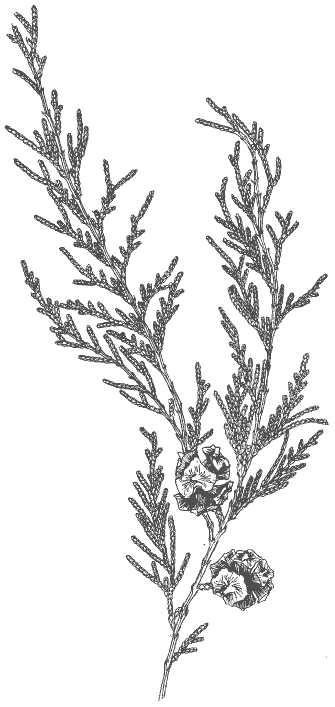
Cone-bearing branchlet with leaves and seed cones [Li Aili] (Fu et al. 1999).

Branchlet with leaves, and seed [Li Aili] (Fu et al. 1999).

Foliage from a tree in the Sacramento Capitol Arboretum [C.J. Earle].
Cone-bearing branchlet with leaves and seed cones [Li Aili] (Fu et al. 1999).
Branchlet with leaves, and seed [Li Aili] (Fu et al. 1999).
Conservation Status

Cupressus funebris
Chinese weeping cypress, 柏木 bai mu [Chinese] (Fu et al. 1999).
Syn: Chamaecyparis funebris (Endl.) Franco, Cupressus funebris var. gracilis Carriere (Fu et al. 1999). It is closely related to C. torulosa and C. cashmeriana, which also bear foliage in a flat single plane.
See C. fallax regarding the hybrid C. × wangii J.Hoch, Maerki & Rushforth.
Tree to 35 m tall and 200 cm dbh. Bark smooth, brown. Branches more or less horizontal or directed upwards. Branchlets arranged in a plane, pendulous, green, slender, flattened, ca. 1 mm wide. Leaves light green or gray green, densely appressed, scalelike, dimorphic, 1-1.5 mm long, apex sharply pointed; facial pairs with a linear abaxial gland; lateral pairs folded face-to-face, overlapping basal part of facial pairs, ridged abaxially. Juvenile foliage, often long-retained in cultivation, soft blue-green leaves 4-7 mm long in whorls of 2 or 4. Pollen cones ellipsoid or ovoid, 2.5-5 mm; microsporophylls 10-14. Seed cones dark brown when ripe, globose, 8-15 mm in diameter, on short petioles; cone scales 6-8(-12), 5-angular, each fertile scale with 3-5(or 6) seeds. Seeds light brown, lustrous, obovate-rhombic or suborbicular, flattened, 2.5-3.5 mm. Cotyledons 2. Pollination Mar-May, seed maturity May-Jun. 2n = 22 (Rushforth 1987, Fu et al. 1999, M.P. Frankis pers. comm. 1999.02.03). See García Esteban et al. (2004) for a detailed characterization of the wood anatomy.
Viet Nam (Rushforth 1987) and China: Anhui, Fujian, Gansu, N Guangdong, N Guangxi, E Guizhou, Henan, W Hubei, Hunan, Jiangxi, Shaanxi, Sichuan, Yunnan, Zhejiang; also widely cultivated in S China. Grows below 2000 m elevation (Fu et al. 1999). Hardy to Zone 8 (cold hardiness limit between -12.1°C and -6.7°C) (Bannister and Neuner 2001).
Listed (as Chamaecyparis funebris) as threatened in Viet Nam by the WCMC (2001).
Planted trees said to be 800 years old grow at Black Dragon Pool Mountain Temple near Kunming, Yunnan, China (International Dendrology Society, 1995 Year Book).
Elwes and Henry (1910) said that the hard, light yellow, even-grained wood was widely used in boat construction, for house-building, and for general carpentry. They also noted that it was widely planted around temples and burial sites. The extent of current use of the species is difficult to determine because it has been widely planted in China outside of its native range (Xiang et al. 2013), and in commercial use is likely not distinguished from other Cupressus cultivated for their wood or essential oils.
No data as of 2026-01-28.
The epithet funebris means "of the funeral", a reference to the tree's traditional use for coffin wood.
Elwes, H. J. and A. Henry 1910. The trees of Great Britain and Ireland, v. 5, p. 1162. Available: Biodiversity Heritage Library, accessed 2026.01.28.
Endlicher, S. L. 1847. Synopsis Coniferarum. Scheitlin und Zollikofer, Sangalli (Sankt Gallen). Available: Biodiversity Heritage Library, accessed 2022.12.26.
[WCMC] World Conservation Monitoring Centre. The Socialist Republic of Viet Nam Appendix 5 - Threatened Plant Species. http://www.wcmc.org.uk/infoserv/countryp/vietnam/app5.html, accessed 2001.11.25, now defunct.
Xiang, Q., T. Christian, and D. Zhang, 2013. Cupressus funebris. The IUCN Red List of Threatened Species 2013: e.T42218A2962455. https://dx.doi.org/10.2305/IUCN.UK.2013-1.RLTS.T42218A2962455.en, accessed on 2024.12.14.
Farjon (2005) provides a detailed account, with illustrations.
Luu and Thomas 2004 provides a more recent description, range map, conservation status, drawings and photos, and a wealth of additional information.
This page co-edited with M.P. Frankis, 1999.02.
Back | Home | Contact us
Copyright 2026 The Gymnosperm Database
Edited by Christopher J. Earle
This page accessed on Friday, October 23, 2026
Last Modified 2026-01-28
 Back to top