
Cone-bearing branchlet with leaves and seed cones [Li Aili] (Fu et al. 1999).
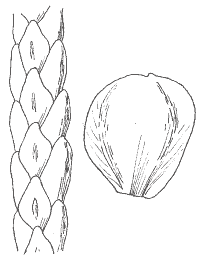
Branchlet with leaves, and seed [Li Aili] (Fu et al. 1999).

Cone-bearing branchlet with leaves and seed cones [Li Aili] (Fu et al. 1999).
Branchlet with leaves, and seed [Li Aili] (Fu et al. 1999).
Conservation Status

Cupressus duclouxiana
Chinese cypress (Vidakovic 1991), 干香柏 gan xiang bai [Chinese] (Fu et al. 1999).
Syn: Cupressus sempervirens Franch. non L. (Dallimore et al. 1967).
Trees to 25 m tall and 80 cm dbh. Crown conical when young, rounded or broadly domed when old. Branches slender and horizontal, densely arranged; branchlets spreading or drooping but not pendulous, thin, ultimate ones 4-angled, 0.8-1 mm in diameter. Leaves closely appressed, slightly glaucous abaxially, 1-2 mm long on ultimate branchlets, ridged or gibbous with an (often inconspicuous) abaxial gland, base long decurrent on leading branchlets, apex acute or slightly obtuse. Pollen cones subglobose or oblong, (4-)5-7 mm; microsporophylls (12-)16-20. Seed cones dark brown or purplish brown when ripe, glaucous, globose, 15-32 mm in diameter; cone scales (6-)8-10, each fertile scale with numerous seeds. Seeds brown or purplish brown, 3-5 mm, with 3 ridges. 2n = 22 (Fu et al. 1999). Cotyledons 2 (Vidakovic 1991). Note that the branchlets spreading in all directions, not in a single plane; and the shoots are very slender, the leaves very small; these features are helpful in distinguishing it from the otherwise similar C. sempervirens (Dallimore et al. 1967). See García Esteban et al. (2004) for a detailed characterization of the wood anatomy.
China: ?Guizhou, SW Sichuan, C and NW Yunnan, and SE Xizang, at elevations of 1400-3300 m (Fu et al. 1999). Hardy to Zone 8 (cold hardiness limit between -12.1°C and -6.7°C) (Bannister and Neuner 2001).
No data as of 2026-01-28.
A popular European ornamental (Vidakovic 1991).
No data as of 2026-01-28.
The epithet remembers French missionary and plant collector F. Ducloux, who lived in Kunming (Farjon 2010).
Camus, A. 1914. Les Cyprès (Genre Cupressus), Encylopédie économique de Sylviculture. II., Paris, p. 91-93 (p. 91). http://www.cupressus.net/CUduclouxianaCamus.html at the Cupressus Conservation Project website, accessed 2007.01.01.
Farjon (2005) provides a detailed account, with illustrations.
Back | Home | Contact us
Copyright 2026 The Gymnosperm Database
Edited by Christopher J. Earle
This page accessed on Friday, October 23, 2026
Last Modified 2026-01-28
 Back to top