Conservation Status

Callitris glaucophylla
J.Thomps. & L.A.S.Johnson (1986)
Common names
White cypress pine, Murray River cypress pine, Murray cypress pine, western sand cypress pine, western cypress pine (Atlas of Living Australia 2026, Grodecki et al. 1996). As with other Callitris it is variably called "cypress", "pine", or "cypress pine".
Taxonomic notes
Type: Australia, NSW, "Noonah Vale", c. 28 km SW of Garah, 29.1333° S, 140.4333° E, 1978.10.05, K. L. Wilson 1942. Holotype NSW, isotypes BRI, K, L, RSA. Synonymy:
- Frenela glauca R.Br. ex Mirb., nom. inval.;
- Frenela hugelii Carriere, Hort., nom. inval.;
- Callitris glauca (R.Br. ex Mirb.) R.T.Baker & H.G.Sm.;
- Callitris hugelii (Carriere) Franco; and
- Callitris columellaris var. campestris Silba.
Traditionally, there was a debate. Non-Australian botanists who knew this taxon mainly from study of dried specimens on herbarium sheets could see no difference between C. columellaris and C. glaucophylla except glaucous foliage on the latter, and so they reduced it to synonymy with the former. Australian botanists who knew these plants looked different, lived in different habitats, and had different distributions, regarded them as clearly and readily distinct species. The debate was resolved by molecular data, abetted by morphological and fossil lines of evidence:
- Pye et al. (2003), using ITS sequence data, found C. glaucophylla sister to C. gracilis and C. tuberculata, in a clade sister to a clade that included C. columellaris and C. intratropica.
- Piggin and Bruhl (2010), in a comprehensive morphological and molecular study of Callitris, found C. glaucophylla sister to the clade of C. columellaris and C. intratropica. The same result occurred when the morphological data were analyzed alone.
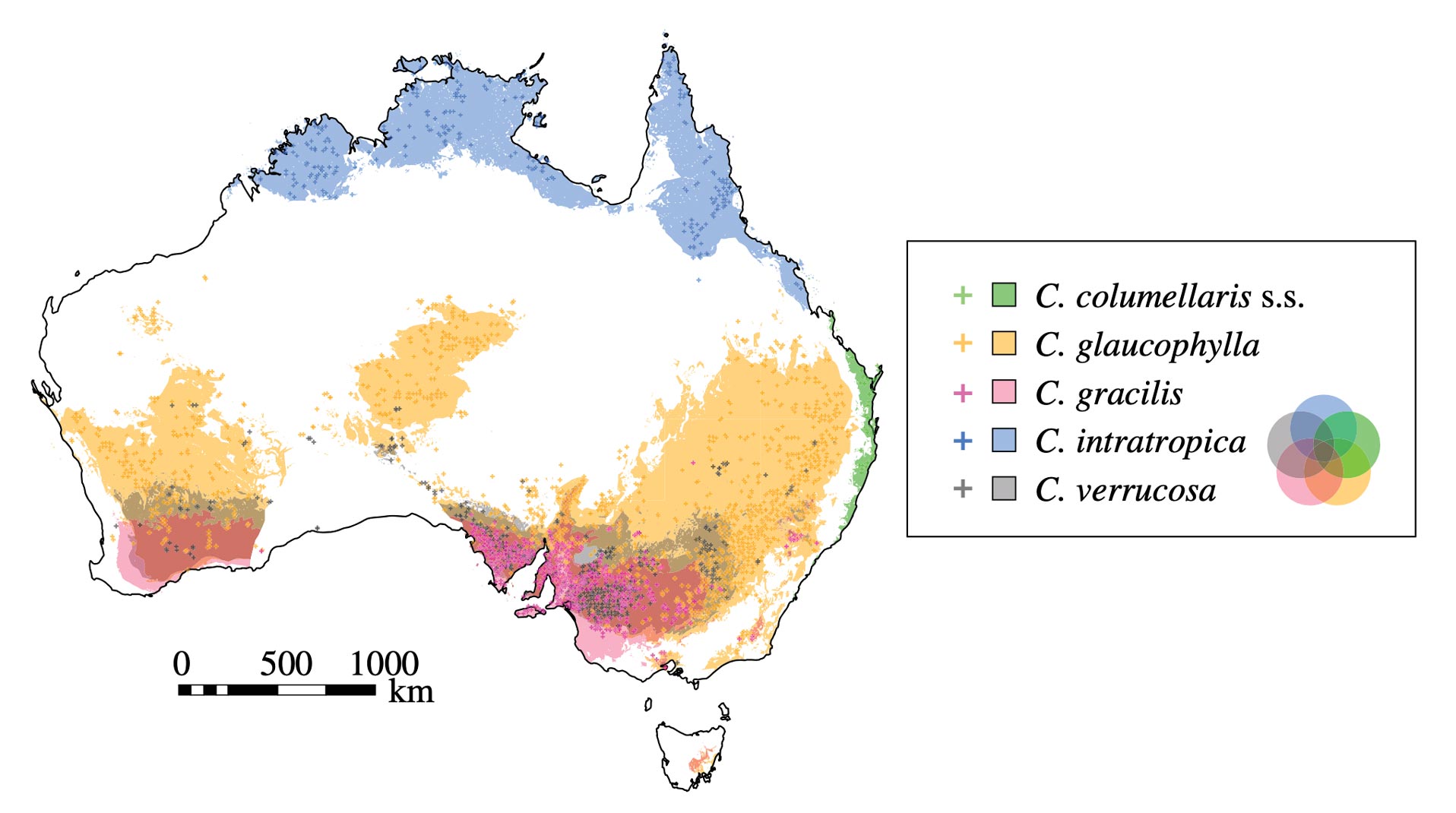
- Sakaguchi et al. (2013) identified C. glaucophylla as one member of a species complex allied to C. columellaris, recognizing C. gracilis, C. intratropica, and C. verrucosa as other members of that species complex. They assessed chloroplast haplotypes and nuclear SSR data for many specimens representing these taxa, and showed relationships between the taxa related to different ecosystems, climates, and glacial-interglacial evolutionary histories. The various species were clearly distinct, with important further genetic variation between populations of C. glaucophylla occurring in different mountain ranges, suggesting that they served as glacial refugia for the species.
- Larter et al. (2017) used an different and more diverse molecular dataset incorporating loci from plastid (rbcL, matK, trnL, psbB, petB) and nuclear DNA (ITS, needly, leafy) sources; they found C. glaucophylla in a clade with C. gracilis, C. tuberculata, and C. verrucosa, sister to a clade of C. columellaris and C. intratropica. Through a molecular clock they estimated that these two clades diverged in the latter Miocene, about 10 million years ago.
- Crisp et al. (2018) used still another comprehensive dataset incorporating molecular, morphological, and fossil data to evaluate all taxa in the subfamily Callitroideae; here again C. columellaris and C. intratropica were distinct but sister taxa, while the placement of C. glaucophylla varied with specimen provenance. Two specimens were sister to C. gracilis, while a third grouped with the southern temperate species C. preissii and C. verrucosa. The same result occurred in both chloroplast and nuclear datasets.
Despite some ambiguities, all of these studies concur in finding that C. glaucophylla is not sister to C. columellaris. The distinct structure is clearer in the more detailed studies (2013 and later), which used a larger suite of molecular and morphological markers as well as sampling more individuals. There is some evidence, particularly in the work of Sakaguchi et al. (2013) and Crisp et al. (2018), that there may be significant undescribed infraspecific variation within the species. Further work will be needed to elucidate this variation. Harden (1990) reported that C. glaucophylla forms natural hybrids with C. preissii; however the populations she was referring to, in New South Wales, are now assigned to C. gracilis rather than C. preissii. This is plausible in view of the molecular findings summarized above. Hybrid populations are common in the Flinders Ranges, the Murray River and the mallee regions of South Australia, Victoria and New South Wales (Thompson and Johnson 1986).
There is also a complicated naming story. The species was first described in 1825 by Robert Brown, based on c. 1825 collections in New South Wales, roughly the area now called the Pilliga; it was named Frenela glauca. Frenela because although Callitris had been described in 1808, Mirbel's 1825 description of Frenela was widely published and recognized. The name Callitris was not generally accepted until much later in the 19th century. It was F. glauca, of course, due to the glaucous foliage. Unfortunately this was not a validly published name because it did not include a description of the plant. Then in 1855 the plant was described, this time under the name Frenela hugelii, a name given by Carriere. This was also invalid, because Carriere did not illustrate the plant, nor did he refer to a particular specimen as the basis of his description, which seems to have been based on a cultivated plant in Paris. Still, the epithets glauca and hugelii continued to appear in the literature, first under Frenela and then under Callitris. In 1952 Franco attempted to clear up the situation by describing Callitris hugelii (Carr.) Franco; he based the species on Carriere's description and he selected as lectotype a specimen collected in the wild in 1845. Unfortunately that was not the specimen Carriere based his description on, and moreover a later study (Blake 1959) found that the lectotype designated by Franco was actually a specimen of C. columellaris. This invalidated Franco's name. Finally in 1986 J. Thompson and L.A.S. Johnson decided that since all previous names were invalid, the best approach was to start with a clean slate. They described a new species, C. glaucophylla, based on a recent type specimen, and that's how we got to the current name.
Description
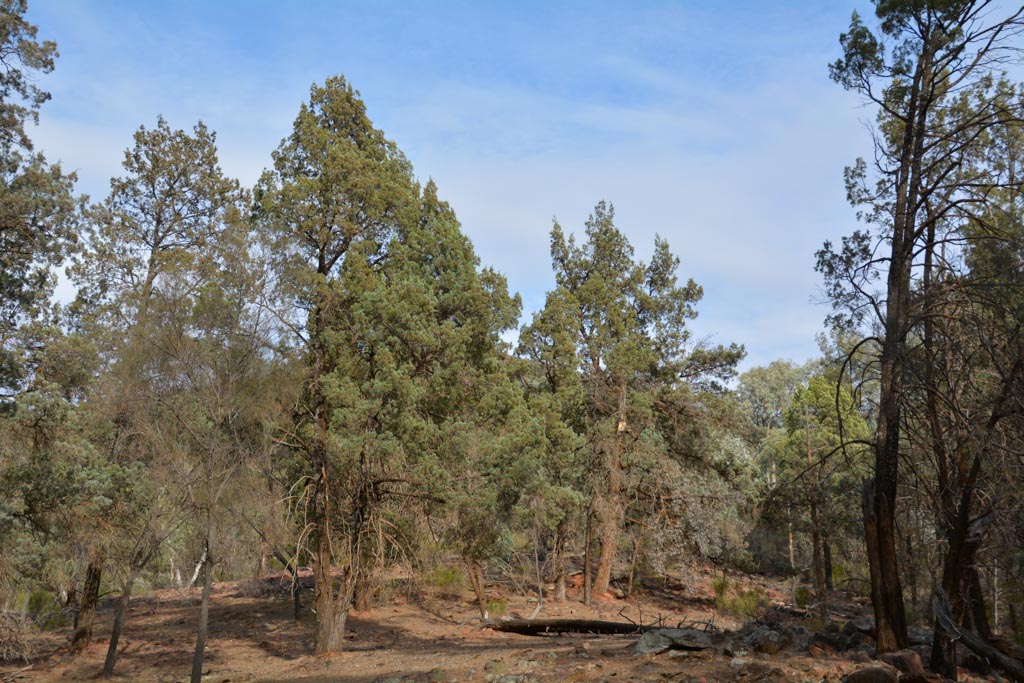
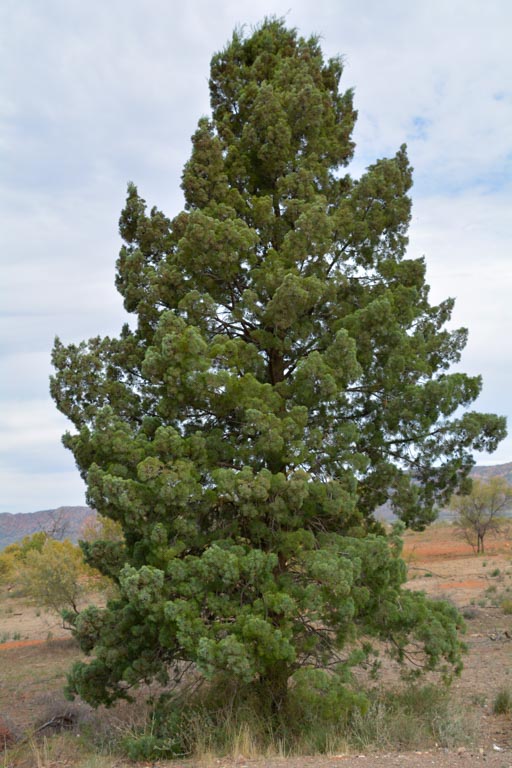
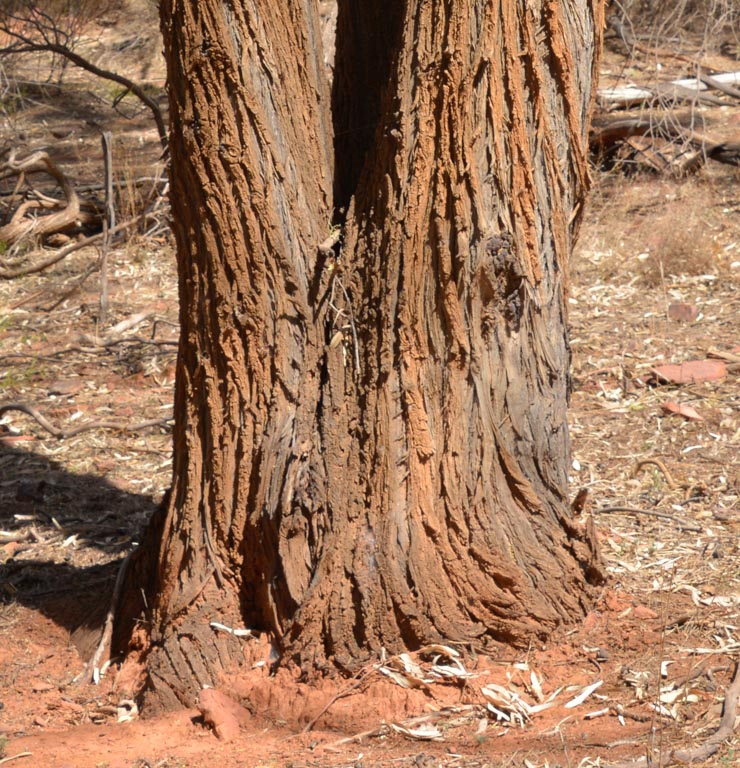
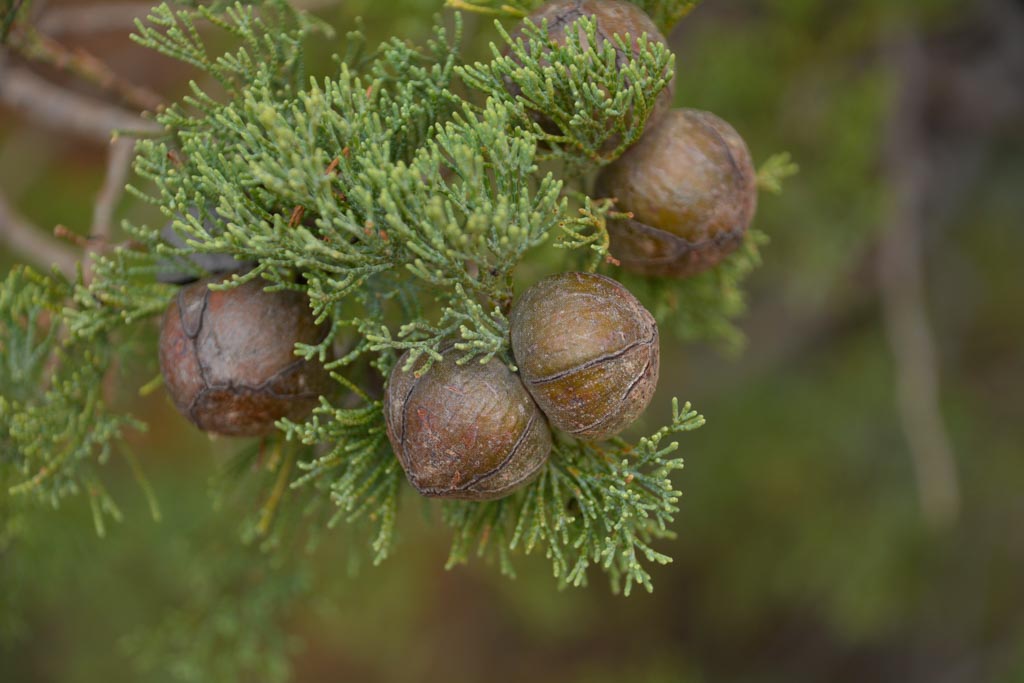
Monoecious evergreen shrubs or trees to 30 m tall, typically with a single trunk of spreading or erect branches. The crown of young trees is typically conical, while trees that have attained site potential tree height often show a flattened crown. Bark brown, rough and furrowed. Leaves in whorls of 3 (sometimes 4 or 5 when juvenile), variably dark green to glaucous, juvenile leaves 7-8 mm, mature leaves 1-3 mm long with apex broadly acute, dorsal surface not keeled. Pollen cones solitary or in small clusters at the tips of branchlets, cylindric-oblong, 3-10 ⨰ 2-5 mm; pollen typically shed in September. Seed cones solitary on slender twigs, falling soon after maturity, which is typically attained in November-December; depressed-globose to ovoid, 12-25 mm diam., dark brown with a 7-8 mm peduncle; cone scales 6, thin, often with a very small dorsal point, separating almost to base and spreading widely after opening, alternate scales short and narrow, larger ones angled into a wide sharp apex, spreading widely at maturity; columella usually slender and 3-7 mm long. Seeds 4-5 mm, chestnut brown, numerous, with 2-3 wings ca. 4 mm wide (Harden 1990, Wunderlin 1993, Hill 1998, Taylor et al. 2005, Thompson and Eldridge 2005). The green wood has a specific gravity of 0.83. The sapwood is cream-colored; the heartwood varies from light yellow through orange to light brown, with occasional dark brown streaks. The straight grain is pierced by many small tight knots. Natural resins in the wood make it highly resistant to termites and decay (FWPA 2022). See García Esteban et al. (2004) for a detailed characterization of the wood anatomy, and see Heady and Cunningham (2008) for a detailed comparison to the wood of C. endlicheri. See Baker and Smith (1910, as Callitris glauca) for copious detail on anatomy and chemistry of the various tissues; in general, the leaf essential oils are dominated by limonene and α-pinene (Brophy et al. 2007).
Hill (1998) provides the following key to the three similar species sometimes synonymized as C. columellaris. These species are distinguished from all other Callitris by having dorsally rounded (not keeled) scale leaves, and seed cone scales that separate almost to the base; these characters readily distinguish C. glaucophylla from other Callitris that may occur with it in habitat. Also, unlike most taxa in the genus, these three species are not serotinous (Crisp et al. 2018).
| 1 |
Largest seed cones less than 18 mm diameter; tropical species. |
C. intratropica |
| 1 |
Largest seed cones more than 18 mm diameter; southern species. |
2 |
| 2 |
Foliage gray-green or glaucous; older trees with a spreading habit, not columnar; inland species. |
C. glaucophylla |
| 2 |
Foliage dark green; older trees with a columnar, erect habit; coastal species. |
C. columellaris |
Distribution and Ecology
Distribution
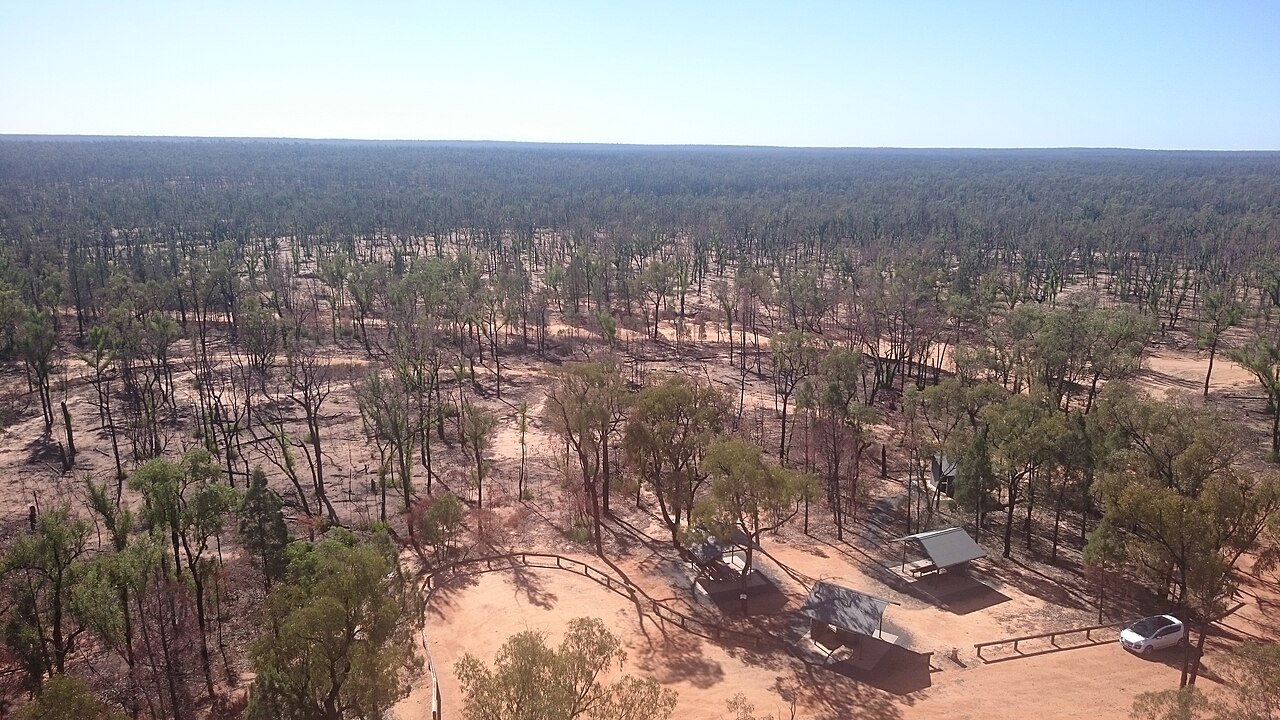
Australia: New South Wales, Northern Territory, Queensland, South Australia, Victoria, Western Australia. As such, this is the most widely distributed species of Callitris. However, its predominance varies widely. It is most abundant in the "Pilliga", a large region in interior NE New South Wales, and in adjacent parts of Queensland; a 2005 inventory found C. glaucophylla to be dominant or subdominant on over 4 million hectares in these two states (Taylor et al. 2005). It is also abundant in the Murray and Darling river basins, and in the Flinders Ranges. Although its distribution continues W of there in central Australia and in parts of Western Australia, it is much less common in those areas. Little has been written about its ecology in areas other than NSW. Moreover, its distribution has been modified since Europeans arrived in Australia: "The pre-European distribution of C. glaucophylla was altered dramatically in the past century because of a combination of grazing by domestic livestock and feral animals, altered fire regimes and weed invasion. Today, the majority of C. glaucophylla woodlands are highly fragmented remnants, with many managed as formal forestry reserves" (Thompson and Eldridge 2005).
Ecology
The species grows on a wide range of soil types, ranging from deep sands to clay soils; it seems to do best on well-drained sandy soils (Taylor et al. 2005). Bowman et al. (2011) sampled C. glaucophylla at sites across Australia to evaluate climate-growth relationships. The sites were at elevations of 110–800 m and had mean annual precipitation of 225–685 mm with mean annual temperature of 11.5–24.4°C. This is quite a wide ecological amplitude, covering arid-hot (Pilbara in western Australia, central Australia, and western NSW sites), humid-subtropical (Pilliga sites), and even maritime-temperate climates (Victoria sites). The greatest rainfall variability was at the arid sites, and here the trees grew most slowly, generally producing a growth ring in response to each rainfall event. The arid sites represent some of the driest places on Earth that support conifer growth (Larter et al. 2017).
Regeneration begins with seedfall. Seeds are typically shed in November-December (in the Pilliga). Seed production depends upon various factors such as fire, soils, and stand density; seed production is inversely proportional to stand density, with densely forested stands producing little or no seed. As with most conifers, seeds are disseminated by wind, and most seed falls within 1-2 tree heights from the source. Successful reproduction and regeneration typically require 2 years of above-average precipitation for seedlings to survive; thus regeneration tends to be highly episodic on arid sites (e.g. central Australia), but more continuous on wetter sites (e.g. the Pilliga). Sometimes regeneration is too successful, producing very dense stands with small diameters (Thompson and Eldridge [2005] recount densities of up to 620,000 stems per hectare). Stands with very high densities become "locked up', a stand condition where tree mortality and growth rates are almost negligible. Stands in this condition may take considerable time, >100 years, to develop to merchantable size trees, if at all (Taylor et al. 2005 and citations therein).
The sites studied by Bowman et al. (2011) were further examined by Prior et al. (2012) who found that the arid sites were strongly dominated by Callitris, usually with over 80% of the tree basal area on the site. These sites generally had no evidence of fire, but did have herbivory by non-native mammals (sheep, goats, or rabbits) at 61% of sites, and about a third of sites had no seedlings or saplings. The relative absence of young trees could have been due to grazing pressure, or to drought; both factors can contribute to the situation (Thompson and Eldridge 2005). The wetter temperate sites had a higher Callitris basal area, but it was a smaller fraction of total woody basal area, about 60%. About half of these sites had evidence of past fire, and only 15% had evidence of grazing; in general, both seedlings and saplings were present, in size classes indicating continuous recruitment to the population.
A variety of other studies have also looked at the effects of grazing by native (macropods) and introduced mammals. An experimental study conducted in the woodlands W of the Blue Mountains in NSW found significant grazing effects from sheep and rabbits, though not from macropods, and impacts were greater on grasslands than in woodlands, suggesting that grazing may be helping to perpetuate grassland habitats (Allcock and Hik 2004). An observational study covering C. glaucophylla over some 451 sites in New South Wales also found effects of grazing, and found it to be a major control on the suite of species found in the C. glaucophylla plant community, although the direct effects on Callitris regeneration and growth were not evaluated (Eldridge et al. 2018). Thompson and Eldridge (2005) cite a variety of other studies, including work on effects of the European rabbit invasion of the late 1800s: "In many areas the population structure comprises individuals in the same age (and size) class, partly attributed to invasions by the European rabbit (Oryctolagus cuniculus) which reached plague proportion on the western slopes of NSW between 1879 and 1897. Rabbits ate pine seedlings, halting regeneration for up to 60 years in some areas. Suppression of C. glaucophylla by rabbit grazing continued until myxomatosis was introduced to control rabbits in the 1950s."
Almost everywhere, fire is a major control on Callitris populations, and this is also true of most C. glaucophylla populations. This species is an obligate seeder, unable to regenerate from the rootstock. As with most conifers the largest seed crops are produced intermittently; in this case, about every 3 years. Unlike most Callitris species C. glaucophylla is not serotinous, so it lacks a mechanism to disseminate abundant seed in response to a fire. Rather, recruitment tends to occur after a year or two of wet summers, accompanied by below-average summer temperatures. Moreover, a severe fire will cause reduced seed production for up to 7 years thereafter (Thompson and Eldridge 2005). All things considered, the species is not well adapted to fire. A survey in central Australia found that C. glaucophylla deals with fire by simply avoiding it, growing on relatively fireproof sites (Bowman and Latz 1993). Cohn et al. (2011) studied the problem in the relatively wet, productive, fire-prone Pilliga region. They found that at times of moderate fire weather, fires burned in the Callitris forest with low intensity and Callitris mortality was low, particularly among the larger size classes. However, this effect disappeared with high fire intensity, a result confirmed by a later study in Warrumbungle National Park (SW of the Pilliga forests) where a mega-fire burned over 50,000 ha of mixed Eucalyptus-Callitris forest. In areas with low fire severity over 60% of C. glaucophylla trees survived, but in high severity areas mortality was near 100%. The eucalypts, in contrast, had much lower total mortality (Denham et al. 2016).
C. glaucophylla is a keystone species, in that it is a dominant habitat-forming species in woodlands that in turn support high biodiversity of plants, wildlife, invertebrates and other organisms. Here again the data have chiefly been collected in NSW. A regional study found that the woodlands support over 350 vascular plant species in 52 families, although often at low cover values in areas where the Callitris canopy is dense (Thompson and Eldridge 2005). There is also a diverse non-vascular and microfungal community associated with biological soil crusts, which are widespread in these woodlands. One NSW study found 39 moss species, 14 liverworts, and 33 soil lichens inhabiting these biocrusts (Thompson et al. 2006, Mallen-Cooper et al. 2018). C. glaucophylla trunks are also known to support a variety of bryophytes and lichens. The vertebrate fauna is also rich. Mammals, birds, and reptiles use all levels of C. glaucophylla communities from the canopy to the soil surface. Large numbers of birds and reptiles reach their highest proportions in C. glaucophylla vegetation communities. The canopy provides shelter for small birds, and cockatoos and galahs (Cacatua roseicapilla) are known to feed on C. glaucophylla seeds. Early bird surveys in the Pilliga woodlands recorded over 80 species (Thompson and Eldridge 2005 and citations therein). A check of iNaturalist records on 2026.08.25 indicated 116 bird species, 47 reptile species, and 22 mammal species in the Pilliga forest region, along with another 458 invertebrate species; a review of eBird data for the same area found over 150 species. A comparable inventory in the Flinders Ranges revealed 107 bird species, 40 reptile species, 21 mammal species, and another 541 invertebrate species; here again eBird inventoried over 150 species. The Pilliga mouse is an obligate species, known only from C. glaucophylla forests in the Pilliga (Fox 1995).
A number of pests and pathogens afflict C. glaucophylla, although none seem to be specific to it; they all affect other species of Callitris as well. The insect Diplosis frenelae is a common producer of galls, and the foliage is afflicted by the cypress pine sawfly Zenarge turneri and the cypress pine aphid Cinara tujafilina (Thompson and Eldridge 2005 and citations therein). There is also a bark beetle, the cypress pine jewel beetle (Diadoxus scalaris and D. erythrurus); Durabilla white grub (Cerambycidae); the cypress bark weevil Aesiotes leucurus, and termites (Coptotermes spp.). The primary pathogens are brown cubical rot (Gloeophyllum spp.) and root rots (Phellinus spp.). None of these pests or pathogens seem to pose a major threat in natural stands of the species; they generally afflict stressed individual trees and as such are contributing factors in mortality. However the bark beetles can "become major pests after catastrophic events such as wildfires or severe storms" (Taylor et al. 2005); an example of such an irruption in the Pilliga, following two severe fires, is recounted by Hadlington and Gardner (1959).
Hypotheses about post-settlement forest changes
There have been a variety of forest history studies of C. glaucophylla, trying to reconstruct changes since presettlement times (ca. 1750) and modern times (ca. 2015). Some hypotheses advanced through this work include:
- Aboriginal burning: Native peoples periodically burned the bush (to support populations of huntable game and increase populations of food plants) with high frequency and low intensity, which established and propagated a Callitris woodland of relatively large old trees. European colonization disrupted this system, suppressing wildfires and allowing profuse regeneration of Callitris, increasing total woody cover and producing dense stands of small trees.
- European pastoralism: European colonization led to the intentional extirpation of Callitris over large areas in order to support large populations of domestic grazers.
- Shocking the system: Episodic events such as mega-fires, the introduction and subsequent population crash of European rabbits, and extreme drought events have caused widespread disturbance, so the status of Callitris can be seen as a successional state of recovery from a recent severe event.
Aboriginal burning: Both early Europeans and later investigations have shown that "Aborigines in the 19th century burned landscapes for a great variety of purposes such as clearing thick vegetation to facilitate travel, signalling, controlling insects and vermin, hunting and waging war." However, fires were much more frequent in coastal areas than in continental interior areas receiving less than about 600 mm rainfall per year (Bowman 1998). By inference, aboriginal fire was uncommon throughout much of the range of C. glaucophylla, and thus far has not been shown to be influential anywhere in the range of this species. In southern Queensland, there is positive evidence on this point; a historical study used a survey performed in 1844-45 for baseline data on forest condition, comparing it to aerial photographs from 1945-78, at which time land use conversion was still very limited in the study area. The results showed that in both time periods there was considerable variance in C. glaucophylla regeneration, including some sites with locally very dense regeneration of small stems (colloquially called "whipstick pine"); but there was no temporal trend in the prevalence of such stands (Fensham 2008).
European pastoralism: As discussed earlier, there is clear evidence that introduced grazers substantially impair regeneration of C. glaucophylla, to the point where some sites have essentially no regeneration. Grazing is in fact an effective management tool to limit and control Callitris regeneration, since it's much easier to manage and control than is prescribed burning (Thompson and Eldridge 2005). Pastoralism grew common shortly after aboriginal burning ceased; but settlers then also used burning to clear whipstick pine thickets and stimulate growth of grasses. Leasehold agreements would also often require control of eucalypts and sometimes of Callitris via techniques that included hand clearing of young trees and cutting or ringbarking of larger trees (Thompson and Eldridge 2005, Fensham 2008). A study estimating forest changes following European settlement, covering much of the C. glaucophylla range in New South Wales, established that settlement did have some substantial effects on forest structure. Stand basal area did not change, but the fraction of basal area in trees >60 cm DBH increased greatly. Presettlement stands were dominated by Eucalyptus with 78% of basal area, but current stands are dominated by Callitris with 74% of basal area (Lunt et al. 2006).
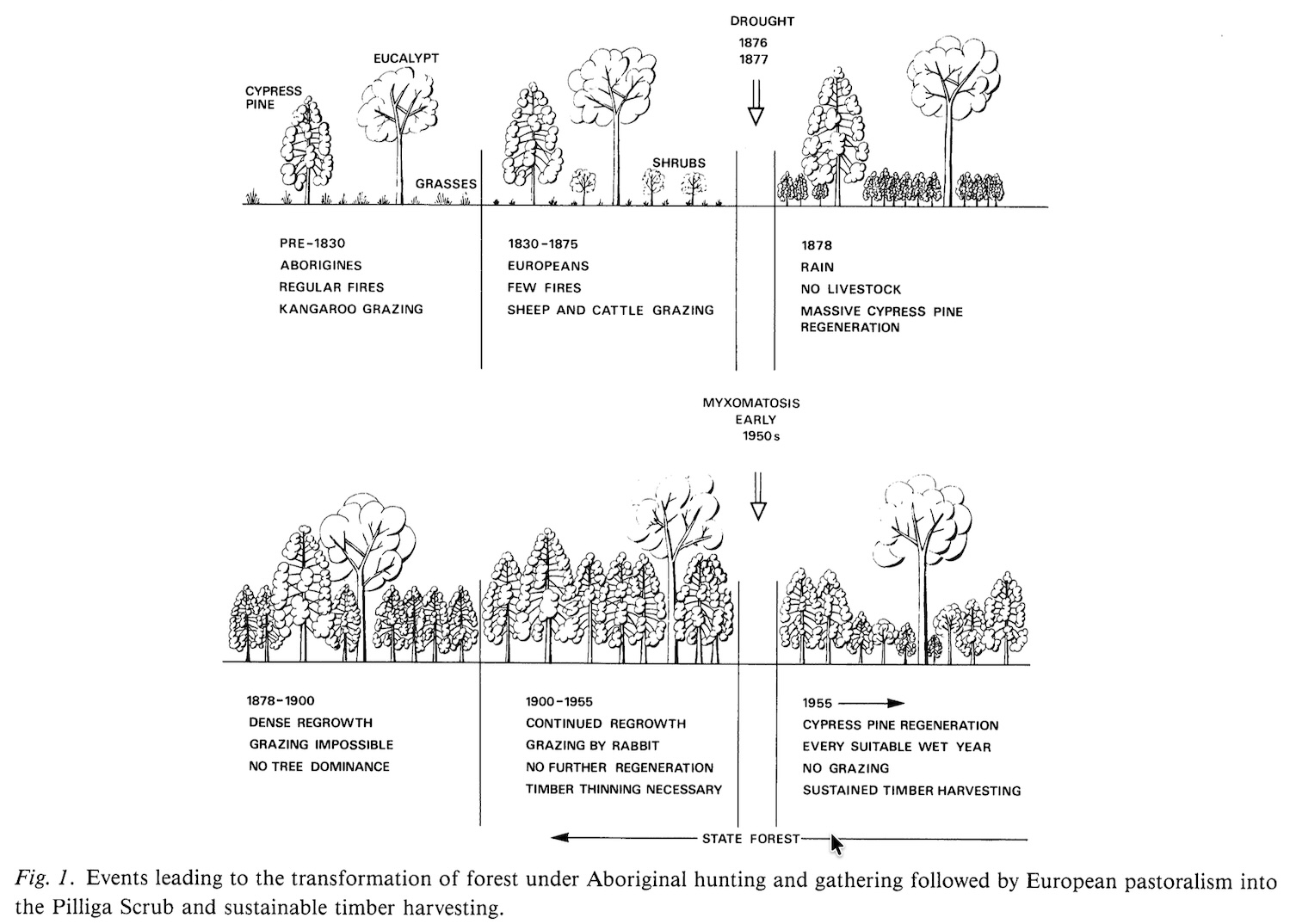
Shocking the system: Ecosystems subject to severe disturbances at decadal time scales tend to be in a perpetual early-successional condition. C. glaucophylla is subject to several such severe disturbances: high-intensity fire, multi-year drought, and stressors introduced by Europeans in the form of grazing animals, a plague of European rabbits, land clearance for agriculture and grazing, and hypothetically other stressors such as introduced pathogens or human-caused climate change. Austin and Williams (1988) present a conceptual model of forest history in the C. glaucophylla woodlands of eastern Australia, as concisely shown in the diagram at right. The model simply proposes that the forest at any time in the past 200 years has essentially been in a state of recovery after a suite of disturbances of varying duration and intensity. Domestic animal grazing would be an example of a long-duration low-intensity disturbance, and the 1876-1877 drought an example of a short-duration high-intensity disturbance. This conceptual model probably works well for C. glaucophylla in areas with relatively high rainfall and thus high regeneration potential. Its application to drier sites is more doubtful, but there are analogues to the pinyon-juniper woodland ecosystems of western North America. Those woodlands also show (in most areas) a pattern of early-successional response to major disturbances that have included fire, grazing, and drought; and in those woodlands the biological response occurs across a wide range of conditions of temperature and precipitation. One consequence of this process is that at any given site the conifers are likely to be either actively expanding their distribution or suffering widespread dieback, so site-specific narratives are of very little use in estimating rangewide expansion or contraction of the species (Lanner and Frazier 2011).
Future prospects for the species
Potential climate change effects on C. glaucophylla seem not to have been evaluated. The form of such an analysis is offered by Sakaguchi et al. (2013), who model the effects of glacial vs. interglacial climates; they found that during the full glacial, a generally drier and cooler period, C. glaucophylla distribution contracted, with large reductions to small isolated refugia in most of its range, excepting a much less pronounced reduction centered on the Pilbara, which generally maintained adequate rainfall. Current climate change projections for the Central Slopes region, which includes the Pilbara, feature year-round mean temperature increases, a winter-spring rainfall decrease, and an increased incidence of harsh fire weather. Extremely similar projections apply in the remainder of the species' range as well (Climate Change in Australia, accessed 2026.08.25). These forecasts are thus consistent with reductions in C. glaucophylla distribution due largely to reduced rainfall and more severe fire weather. Its occurrence in western NSW and central Australia is currently at the limits of its drought tolerance, with annual rainfall <300 mm (Bowman et al. 2011), and in this area reduced rainfall, increased temperatures, and increased fire weather would likely cause the greatest range reductions.
By the end of the 20th century, management of C. glaucophylla had settled into a pattern of native forest management using silvicultural techniques for timber production in the Pilliga and other relatively wet/productive areas; protection in reserves scattered widely throughout its distribution; and no systematic management on equally scattered private and leasehold lands. Woodlands in this last category, however, did experience widespread removal due to land clearing and conversion to industrial-scale agriculture (wheat and in some areas irrigated crops) and sheep grazing. For example, Thompson and Eldridge estimate that 88% of Queensland's C. glaucophylla forest has been lost to such clearance activities, and the remaining habitat is dispersed and severely fragmented. There were no examples of plantation forestry, as the vast naturally-regenerated woodlands in NSW and Queensland were adequate to meet demand (Thompson and Eldridge 2005, FWPA 2022, Huynh et al. 2023). The 21st century has seen increasing interest in the nontimber values of these woodlands, and in parallel, an increased interest in plantation cultivation. The latter is discussed below (Ethnobotany). The nontimber values of interest include wildlife habitat and general biodiversity, which constitute management objectives on government-owned production forests subject to silvicultural manipulation; and nature conservation reserves, which are important but relatively small and scattered, constituting about 9% of the C. glaucophylla woodlands (Thompson and Eldridge 2005).
The IUCN has evaluated the conservation status of the three species C. columellaris, C. glaucophylla, and C. intratropica, as they consider these three species to be a single species. However, the majority of the distribution of the group is accounted for by C. glaucophylla, and in view of the species' vast range and genetic diversity, it certainly warrants a "Least Concern" assessment under IUCN criteria, even though land clearance activities have greatly reduced its distribution. It is subject to varied threats that include altered fire regimes, continuing land conversion to non-habitat uses, grazing by domesticated and introduced mammals, and possibly other factors; but for the foreeable future, this species will remain a dominant tree on large parts of the Australian landscape.
Hardy to Zone 9 (cold hardiness limit between -6.6°C and -1.1°C) (Bannister and Neuner 2001). Naturalized in USA: Florida: Brevard, Indian River, Orange, and Seminole counties at 0-10 m elevation, where it occurs in sand pine (Pinus clausa) scrub and thickets (Wunderlin 1993, citing Blake 1959).
Remarkable Specimens
Exceptionally large and tall trees have been fairly well inventoried in this relatively common species. Noteworthy specimens listed in the National Register of Big Trees (2026) include:
- 118 cm dbh and 17 m tall, with a 18.0 m crown spread, last measured in 2012; a remnant in pasture, Grenfell, NSW.
- 108 cm dbh and 15.5 m tall, with a 19.0 m crown spread, last measured in 2015; a remnant in pasture, Grenfell, NSW.
- 97 cm dbh and 23 m tall, with a 10.0 m crown spread, last measured in 2010; "Old Grey", growing in Kerringle State Forest, NSW.
- 71 cm dbh and 33 m tall, with a 5.5 m crown spread, last measured in 2012; "West Parent", in a closed-canopy forest remnant in Saverlake, NSW.
- 96 cm dbh and 15.5 m tall, with a 12.0 m crown spread, last measured in 2017; "Robber's Tree", growing in Cunnamulla, Qld. A 2025 Google Street View image shows that this tree has died and is now a snag, its crown snapped off.
A specimen in Bradenton, Florida has a height of 18 m, a dbh of 146 cm, and a crown spread of 9 m (American Forests 1996). This tree may no longer exist; there are online clues that some large Bradenton trees have since been cut, with others felled by hurricanes.
There are few age data. Cullen and Grierson (2009) report collecting tree-ring series with a length of up to 397 years. They don't state that this tree was alive (they collected 13 live and 2 dead trees), but their sample depth is such that several trees must have exceeded 300 years.
Ethnobotany
Apart from aboriginal burning and its diverse purposes, discussed above, native Australians used C. glaucophylla wood to make spears, spear-throwers, paddles, ceremonial objects, and musical sticks. They prepared an adhesive using Callitris resin and kangaroo dung, and the bark and foliage provided a mosquito repellent (Thompson and Eldridge 2005 and citations therein). Infusions of the foliage and resins were used to treat rashes and diarrhea (Rolls 2001).
European colonists were harvesting C. glaucophylla as soon as they found it. An 1815 observer in central NSW reported "useful pine trees ... three feet in diameter, as straight as arrows, some of them at least forty feet high before the branches begin to shoot out"; and in 1832 an explorer in the same area reported "forests of magnificent pine trees" (Rolls 2001). Formal timber management in the Pilliga began in 1877-78 with declaration of several timber reserves, and silvicultural manipulation via thinning began in 1893. Since NSW established its Forestry Commission in 1916, the area has been continuously managed for timber production (Rolls 2001, Thompson and Eldridge 2005). That silviculture seems to consist largely of thinning. It was early recognized that C. glaucophylla performed poorly as a plantation species, and also that it does not readily self-thin. Thus management has, from the start, focused on thinning and harvest of naturally regenerated stands (Thompson and Eldridge 2005, FWPA 2022). Increasingly, the thinning is done in a way that supports nontimber values such as biodiversity, as well (Gonsalves et al. 2018).
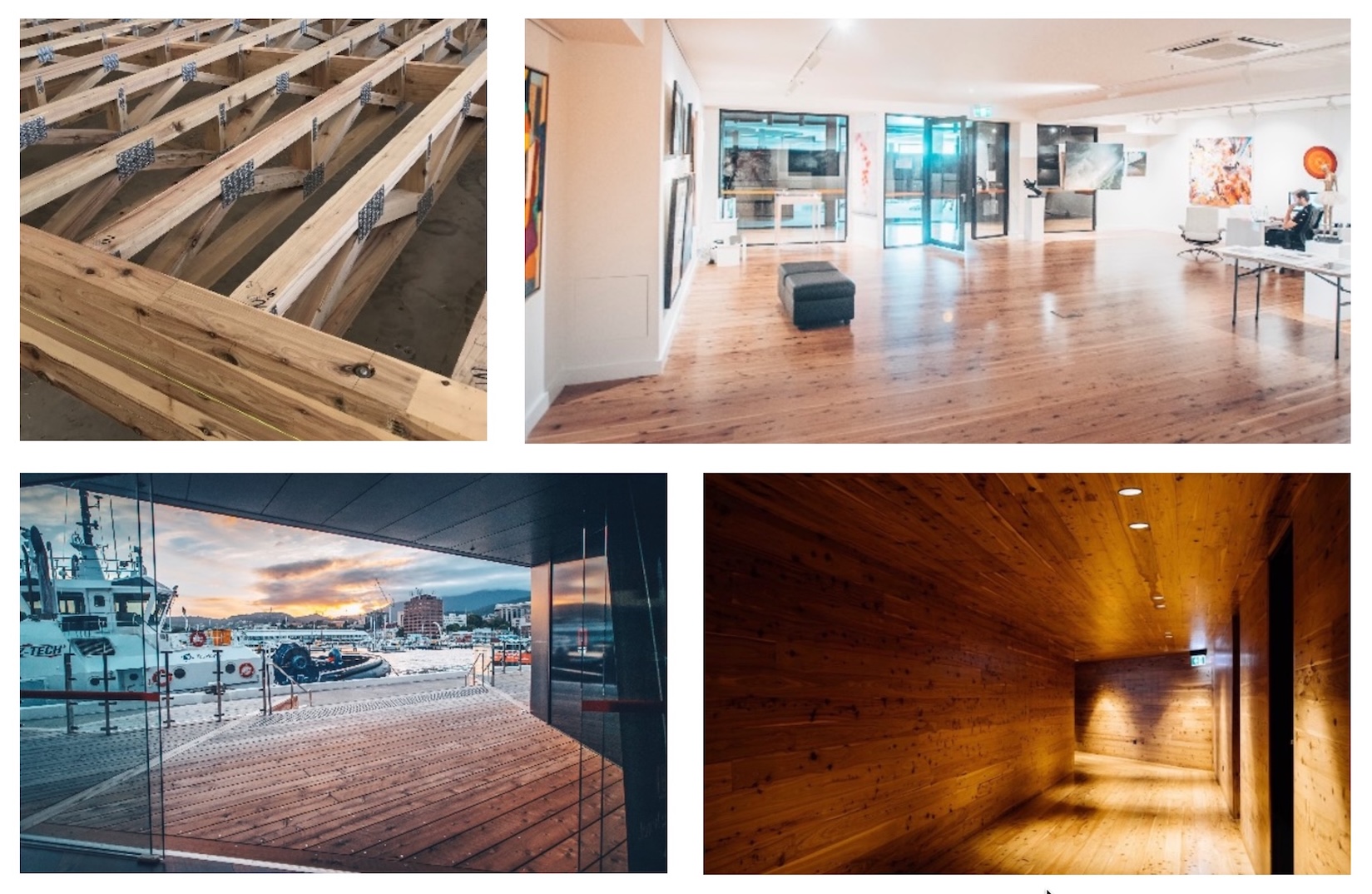
Historically the wood was extensively used for house construction. Also it "occasionally has some very handsome markings, which make it a valuable timber for some kinds of cabinet work, such as panelling, &c. When polished it is very attractive ... The white-ants or termites are not particularly partial to it, and will attack it only as a dernier ressort, and this fact, of course, accounts for its utilisation for fence and foundation posts" (Baker and Smith 1910). In the modern world, this is the most economically important Callitris species (Christiansen 2000). In 2016-17 there were 17 cypress sawmills in Australia, 13 in Queensland and 4 in New South Wales. In 2018-19 these sawmills processed an estimated 149,000 m3 of cypress logs (FWPA 2022). Uses for the timber include flooring, paneling, cladding, joinery, frameworks, posts, small poles, and beehive construction. The wood, although somewhat brittle, can be turned and machined reasonably well, and it has high dimensional stability after it is seasoned (TBIA 2002). Due to its termite resistance, the timber remains popular for ground-contact uses; in exterior use heartwood timber is expected to last at least 40 years and in-ground use such as fenceposts will last at least 25 years (FWPA 2022).
This species has proven useful in dendrochronological research. Research in southern Western Australia developed a 350-year chronology and used it to reconstruct autumn-winter rainfall since 1655 (Cullen and Grierson 2009).
Observations
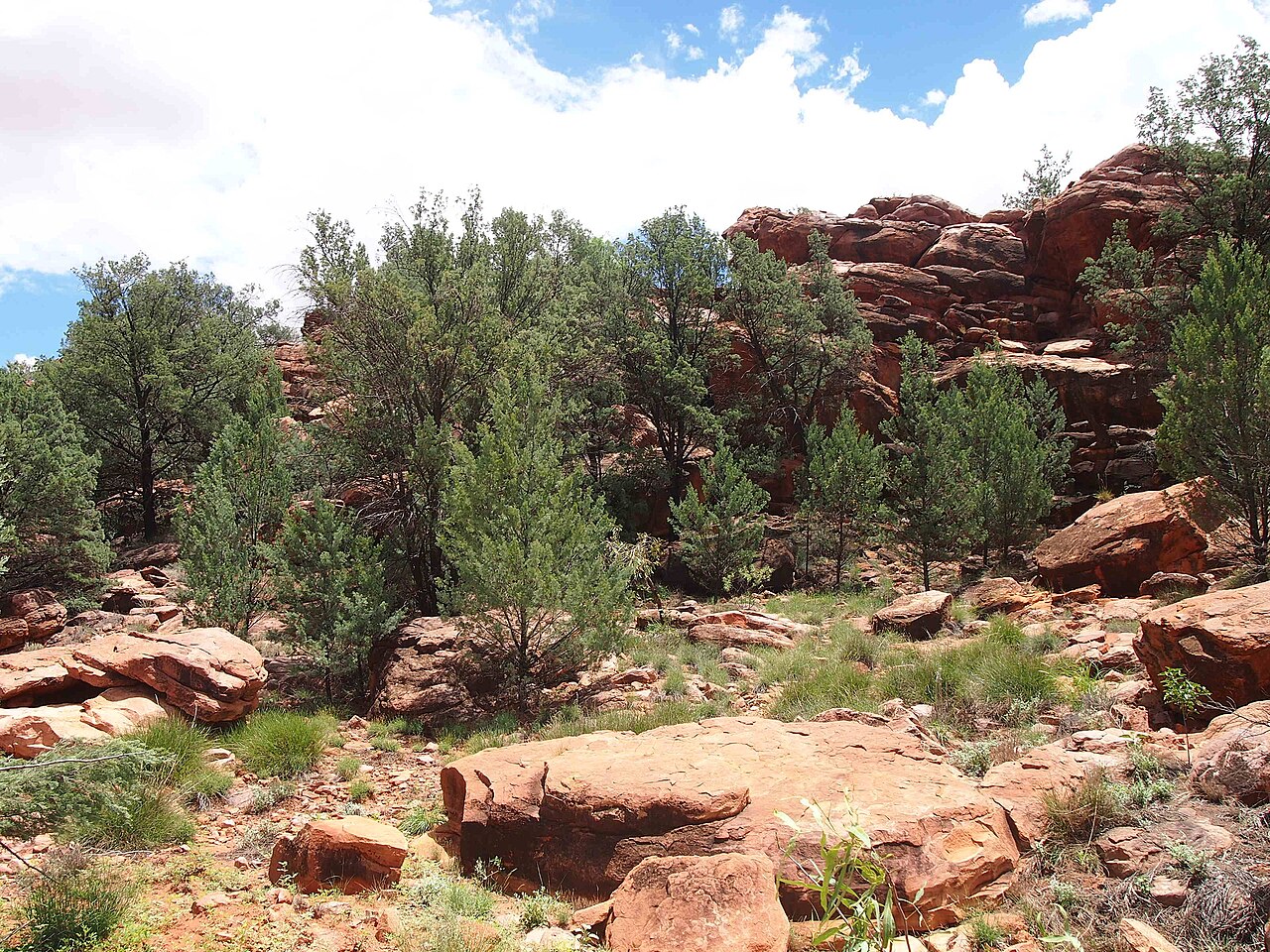
C. glaucophylla can be seen widely in its principal range in the Pilliga, e.g. in Pilliga National Park and the Pilliga State Conservation Area. Fairly extensive stands can be found amid great scenery at Flinders Ranges National Park, Snowy River National Park, and Terrick Terrick National Park. In central Australia it can be seen in parts of Tjoritja / West MacDonnell National Park
Remarks
The epithet glaucophylla refers to the bluish cast of the foliage. Conifer leaves (pretty much all leaves, actually) are typically exposed to a harsh environment on the outside, and on the inside, contain air spaces where carbon dioxide diffuses into the leaf and oxygen diffuses out, at rates and concentrations related to photosynthetic activity. That gas movement occurs via movement through pores called stomata, which the plant can open or close; and also via diffusion directly through the leaf surface, which the plant largely cannot control. Loss of water vapor through the epidermis of the plant is limited by the amount of waxy cuticle covering the plant's epidermis, and a thick layer of wax gives the foliage a blue color. Thus glaucous plants generally reflect an adaptation to water stress; a glaucous plant can limit its water loss by closing its stomata. Glaucousness sometimes varies on an individual plant or between plants, with branches or plants subject to greater water stress showing increased glaucousness.
Watanabe et al. (2005) studied the heartwood of C. glaucophylla and determined that its termite repellence is mainly due to two compounds, ilicic acid methyl ester (IAME) and costic acid. IAME is also found in the heartwood of Chamaecyparis obtusa, another conifer known for its spectacular decay resistance, as well as in certain angiosperms such as Artemisia spp.
Citations
Allcock, K. G., and D. S. Hik. 2004. Survival, growth, and escape from herbivory are determined by habitat and herbivore species for three Australian woodland plants. Oecologia 138:231–241.
American Forests 1996. The 1996-1997 National Register of Big Trees. Washington, DC: American Forests.
Austin, M. P., and O. B. Williams. 1988. Influence of climate and community composition on the population demography of pasture species in semi-arid Australia. Vegetatio 77:43–49.
Baker, R. T. and H. G. Smith. 1910. A Research on the Pines of Australia, p. 157. Available: Biodiversity Heritage Library, accessed 2026.08.23.
Blake, S. T. 1959. New or noteworthy plants, chiefly from Queensland, l. Proc. Roy. Soc. Queensland 70(6): 33-46.
Bowman, D. M. J. S. 1998. Tansley Review No. 101—The impact of Aboriginal landscape burning on the Australian biota. New Phytologist 140(3):385-410.
Bowman, D. M. J. S., L. D. Prior, D. Y. P. Tng, Q. Hua, and T. J. Brodribb. 2011. Continental-scale climatic drivers of growth ring variability in an Australian conifer. Trees 25:925–934.
Brophy, J. J., R. J. Goldsack, P. I. Forster, L. M. Copeland, W. O’Sullivan, and A. C. Rozefelds. 2007. Chemistry of the Australian Gymnosperms. Part IX. The leaf oils of the Australian members of the genus Callitris (Cupressaceae). Journal of Essential Oil Research 19:57–71.
Carrière, E. A. 1855. Traité Général des Coniféres. Publ. by author. Paris. Available: Biodiversity Heritage Library, accessed 2026.01.11.
Christiansen, D.L. 2000. Australian cypress. INTAD. http://www.intad.asn.au/materials/wd_cypss.asp, accessed 2002.01.18, now defunct. This site has quite a variety of information on commercial uses of Callitris wood, lists common names for many of the species, and has several links to photographs.
Cohn, J. S., I. D. Lunt, K. A. Ross, and R. A. Bradstock. 2011. How do slow-growing, fire-sensitive conifers survive in flammable eucalypt woodlands? Journal of Vegetation Science 22:425–435.
Crisp, M. D., L. G. Cook, D. M. J. S. Bowman, M. Cosgrove, Y. Isagi, and S. Sakaguchi. 2018. Turnover of southern cypresses in the post-Gondwanan world: extinction, transoceanic dispersal, adaptation and rediversification. New Phytologist 221:2308–2319. Note that important findings appear in the supplemental data to this paper.
Cullen, Louise E. and Pauline F. Grierson. 2009. Multi-decadal scale variability in autumn-winter rainfall in south-western Australia since 1655 AD as reconstructed from tree rings of Callitris columellaris. Climate Dynamics 33:433-444.
Denham, A. J., B. E. Vincent, P. J. Clarke, and T. D. Auld. 2016. Responses of tree species to a severe fire indicate major structural change to Eucalyptus–Callitris forests. Plant Ecology 217:617–629.
Eldridge, D. J., M. Delgado-Baquerizo, S. K. Travers, J. Val, and I. Oliver. 2018. Livestock grazing and forest structure regulate the assembly of ecological clusters within plant networks in eastern Australia. Journal of Vegetation Science 29:788–797.
Fensham, R. J. 2008. Leichhardt’s maps: 100 years of change in vegetation structure in inland Queensland. Journal of Biogeography 35:141–156.
Fox, B. J. 1995. Pilliga mouse Pseudomys pilligaensis. P. 616 in Strahan, R. (ed.) The Mammals of Australia. Sydney: Reed Books.
Franco, J. do Amaral. 1952. Nomenclatura de algumas coniferas. Anais Inst. Super. Agron. 19; 12-15.
FWPA [Forest and Wood Products Australia]. 2022. Environmental Product Declaration (EPD) White Cypress timber. Melbourne.
Gonsalves, L., B. Law, T. Brassil, C. Waters, I. Toole, and P. Tap. 2018. Ecological outcomes for multiple taxa from silvicultural thinning of regrowth forest. Forest Ecology and Management 425:177–188.
Grodecki, Andy, Sylvia Willie and Matt Deshon. 1996. Queensland tree selector. Online database; these data cited at http://ocean.fit.qut.edu.au/tsm/html/treetext.html, accessed 2002.01.22, now defunct.
Hadlington, P. and M. J. Gardner. 1959. Diadoxus erythrurus (White) (Coleoptera-Buprestidae), attack
of fire-damaged Callitris spp. Proceedings of the Linnean Society of New South Wales 84:325-331 and Plate XVI. Available: Biodiversity Heritage Library, accessed 2026.08.25.
Heady, R., and R. Cunningham. 2008. Differences in the ultrastructure of their large warts allow white cypress pine (Callitris glaucophylla) to be distinguished from black cypress pine (C. endlicheri). Wood Science & Technology 42:313–323.
Huynh, T., D. J. Lee, and S. Van Holsbeeck. 2023. Plantation development models: White cypress (Callitris glaucophylla) plantations feasibility scoping study. South & Central Queensland Regional Forestry Hub, Kedron, QLD.
Lanner, R. M., and P. Frazier. 2011. The historical stability of Nevada’s pinyon-juniper forest. Phytologia 93:360–387. Available: Biodiversity Heritage Library, accessed 2026.08.25.
Larter, Maximilian, Sebastian Pfautsch, Jean-Christophe Domec, Santiago Trueba, Nathalie Nagalingum, and Sylvain Delzon. 2017. Aridity drove the evolution of extreme embolism resistance and the radiation of conifer genus Callitris. New Phytologist 215(1):97–112. https://doi.org/10.1111/nph.14545.
Lunt, I. D., N. Jones, P. G. Spooner, and M. Petrow. 2006. Effects of European colonization on indigenous ecosystems: post-settlement changes in tree stand structures in Eucalyptus–Callitris woodlands in central New South Wales, Australia. Journal of Biogeography 33:1102–1115.
Mallen-Cooper, M., D. J. Eldridge, and M. Delgado-Baquerizo. 2018. Livestock grazing and aridity reduce the functional diversity of biocrusts. Plant and Soil 429:175–185.
National Register of Big Trees. 2026. Tree Register: National Registry of Big Trees. www.nationalregisterofbigtrees.com.au, accessed 2026.08.23.
Piggin, J., and J. J. Bruhl. 2010. Phylogeny reconstruction of Callitris Vent. (Cupressaceae) and its allies leads to inclusion of Actinostrobus within Callitris. Australian Systematic Botany 23:69-93.
Prior, L. D., P. F. Grierson, W. L. McCaw, D. Y. P. Tng, S. C. Nichols, and D. M. J. S. Bowman. 2012. Variation in stem radial growth of the Australian conifer, Callitris columellaris, across the world’s driest and least fertile vegetated continent. Trees 26:1169–1179.
Pye, M.G., P.A. Gadek, and K.J. Edwards. 2003. Divergence, diversity and species of the Australian Callitris (Cupressaceae) and allied genera: evidence from ITS sequence data. Australian Systematic Botany 16:505–514.
Rolls, Eric. 2001. Perfumed pines: the exploited and the exploiter. Pp. 195-201 in J. Dargavel, D. Hart and B. Libbis (eds.), "Perfumed Pineries: Environmental History of Australia's Callitris Forests." Canberra: Centre for Resource and Environmental Studies, Australian National University.
Sakaguchi, S., D. M. J. S. Bowman, L. D. Prior, M. D. Crisp, C. C. Linde, Y. Tsumura, and Y. Isagi. 2013. Climate, not Aboriginal landscape burning, controlled the historical demography and distribution of fire-sensitive conifer populations across Australia. Proceedings of the Royal Society B: Biological Sciences 280:20132182.
Taylor, D., J. King, S. Swift, G. Hopewell, V. Debuse, S. Roberts, and D. Cotter. 2005. The influence of forest management on sawn timber recovery and value in cypress pine. RIRDC Publication 04/184, Kingston, ACT: RIRDC Joint Venture Agroforestry Program. 88 pp.
TBIA [Timber Building in Australia]. 2002. Species detail: white cypress pine.Timber Research Unit, School of Architecture, University of Tasmania. http://oak.arch.utas.edu.au/SCRIPTS/db/specquery_2.idc?49495, accessed 2002.01.22, now defunct.
Thompson, J. and L. A. S. Johnson. 1986. Callitris glaucophylla, Australia's 'White Cypress Pine' - a new name for an old species. Telopea 2: 731-736. Available: Biodiversity Heritage Library, accessed 2026.08.22.
Thompson, W. A., and D. J. Eldridge. 2005. White cypress pine (Callitris glaucophylla): a review of its roles in landscape and ecological processes in eastern Australia. Australian Journal of Botany 53:555–570.
Thompson, W. A., D. J. Eldridge, and S. P. Bonser. 2006. Structure of Biological Soil Crust Communities in Callitris glaucophylla Woodlands of New South Wales, Australia. Journal of Vegetation Science 17:271–280.
Watanabe, Y., R. Mihara, T. Mitsunaga, and T. Yoshimura. 2005. Termite repellent sesquiterpenoids from Callitris glaucophylla heartwood. Journal of Wood Science 51:514–519.
Wunderlin, Richard P. at the Flora of North America.
See also
Bowman, D. M. J. S. and P.K. Latz. 1993. Ecology of Callitris glaucophylla (Cupressaceae) on the MacDonnell Ranges, Central Australia. Australian Journal of Botany 41(2):217.
Cullen, L. E., M. A. Adams, M. J. Anderson, and P. F. Grierson. 2008. Analyses of {delta}13C and {delta}18O in tree rings of Callitris columellaris provide evidence of a change in stomatal control of photosynthesis in response to regional changes in climate. Tree Physiology 28:1525–1525.
Cullen, L. E., and P. F. Grierson. 2007. A stable oxygen, but not carbon, isotope chronology of Callitris columellaris reflects recent climate change in north-western Australia. Climatic Change 85:213–229.
Garden, Joy. 1957. A revision of the genus Callitris Vent. Contributions from the N.S.W. National Herbarium 2:363-392. Available: Biodiversity Heritage Library, accessed 2026.08.24.
McHenry, M. T., B. Wilson, C. Guppy, B. Sindel, and P. Lockwood. 2009. Optimum Management of White Cypress Pine (Callitris glaucophylla): Individuals to Landscapes. Ph.D., University of New England, New South Wales, Australia.
McHenry, M. T., B. R. Wilson, J. M. Lemon, D. E. Donnelly, and I. G. Growns. 2006. Soil and vegetation response to thinning White Cypress Pine (Callitris glaucophylla) on the North Western Slopes of New South Wales, Australia. Plant and Soil 285:245–255.
Prior, L. D., Z. Lee, C. Brock, G. J. Williamson, and D. M. J. S. Bowman. 2010. What limits the distribution and abundance of the native conifer Callitris glaucophylla (Cupressaceae) in the West MacDonnell Ranges, central Australia? Australian Journal of Botany 58:554–564.
Prior, L. D., W. L. McCaw, P. F. Grierson, B. P. Murphy, and D. M. J. S. Bowman. 2011. Population structures of the widespread Australian conifer Callitris columellaris are a bio-indicator of continental environmental change. Forest Ecology and Management 262:252–262.
Prior, L. D., Q. Hua, and D. M. J. S. Bowman. 2018. Demographic vulnerability of an extreme xerophyte in arid Australia. Australian Journal of Botany 66:26–38.
Rolls, Eric. 1981. A Million Wild Acres: 200 Years of Man and an Australian Forest. Melbourne: Thomas Nelson. 465 pp.
Ross, K. A., M. Bedward, M. V. Ellis, A. Deane, C. C. Simpson, and R. A. Bradstock. 2008. Modelling the dynamics of white cypress pine Callitris glaucophylla woodlands in inland south-eastern Australia. Ecological Modelling 211:11–24.
Ross, K. A., I. D. Lunt, R. A. Bradstock, M. Bedward, M. V. Ellis, and S. Bartha. 2012. Did historical tree removal promote woody plant encroachment in Australian woodlands? Journal of Vegetation Science 23:304–312.
Vanclay, J. K., and N. B. Henry. 1988. Assessing Site Productivity of Indigenous Cypress Pine Forest in Southern Queensland. The Commonwealth Forestry Review 67:53–64.

 Back to top