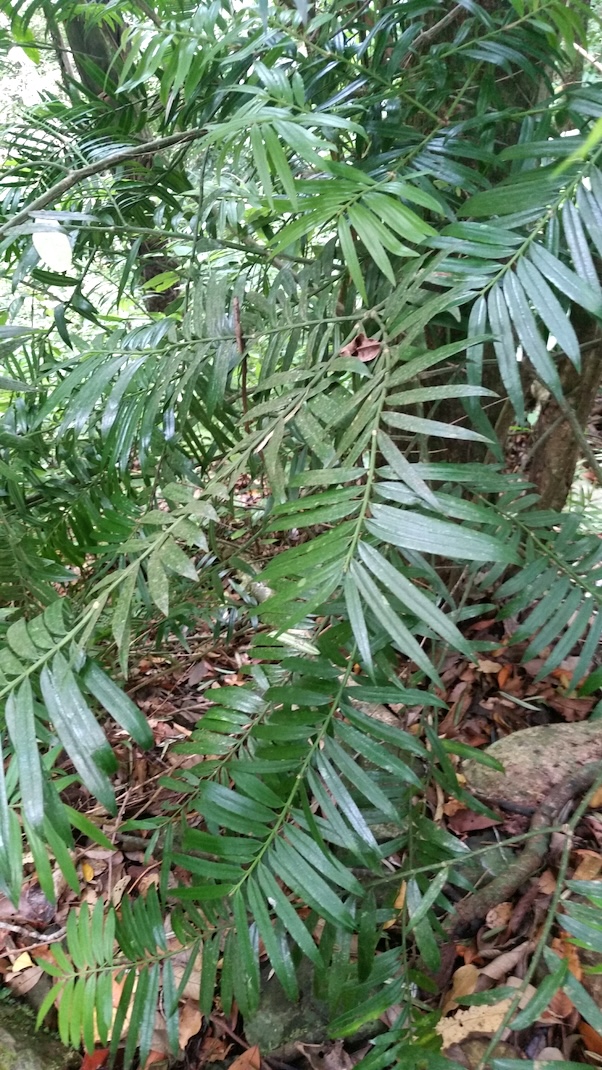
Tree in habitat, Vietnam. iNaturalist observation 24656576; see the observation for additional photos [Eugene Popov, 2019.05].

Tree in habitat, Vietnam. iNaturalist observation 24656576; see the observation for additional photos [Eugene Popov, 2019.05].
Conservation Status

Amentotaxus poilanei
None are known. The scientific name translates as "Poilane's catkin-yew".
Syn.: Amentotaxus yunnanensis var. poilanei Ferré et Rouane 1978 (Farjon 1998).
Trees to 20 m tall and 100 cm dbh with a crown of spreading or ascending branches. Bark smooth, brown, becoming scaly on large stems, exfoliating in flakes. Foliage-bearing twigs opposite, spreading at 25-60° from the shoot axis, ascending or spreading, angular in cross-section, with twisted grooves running from one leaf base to the next; green in the first year, turning yellowish brown in following years; terminal foliar bud ovoid with with ovate-triangular, acute, keeled scales. Leaves spreading distichously at 50-70° from shoot axis, elliptical, oblanceolate or linear, (3-)5-8(-9) cm long, (4.3-)5-8.5 mm wide, straight to falcate, short petiolate, narrowing at base, tapering to a long acute or obtuse apex, dark green, with two abaxial (lower) white or cream-colored stomatal bands bordered by green leaf margins and a midrib on the lower surface; margins revolute. Leaf texture coriaceous, with sclereids causing a mottled, rugose upper surface. Midrib prominently raised on the adaxial (upper) side, lying in a shallow groove 0.5 mm wide, continuous to apex, raised near base and 1-1.8 mm wide on the abaxial side. Pollen cone racemes depend from large axillary or subterminal buds with 3-4 racemes together, rarely solitary, 2.5-4.5 cm long, each with 8-12 cone pairs when full-grown, cones subglobose or ovoid, 3-4 mm long; microsporophylls 8-11, peltate, each with (3-)4-6-8) pollen sacs. Seed-bearing structures near ends of foliage shoots, axillary, solitary on a slender, downcurved, 1-2 cm long peduncle, with ca. 8 decussate, keeled bracts enclosing a single, terminal ovule; only known in immature stage (Farjon 2010).
Viet Nam: only known from Kon Tum Province in Ngoc Linh Nature Reserve; also reported from two other areas but not yet confirmed. This species is facing a high risk of extinction in the wild due to habitat loss (Hiep 2004). It grows as a dominant tree in high montane closed evergreen rainforest, at an elevation of about 2300 m. It is locally common but scattered, mixed with broad-leaved (angiosperm) trees and perhaps Nageia wallichiana as the only other conifer. Annual rainfall is at least 3000 mm, perhaps more, and temperatures are cool due to almost continuous cloud cover (Farjon 2010).
Distribution data from GBIF (2022). A. poilanei is yellow.
No data as of 2026-04-02.
No data as of 2026-04-02.
No data as of 2026-04-02.
The epithet honors Eugene Poilane (1888-1964), who collected the type specimens.
Ferguson, D. K. 1989. Bulletin du Museum National d'Histoire Naturelle. Section B, Adansonia: Botanique Phytochemie 11(3):316.
Hiep, N. T. 2004. Amentotaxus poilanei. In: IUCN 2010. IUCN Red List of Threatened Species. Version 2010.3. https://www.iucnredlist.org/details/34416/0, accessed 2010.10.19, now defunct.
The species account at Threatened Conifers of the World.
Luu and Thomas 2004 provide a description, range map, conservation status, drawings and photos, and a wealth of additional information.
Back | Home | Contact us
Copyright 2026 The Gymnosperm Database
Edited by Christopher J. Earle
This page accessed on Sunday, April 26, 2026
Last Modified 2026-04-02
 Back to top