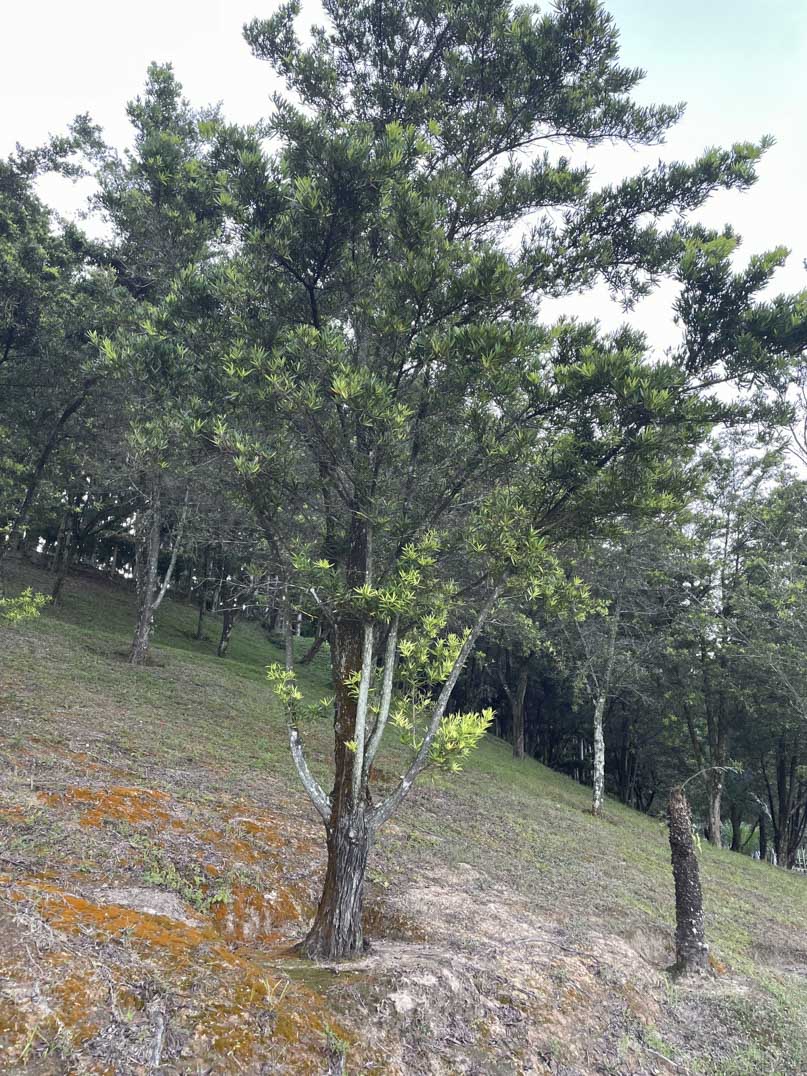
A cultivated plant in Malaysia. iNaturalist observation 164785798 [hfyzirfan, 2023.05].

Foliage and active pollen cones on a cultivated plant in Singapore. iNaturalist observation 35231890 [budak, 2019.11].

A cultivated plant in Malaysia. iNaturalist observation 164785798 [hfyzirfan, 2023.05].
Foliage and active pollen cones on a cultivated plant in Singapore. iNaturalist observation 35231890 [budak, 2019.11].
Conservation Status

Podocarpus polystachyus
In Malaya, it is called jati bukit [Selangor] or kayu karamat [Lingga]. On Borneo, in W Kalimantan it is called mayu serai in Bt. Besar, or tentada in Matan; in Sarawak it is landin [Bintulu], in Brunei it is anggeriting, and in Sabah it is kandabang in Bajau I'tan, kayu china in the Sibuboh Forest Reserve, and saumah in Manadahan. In New Guinea (Vogelkop) it is arbudjin [Maibrat], or rabudien around Lake Ajamaru (de Laubenfels 1988).
Type: Singapore, N. Wallich 6052B (lecto K-W). Syn. Nageia thevetiaefolia (Zipp. ex Blume) Kuntze 1891, but see also Podocarpus thevetiifolius, which Farjon (2010) and others have placed into synonymy with P. polystachyus.
"Tree 1-20 m tall, 3-45 cm diam., most commonly c. 6 m. Foliage buds 1.5-3 mm long. Juvenile leaves generally within the upper range of adult leaf size, linear to linear-lanceolate, acute and almost apiculate, sometimes mixed with more typical adult leaves. Adult leaves linear to oval, 3-10 cm by 6-13 mm, more or less acute to rounded at the apex, narrowed abruptly at the base to a 1-3 mm peduncle, margin flat or nearly so; midrib above a sharp ridge 0.3-0.4 mm wide and 0.2 mm high. Buds for pollen cones sessile. Pollen cones 2-4 cm long, clustered in groups of up to at least five. Seed-bearing structure on a 1-6 mm peduncle; foliola 1-1.5 mm long, falling; receptacle 7-10 mm long. Seed with its covering 7-9 by 5-7 mm" (de Laubenfels 1988).
Brunei; Indonesia (Kalimantan, Maluku, Sumatera, Papua); Malaysia (Sarawak, Peninsular Malaysia, Sabah); Papua New Guinea; Philippines; Singapore; Thailand. Based on data from 29 collection localities, it grows at elevations of 340 ±640 m. Within its range, mean annual temperature is 25°C, with an average minimum in the coldest month of 21°C (the warmest recorded for a species of Podocarpaceae), and a mean annual precipitation of 2730 mm (Biffin et al. 2011, Table S5).
"The main occurrences are at low altitudes and fall apart for the major part into three ecologies. First, the principal habitat is sandy beaches, often gregariously bordering the sea at hightide mark and sandy coastal bluffs and low outcrops, also mentioned for sandy ridges in the mangrove. On coastal granite and limestone rocks the trees are gnarled. Second, it is often frequent on lowland coastal kerangas and sandy 'pandangs' (degraded heath forest) and sandy heath forest (Menchali For. Res., Pahang). These two habitats are typical in the Sunda Land. Third, on limestone hills inland, for instance in Malaya and the Philippines, in Obi, Waigeu, and the Vogelkop Peninsula in New Guinea at 180, 280 and 550 m, at 1000 m in Palawan. In East Malesia these occurrences are scattered" (de Laubenfels 1988).
"The bole is sometimes recorded to be fluted. The tree is found in Obi exceptionally tall, 40 m, with a clear bole of 25 m and 38 cm diam., and buttresses of 1 by 1.5 m" (de Laubenfels 1988).
"Often cultivated (e.g. in Medan in gardens and parks) and remarkably similar to the also widely cultivated P. macrophyllus whose native range and ecology nevertheless is quite distinct" (de Laubenfels 1988).
No data as of 2026-01-29.
No data as of 2026-01-29.
Endlicher, S. L. 1847. Synopsis Coniferarum. Scheitlin und Zollikofer, Sangalli (Sankt Gallen), p.215. Available: Biodiversity Heritage Library, accessed 2022.12.26.
The species account at Threatened Conifers of the World.
de Laubenfels, David J. 1978. The taxonomy of the Philippine Coniferae and Taxaceae. Kalikasan 7:142.
Foxworthy, F. W. 1911. Philippine gymnosperms. Philippine Journal of Science, C. Botany 6(3):149-177 (p. 161). Available: Biodiversity Heritage Library, accessed 2026.01.19.
Gaussen (1976), p. 191.
Gray, Netta E. 1958. A Taxonomic Revision of Podocarpus, XI. The South Pacific Species of Section Podocarpus, Subsection B. Journal of the Arnold Arboretum 39:469. Available: Biodiversity Heritage Library, accessed 2023.01.08.
Henkel, J. B. and W. C. Hochstetter. 1865. Synopsis der Nadelhöser... xvii, 1. Available: Biodiversity Heritage Library, accessed 2023.03.04.
Keng. 1972. In Whitmore, T.C. 1973. Tree Flora of Malaya 1:49, f. 3.
Merrill. 1908. Philippine Journal of Science 3 Botany, p. 394.
Miquel. 1859. Fl. Ind. Bat. 2:1072.
Parlatore (1867), p. 515.
Pilger, Robert Knud Friedrich. 1903. Taxaceae. Das Pflanzenreich: regni vegetablilis conspectus, v. 18 p. 79. Berlin. Available: Biodiversity Heritage Library, accessed 2026.01.20.
Ridley (1925), p. 228.
Warburg (1900), p. 192.
Wasscher. 1941. Blumea 4:456.
Back | Home | Contact us
Copyright 2026 The Gymnosperm Database
Edited by Christopher J. Earle
This page accessed on Sunday, April 26, 2026
Last Modified 2026-01-29
 Back to top