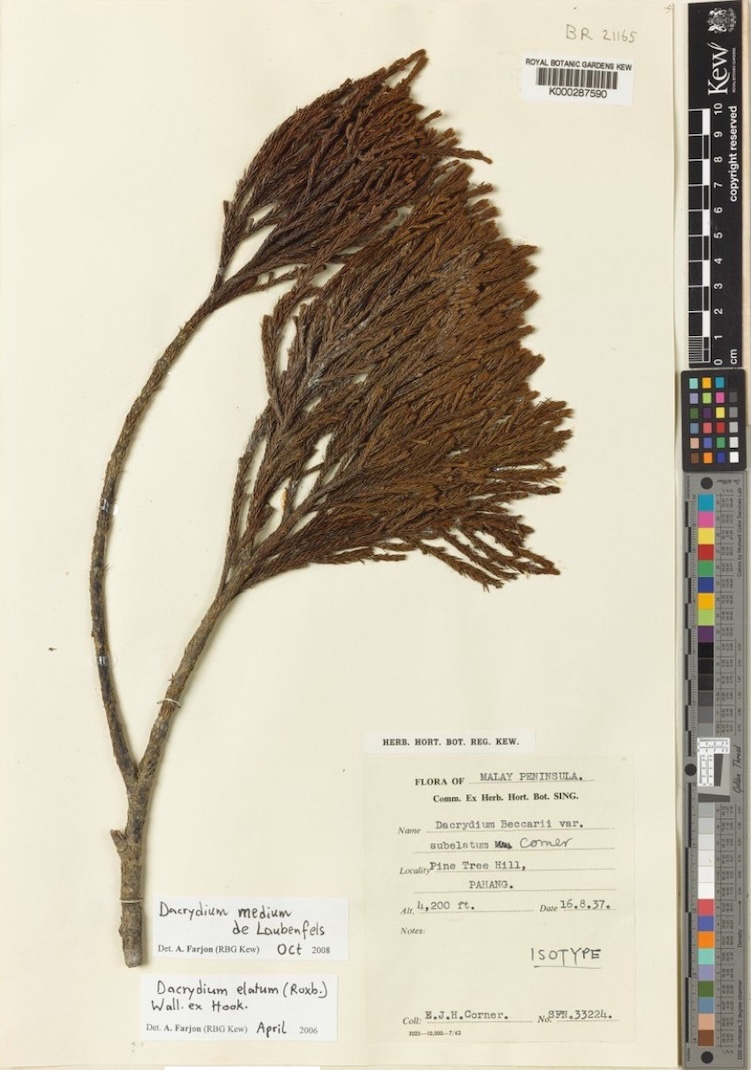
Image of the isotype, K000287590.

Conservation Status

Dacrydium medium
Sangu [Gajo language] (de Laubenfels 1988).
Type: Malaysia, Pahang, Gunung Tahan, 1973.08.04, male tree 4 m tall, D. J. de Laubenfels P 540 (holotype L1189035, isotype K000287590). Syn. Corneria media (de Laub.) A.V.Bobrov & Melikyan. Phylogenetic placement within Dacrydium has not been investigated.
Shrub, or trees up to 20 m tall but typically small, often gnarled. Crown densely branched, compact, oval. Juvenile leaves spreading widely but sometimes distinctly curved forward so that the apiculate apex is more or less parallel to the branch, lanceolate, up to 20 mm long, strongly keeled on three sides, nearly flat on the adaxial surface, up to 0.6 mm wide, 0.3 mm thick. Adult leaves on younger trees nearly straight and up to 8 mm long but with greater age the leaves become shorter and sharply curved forward or even slightly inward, apiculate, linear-lanceolate, 3-6 mm long but nearly uniform on a branch, 0.5-0.6 mm wide, 0.3 mm thick. Pollen cones mostly terminal, basal leaves hardly different from foliage leaves, 7-9 × 2.5 mm. Apex of the microsporophyll a linear-lanceolate spur 1.5-2 × 0.5 mm with the broadly acute apex strongly curved inwards so as to appear rounded and blunt. Seed-bearing structure subtended by a zone of reduced leaves 2 mm long, the cone bracts longer and partly covering the seed. The brown seeds 5 mm long (de Laubenfels 1988).
The most distinguishing characteristic is the greatly elongated pollen cone scales with a linear tip as much as 2 mm long and 0.5 mm wide beyond the pollen sacs. The apex of this elongated tip is sharply incurved making the tip appear rounded and blunt. Other related species have pollen cone scales which are triangular and acute. The seed cone is dark red. Compared to D. beccarii the leaves of D. medium are much more robust and generally shorter. The short fertile shoots are only slightly modified from the foliage branches, unlike the strong contrast characteristic of D. beccarii (de Laubenfels 1976). "The shortest leaved specimens resemble D. pectinatum foliage, a species which grows under similar conditions at lower elevations" (de Laubenfels 1988).
Indonesia (Gajo Lands, Sumatra) and Malaysia (Gunung Tahan area). Rising above and often dominant in low mountain scrub on rather poor soils at 960-2100 m elevation in Malaya and 1800-2600 m in Sumatra; may be associated with Baeckea and Leptospermum (de Laubenfels 1988). Locally (Sumatra) it occurs above the tree line as a shrub in alpine scrub (Enright and Jaffré 2011).
Distribution data for all species, from GBIF Occurrence Download https://doi.org/10.15468/dl.yvmru2 accessed 2025.12.08. D. medium color is red. Click on any point for more info.
In 2010 the IUCN assessed the conservation status of this species as "Vulnerable" because it is known from fewer than ten highly scattered locations, seven in Peninsular Malaysia and two in northern Sumatera. The area of occupancy is estimated to be less than 2,000 km2. Two of its locations are threatened with development for tourism, and more generally the species is at risk from altered fire regimes.
No data as of 2026-01-10.
No data as of 2026-01-10.
No data as of 2026-01-10.
The epithet means "middle"; de Laubenfels (1976) says "In general appearance this new species is very average for the genus, hence the specific name."
de Laubenfels, David J. 1976. The genus Dacrydium in Malaya (Gymnospermae). Blumea 23:97-98.
de Laubenfels, David J. 1988. Coniferales. P. 337-453 in Flora Malesiana, Series I, Vol. 10. Dordrecht: Kluwer Academic. Available: Biodiversity Heritage Library, accessed 2025.12.11.
Enright, N. J., and T. Jaffré. 2011. Ecology and distribution of the Malesian podocarps. Pp. 57-77 in B. L. Turner and L. A. Cernusak (eds.), Ecology of the Podocarpaceae in Tropical Forests. Smithsonian Contributions to Botany no. 95. Smithsonian Institution, Washington, DC.
The species account at Threatened Conifers of the World.
Back | Home | Contact us
Copyright 2026 The Gymnosperm Database
Edited by Christopher J. Earle
This page accessed on Sunday, April 26, 2026
Last Modified 2026-01-10
 Back to top