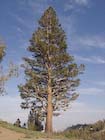
Forest of Sierra lodgepole over evergreen oak scrub on Mt. San Gorgonio, California [C. J. Earle, 2019.05.22].
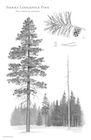
Forest, tree, foliage and cone. Drawing by Matt Strieby, 2018.
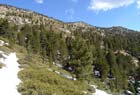
A solitary Sierra lodgepole on Mt. San Antonio, with Mt. San Gorgonio in the distance [C. J. Earle, 2019.05.24].
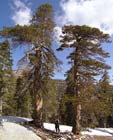
A pair of old trees on Mt. San Jacinto, California [C. J. Earle, 2004.04.10].
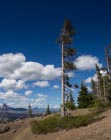
A skirted tree near McKenzie Pass, Oregon. This growth form indicates exposure to severe windblown ice and snow in the winter, with the lower part of the tree shielded within the snowpack [C. J. Earle, 2016.07.02].
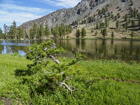
A small tree by a subalpine lake on Mt. Eddy, California [C. J. Earle, 2023.07.23].
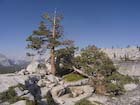
Small trees of P. contorta ssp. murrayana and Juniperus grandis at Olmstead Point, California [C. J. Earle, 2008.06.30].
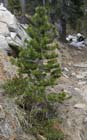
Sapling above Wellman Cienega on Mt. San Jacinto, California [C. J. Earle, 2004.04.10].
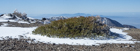
A krummholz plant above treeline on Mt. San Antonio. Brown foliage indicates desiccation and needle death due to ablationg of needle cuticle by windblown ice crystals [C. J. Earle, 2019.05.24].
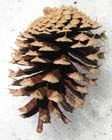
Cone about 6 cm long on Mt. San Jacinto, California [C. J. Earle, 2004.04.10].
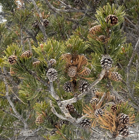
Multiple years of cones on a tree on Mt. San Gorgonio, California. Note that none of these cones are serotinous [C. J. Earle, 2004.04.10].
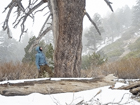
An exceptionally large tree on Mt. San Gorgonio, California [C. J. Earle, 2019.05.22].

Conservation Status

Pinus contorta subsp. murrayana
(Balf.) Engelm. (1880)
Common names
Sierra lodgepole pine, tamarack pine, tamrac pine.
Taxonomic notes
Syn: Pinus murrayana Balf.; P. contorta var. murrayana (Balf.) Engelm.; P. bourcieri Carrière; P. tamrac A.Murray (Critchfield 1957).
Description
Trees to 41 m tall and 200 cm dbh, straight, little tapering; crown mostly conic at maturity. Bark scaly, not evidently furrowed, orange- to purple-brown. Branches spreading, ascending at tips. Leaves 5–8 cm × 1–2 mm, yellow-green, apex acute. Seed cones maturing in 14–18 months, shedding seeds and falling soon thereafter, 3–6 cm long, nearly symmetric, buff-brown (unlike the darker orange-brown of the other ssp.), mostly spreading, rarely in whorls, more often paired or solitary, scales thin, flexible; mid and lower apophyses mostly shallowly domed; umbo with a slender, fragile 2–4 mm spine (Kral 1993, M. P. Frankis e-mail 1999.02.28).
Burns and Honkala (1990) state that compared to the other subspecies, murrayana has wider needles, substantially larger seeds, flatter apophyses, little or no serotiny, and seedlings with more cotyledons; while Kral (1993) says that subsp. latifolia has asymmetric, recurved, long-persistent seed cones with mid and lower apophyses mostly much domed, while subsp. murrayana has nearly symmetric, non-persistent seed cones with mid and lower apophyses mostly shallowly domed.
Distribution and Ecology
USA: Oregon (Cascade Range), California (Cascade, Klamath, Sierra Nevada, Transverse Ranges, and Peninsular Ranges); Nevada (Basin and Range, several ranges near the California border); Mexico: Baja California Norte (the Sierra San Pedro Martír) (Kral 1993, Charlet 1995, Minnich 1987). I suspect that reports of subsp. murrayana located far outside its core range (i.e., in northern Oregon and southern Washington) simply correspond to herbarium sheets that represent slightly anomalous specimens of subsp. latifolia. The occurrence in Baja California is noteworthy because it is disjunct from the nearest other population, 270 km to the north in the San Jacinto Mountains. It occurs mostly in the Vallecitos and La Tasajera basins at 2300-2400 m elevation, which endure cold air inversions in the winters; lodgepole typically appears as the dominant tree at edges of meadows.
Distribution of P. banksiana (blue) and P. contorta (color coded by subspecies and variety), based on data downloaded from GBIF: 2021.02.27, DOI: https://doi.org/10.15468/dl.yszq86 (banksiana) and 2021.02.27, DOI: https://doi.org/10.15468/dl.au4a94 (contorta) and 2025.02.07, DOI: https://doi.org/10.15468/dl.3yqdgt (var. yukonensis). The boundaries are gradational; for instance, subsp. latifolia is found on fire-prone sites within the mapped distribution of subsp. contorta, e.g. at Deer Park in the northeastern Olympic Mountains; subsp. contorta occurs at some fire-resistant sites (such as bogs) east of the Cascade crest; and the boundary between these and subsp. murrayana is gradational.
Subsp. murrayana differs from the other subspecies of Pinus contorta primarily in its distribution and ecological associations. It grows in montane to subalpine forests at 400–3500 m elevation, with the lowest elevations at relatively northerly latitudes and in areas with strong cold-air drainage into mountain valleys; and the highest elevations at timberline near the southern limits of distribution (Critchfield 1957, Millar and Rundel 2016, Wheeler and Guries 1982). It is adapted to tolerate relatively frequent, low to moderate intensity fire (Burns and Honkala 1990). Common associates include Pinus ponderosa, P. jeffreyi, P. lambertiana, P. monticola, Abies concolor, A. magnifica, Calocedrus decurrens and Pseudotsuga menziesii in the mixed conifer forest, and in the subalpine forest, P. albicaulis, P. balfouriana subsp. austrina, P. flexilis, P. monticola, Tsuga mertensiana, and Juniperus grandis (North et al. 2016, Millar and Rundel 2016). As described by Millar (2016), the "low stature and open stand structure of lodgepole pine subalpine forests are a function of the short growing season, associated severe climate conditions, and the thin, nutrient-poor soils that characterize the subalpine zone. These stands commonly contain few understory shrubs and little litter accumulation."
The fire ecology of subsp. murrayana is highly variable with site. The longest fire return intervals are found in mixed conifer forests of the subalpine zone, where intervals exceed 100 years. Drier forests have shorter return intervals and the shortest intervals, on the order of 33 years, occur in lodgepole-dominated stands (Millar and Rundel 2016).
One of the principal pests is a needle miner moth, Coleotechnites milleri, which primarily attacks P. contorta subsp. murrayana in the Sierra Nevada (although in the course of an irruption, other conifers may also be attacked). It has a limited distribution, mainly within Yosemite National Park and adjacent Sierra National Forest. Major irruptions can completely defoliate trees across thousands of hectares, and if repeated in sequential years, defoliation can cause mortality either directly, or by reducing the trees' resistance to a much more widespread pest, the bark beetle Dendroctonus ponderosae (Koerber and Struble 1971).
Remarkable Specimens
This subspecies attains much larger sizes and much greater ages than any other taxa of P. contorta. Currently, the largest is a specimen in San Bernardino, California, measured in 2019 at 204 cm dbh and 41.4 m tall (American Forests 2021; includes photos). Former champions included one 196 cm dbh and 32 m tall, and another 185 cm dbh and 36 m tall, both located in Stanislaus National Forest, California (American Forests 1996).
The oldest recorded specimen is 628 years, crossdated, for sample UT 5G 48 collected by Tony Caprio, Gus Smith, and Peter Brown in Yosemite National Park, California (Brown 2025). There is also another tree-ring chronology covering 471 years, collected in 1984 in Yosemite Park, California (3000 m elev.; 37° 48'N, 119° 15' W) by K. Briffa and F. H. Schweingruber (NOAA 1999).
Ethnobotany
See Pinus contorta regarding aboriginal and traditional ethnobotany, which generally included practices affecting multiple subspecies.
In the modern world, there is little commercial or ornamental use of subsp. murrayana. In the Sierra, lodgepole pine forest has been described as "one of the least altered Sierra Nevada ecosystems" (Helms and Tappeiner 1996) and other conifers offer more productive silvicultural prospects. I can find no record of an ornamental cultivar based on subsp. murrayana.
Observations
This is a reasonably common and distinctive tree throughout its range. The most memorable stands that I have seen are probably those on the southern approaches to the summit of Mt. San Jacinto, where trees of exceptional size and age can be found. Some of the most pleasingly contorted specimens I have seen are in the vicinity of Olmstead Point in Yosemite National Park, with more fine trees found scattered on the open granite throughout the Yosemite backcountry. At the appropriate elevations it is also easily seen along the Sonora Pass road and along the Generals Highway in Sequoia-Kings Canyon National Parks.
Remarks
The epithet murrayana honors Andrew Murray (1853), who led the Botanical Expedition to Oregon, an enterprise funded by a group of Scottish horticulturalists. Murray did not name the species after himself; the plant was collected by botanist John Jeffrey, and the name was given by John H. Balfour, professor of botany at the University of Edinburgh, who prepared the description. At the same time Balfour also honored Jeffrey with Pinus jeffreyi, while Balfour himself is remembered in Pinus balfouriana, so Murray's expedition was a good deal for all botanists involved.
Citations
American Forests 1996. The 1996–1997 National Register of Big Trees. Washington, DC: American Forests.
Brown, Peter. 2025. OLDLIST, a database of old trees. https://www.rmtrr.org/oldlist.htm, accessed 2025.03.01.
Charlet, David A. 1995. Atlas of Nevada Conifers. Reno: University of Nevada Press. 320 pp.
Critchfield, W. B. 1957. Geographic variation in Pinus contorta. Maria Moors Cabot Foundation (Harvard) Publ. 3.
Engelmann, G. E. 1880. Revision of the genus Pinus, and description of Pinus elliottii. Transactions of the Academy of Science of Saint Louis 4:161–190 (p. 177, 181). Available from Google Books, accessed 2011.05.20).
Helms, J. A. and J. C. Tappeiner. Silviculture in the Sierra. Pp. 439-476 in Sierra Nevada Ecosystem Project: Final report to Congress, vol. II, Assessments and scientific basis for management options. Davis: University of California Centers for Water and Wildland Resources.
Koerber, T. W. and G. R. Struble. 1971. Lodgepole needle miner. USDA Forest Service Forest Pest Leaflet 22. https://www.fs.usda.gov/foresthealth/docs/fidls/FIDL-22-LodgepoleNeedleMiner.pdf, accessed 2025.11.29.
Kral, R. 1993. Pinus. Flora of North America Editorial Committee (eds.): Flora of North America North of Mexico, Vol. 2. Oxford University Press.
Millar, C. I. and P. W. Rundel. 2016. Montane forests. Pp. 553-577 in Mooney, H., E. Zavaleta and M. C. Chapin (eds.), Ecosystems of California. Berkeley: University of California Press.
Minnich, R. A. 1987. The distribution of forest trees in northern Baja California, Mexico. Madroño 34:98–127.
Murray, Andrew. 1853. Botanical Expedition to Oregon, v. 8, t. 2.
NOAA Paleoclimatology Program Tree-Ring Data Search Page. http://julius.ngdc.noaa.gov/paleo/ftp-treering.html, accessed 1999.02.24, now defunct.
North, M., B. Collins, H. Safford and N. L. Stephenson. 2016. Subalpine forests. Pp. 579-611 in Mooney, H., E. Zavaleta and M. C. Chapin (eds.), Ecosystems of California. Berkeley: University of California Press.
Wheeler, N. C. and R. P. Guries. 1982. Population structure, genic diversity, and morphological variation in Pinus contorta Dougl. Canadian Journal of Forest Research 12: 595–606.
See also
Arno, Stephen F. and Jane Gyer. 1973. Discovering Sierra trees. Yosemite Natural History Association. 89pp.
Farjon and Styles (1997).
FEIS database.
Hickman, James C. (ed.). 1993. The Jepson Manual. Berkeley, CA: University of California Press.
Lanner (1999).
Millar, C. I., J. C. King, R. D. Westfall, H. A. Alden, and D. L. Delany. 2006. Late Holocene forest dynamics, volcanism, and climate change at Whitewing Mountain and San Joaquin Ridge, Mono County, Sierra Nevada, CA, USA. Quaternary Research 66:273–287.
Millar, C. I., R. D. Westfall, D. L. Delany, J. C. King, and L. J. Graumlich. 2004. Response of subalpine conifers in the Sierra Nevada, California, U.S.A., to 20th-century warming and decadal climate variability. Arctic, Antarctic, and Alpine Research 36:181–200.
North, M. P., K. M. Van de Water, S. L. Stephens, and B. M. Callins. 2009. Climate, rain shadow, and human-use influence on fire regimes in the eastern Sierra Nevada, California, USA. Fire Ecology 5:20–34.


 Back to top