Conservation Status

Pinus contorta subsp. latifolia
(Engelm.) Critchf. (1957)
Common names
Lodgepole, black, spruce, prickly, jack or tamrac pine.
Taxonomic notes
Synonymy: see POWO. Subsp. latifolia hybridizes with P. banksiana in parts of W Alberta and in NE British Columbia; the fertile hybrid is Pinus × murraybanksiana Righter & Stockw. Wood (2006) found hybrids to be common in the area around Fort Nelson, BC. The hybrids all showed P. contorta maternity and P. banksiana paternity, with physical differences in characters including needle width/length, cone angle of attachment, cone curvature, and cone length. More geographically extensive sampling of the hybrid zone showed that P. contorta and the hybrids grow at consistently higher elevations than the P. banksiana parents (Rweyongeza et al. 2007). Plastid markers in the populations indicate the area was first colonized by P. contorta from a glacial-epoch population west of the Rocky Mountains, and then supplanted by P. banksiana migrating westward during the Holocene (Godbout et al. 2012). For more on this hybrid zone, see Krajina et al. (1982) and Cullingham et al. (2013). There is also genetic evidence that subsp. latifolia is separable into two populations, a southern one in the Rocky Mountains S of the Pleistocene ice, and a northern one (including the hybrid populations) that survived in ice-free areas N of the main ice front (Wheeler and Guries 1982b, Wheeler and Critchfield 1985).
Description
Monoecious evergreen trees to 41 m tall and 80 cm dbh, mostly straight and evenly tapering, or near timberline reduced to shrub form by windblown ice; crown usually conic to columnar at maturity, crown depth as low as 10-20% in closed-canopy stands. Bark thin, gray- to red-brown, not evidently furrowed, with age separating into loose plates that exfoliate. Branches mostly horizontally spreading, not ascending at tip. Leaves (4–)5–8 cm × 1.4–2.5(–3) mm, yellow-green, apex narrowly acute to short-acuminate. Seed cones produced regularly from an early age, maturing in 16–18 months, then shedding seeds or (often) serotinous, long-persistent, strongly asymmetric, mostly recurved, seldom whorled, mostly in twos or solitary, (2–)2.5–5(–5.5) cm long, orange-brown, mid and lower apophyses mostly much domed. Seeds small and germinate readily without pretreatment; seedlings have few cotyledons (Critchfield 1957, Lotan and Critchfield 1990, Kral 1993). Trees in Yukon have a high frequency of three-needled fascicles, and stands in southern interior British Columbia and adjacent United States may have some traits typical of subsp. contorta: thick bark, repeated stem forking, and a low incidence of serotinous cones (Lotan and Critchfield 1990).
Distribution and Ecology
Rocky Mountains and various Intermountain ranges, including: USA: Alaska (marginally), E Washington, NE Oregon, Idaho, Montana, South Dakota, Colorado, Utah; Canada: Yukon, SW Northwest Territories, British Columbia, Alberta, Saskatchewan. Found in montane and subalpine forests, often at upper or lower treeline, at elevations of 100–3500 m (Kral 1993). The subspecies reaches its easternmost limits in the Black Hills of South Dakota (Rogers 1969).
Distribution of P. banksiana (blue) and P. contorta (color coded by subspecies and variety), based on data downloaded from GBIF: 2021.02.27, DOI: https://doi.org/10.15468/dl.yszq86 (banksiana) and 2021.02.27, DOI: https://doi.org/10.15468/dl.au4a94 (contorta) and 2025.02.07, DOI: https://doi.org/10.15468/dl.3yqdgt (var. yukonensis). The boundaries are gradational; for instance, subsp. latifolia is found on fire-prone sites within the mapped distribution of subsp. contorta, e.g. at Deer Park in the northeastern Olympic Mountains; subsp. contorta occurs at some fire-resistant sites (such as bogs) east of the Cascade crest; and the boundary between these and subsp. murrayana is gradational.
Despite its vast range, this subspecies has a fairly consistent ecological role. On productive sites it is generally not competitive with other western conifers that share its range; these include, primarily, Pinus albcaulis, Pinus flexilis, Abies lasiocarpa and Picea engelmannii in subalpine areas; Abies concolor, Abies grandis, Picea engelmannii, and Pseudotsuga menziesii subsp. glauca in montane environments; and Picea pungens, Pinus ponderosa, and Juniperus scopulorum near the lower treeline. Less commonly, lodgepole occurs with a wide variety of other trees, both conifers and angiosperms. Lodgepole will often appear as an early seral species in a stand that is later dominated by these other species. However, lodgepole will typically prevail over these other species on sites with exceptionally poor soils, exceptionally stressful climate, or exceptionally severe/frequent fire (Anderson 2003).
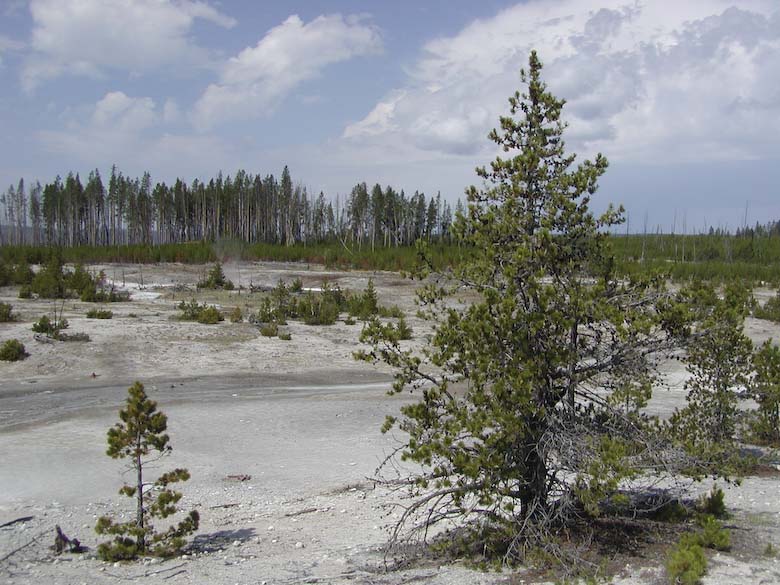
The array of poor soil conditions that lodgepole pine can tolerate includes nutrient-poor lithic soils; nutrient-poor, saturated and highly acidic bog soils; and nutrient-poor high-temperature soils in the geyser basins of Yellowstone (photos at right).
As far as poor climate is concerned, this is one of the few conifers that can tolerate temperatures lower than -40°C, although such low temperatures can cause damage such as frost cankers (Zalasky 1975). Lodgepole is a common species at the alpine timberline and compared to other highly cold-tolerant species is generally more drought-tolerant, inhabiting sites with as little as 250 mm annual precipitation. Seedlings, as with most plants, are less tolerant of climate extremes but still show greater cold tolerance than most conifer seedlings (Lotan and Critchfield 1990).
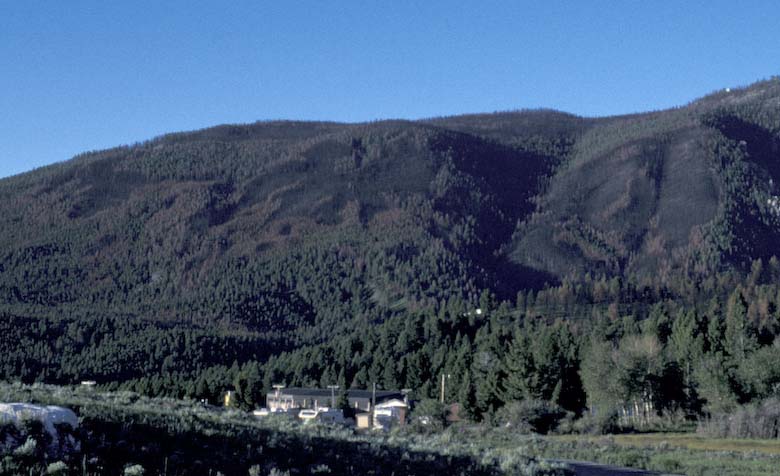
Overall, though, in most of its range lodgepole occupies decent soils and avoids the most severe climates. Its primary means of achieving dominance over other conifers is through life history traits that contribute to a high probability of high-severity fire. The species forms dense stands of even-aged timber that tend to burn in their entirety when ignited (photo at right), particularly if a large fraction of the stand has recently been killed by an insect infestation such as that caused by mountain pine beetle (Dendroctonus ponderosae). Rate of fire spread and fire intensity are both signficantly higher in stands undergoing beetle epidemics, although the correlation drops rapidly in post-epidemic stands as snags decay and fall. Lodgepole also has serotinous cones that open and spread seed in response to the heat generated by fire, allowing the species to re-establish before its competitors. Generally a certain fraction of the cones are also non-serotinous, enabling rapid regeneration after a catastrophic disturbance other than fire; the most common example is a bark beetle epidemic. Although fire adaptions are common among conifers, no other conifer within the distribution of subsp. latifolia is so well adapted to incite and regenerate after frequent, high-severity fire (Anderson 2003, Jenkins 2011, Vacek et al. 2022).
Subsp. latifolia is subject to a wide variety of pests and pathogens. Those having effects on two or more subspecies of lodgepole are discussed on the Pinus contorta page, but the following primarily afflict subsp. latifolia:
- Comandra blister rust, Cronartium comandrae, has caused widespread damage to lodgepole pine in the Rocky Mountains. It affects more than 30 species of hard pines and is found throughout much of North America. It causes growth reduction, stem deformities, and mortality. Pines of all ages and sizes are attacked; seedlings usually die within a few years, but mature trees may survive decades before finally dying when the fungal canker girdles the tree. Outbreaks have been episodic and are usually localized (Johnson 1986).
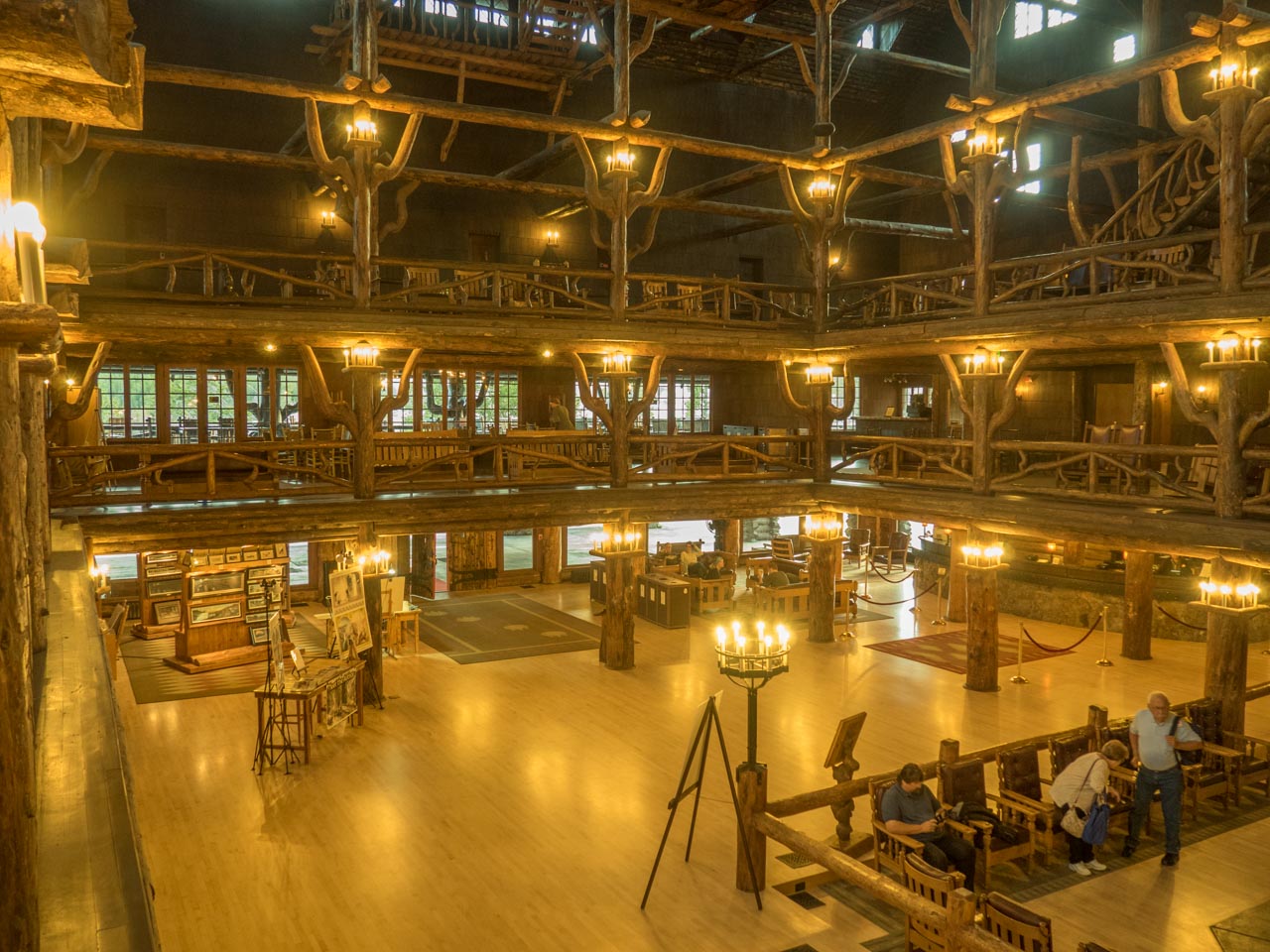
- Western gall rust, Peridermium harknessii, primarily afflicts lodgepole pine in the U.S. Rocky Mountains. It is a native disease that may kill individual trees but rarely has effects at the stand or population level. It forms galls on stems and branches, which can over the years become large enough to encircle the stem, or to become a large burl; it also form cankers that may lead to grooving, twisting and other deformations of the stem (Peterson 1960). Some of the interesting shapes seen in lodgepole pines in the Old Faithful Inn are likely a product of gall rust infections.
Red squirrels (Tamasciurus hudsonicus) and secondarily red crossbills (Loxia curvirostra complex) are major seed predators on lodgepole pine. In a few isolated mountains ranges east of the Rocky Mountain front, though, red squirrels are absent and the pine cones have weak defenses against squirrel predation, but have more effective defenses against red crossbill predation, mainly in the form of larger and thicker cone scales (Benkman et al. 2001).
Climate change effects on subsp. latifolia will be highly varied due to its large ecological amplitude. Effects recorded to date include invasion of wet subalpine meadows by lodgepole seedlings in Wyoming (Moir et al. 1999), dieback due to direct and indirect effects of drought (McKenzie et al. 2008, Anderegg et al. 2015), and bark beetle epidemics that have killed tens of millions of hectares of lodgepole forest throughout most of the range of subsp. latifolia. The bark beetle problem is particularly complex (Bentz et al. 2022). Effects seen to date reflect a combination of factors: timber harvest practices that have established uniform-sized plantations of trees across vast areas, fire suppression during the 20th century, extended droughts that reduce the trees' resistance to beetle attack, reduced incidence of very cold winters that formerly caused high beetle mortality, and resulting beetle range extension into new areas (Axelson et al. 2009, Carroll et al. 2003, Kurz et al. 2008, Macias Fauria and Johnson 2009, Vacek et al. 2022). It is interesting, though, that experimental evidence shows Pinus × murraybanksiana is more drought-resistant than Pinus contorta subsp. latifolia, and thus may prove more resistant to climate change (Bockstette et al. 2021).
Remarkable Specimens
Currently, the largest is a specimen in Grant County, Oregon measured in 2017 at 110 cm dbh and 33.5 m tall (American Forests 2021). A former champion, presumably now dead, was larger: dbh 111 cm, height 41 m, located in Valley County, ID (American Forests 1996). The old tree referred to below was also very tall, 37.2 m, and appears to have been about 100 cm dbh (Enright 2021). Big trees seem to have been about this size for a long time, as Mason (1915) reports the tallest as being a tree on the Deerlodge National Forest in Montana 66 cm dbh and 35 m tall.
There are few data on old trees. Since this is generally a fire-dependent, early-successional species, the vast majority of trees die in fires, typically at ages of less than 100 years. However, the U.S. Forest Service office in Rapid City, South Dakota has on display a cookie from a tree cut in 1972 and ring-counted at 397 years old (Enright 2021). Huckaby and Moir (1995) report one tree, evidently a ring-counted age, of about 325 years, and Mason (1915) reports a "stand age" of "about 450 years" from the Beaverhead National Forest in Montana.
Ethnobotany
See Pinus contorta regarding aboriginal and traditional ethnobotany, which generally included practices affecting multiple subspecies; but as subsp. latifolia is the most widespread subspecies, it was also used by more native tribes.
Lodgepole pine continues to be highly desirable as a source of pole timber, which today is used in construction of rail fences, post-and-beam structures such as barns, and modern log cabins. Modern lumber mills using computer-directed saws are able to produce saw timber from trees as small as 5 cm diameter, using small timbers to build up glue-laminated beams of dimensional sizes.
One social consequence of the fire ecology of this species is that when meteorological conditions suitable for fire prevail in the species' range, the fires tend to be widespread, large, and severe. The U.S. government, as an example, will often spend billions of dollars during a year of fighting such fires with the result that the fires are extinguished when, and not until, the fall rains begin. This self-defeating approach to fire management rose to national prominence in 1988 when several million acres in the vicinity of Yellowstone National Park in Wyoming, Montana and Idaho were burned. The park and most surrounding forests had been subjected to a policy of full fire suppression since at least 1910 and as a result, had reached a condition in which most of the forested area of the park consisted of old lodgepole pine stands that were primed to burn.
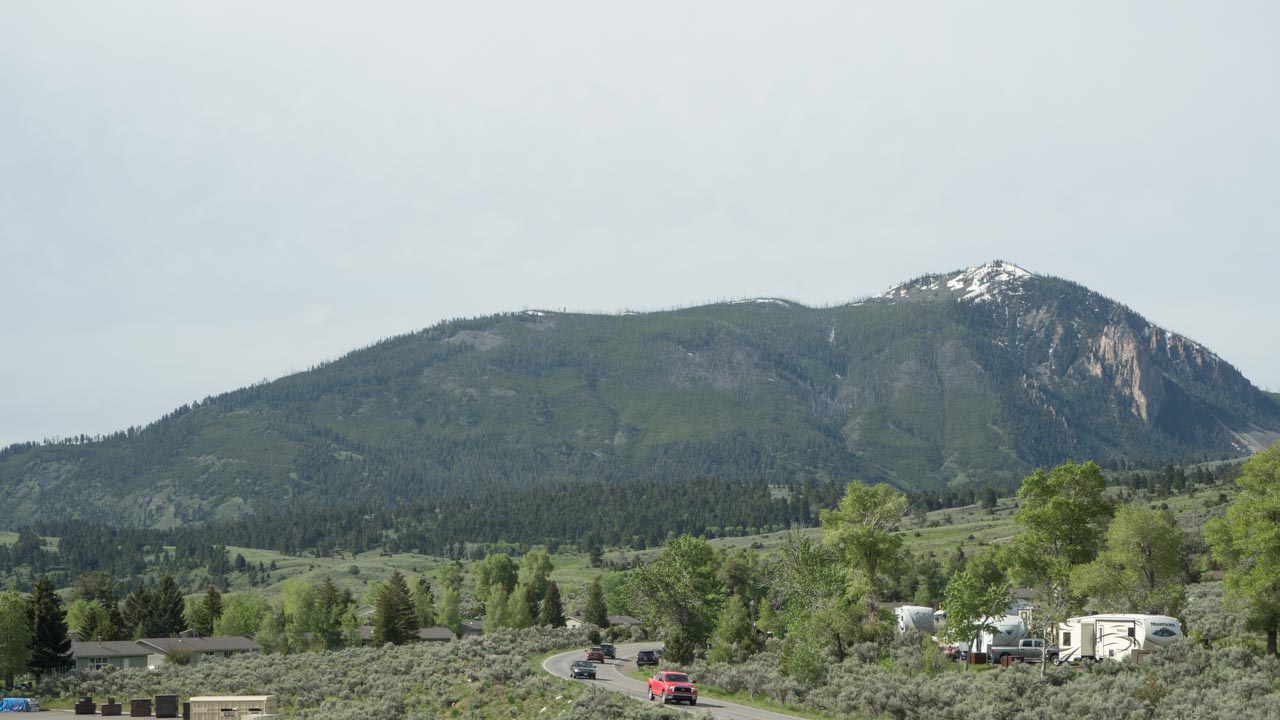
The popular media at the time portrayed the fires as a holocaust, exterminating all life across hundreds of square kilometers. A photo at right, taken in northern Yellowstone the year after the fire, shows the pathology of this huge fire event more clearly. Nearly all trees in the photo are lodgepole pine. The black areas in the photo are areas where a crown fire killed almost all trees and burned most organic matter in the soils. The orange-brown areas are trees that were killed by the heat, but where a crown fire did not develop. Numerous green areas show where trees survived the blaze. Another photo at right shows forest recovery at the same site, 30 years later. Overall, the fires effectively opened up the forest, led to widespread establishment of young forest, and in the meantime produced a patchwork of forest and meadow that has been highly beneficial to the park's wildlife, particularly to the bears, wolves, elk and bison that attract millions of visitors to the park. Despite these ecological benefits, the policy of full fire suppression was affirmed in Yellowstone in the aftermath of the fires, and the Yellowstone event acted to confirm public support of a full fire suppression policy, rather than illustrating the folly of such a policy. In all these respects: the cause of the fires, the attempts to control them, their ecological consequences, and the misguided human response: the Yellowstone fires are perfectly representative of what continues to be a very widespread approach to fire management in the western U.S.
USDA hardiness zone 3-4.
Consuming foliage of lodgepole pine can induce abortions in domestic cattle, largely due to foliar content of isocupressic acid; although, this was shown by giving doses equivalent to 4-5 kg/day dry weight of needles (Gardner et al. 1998).
Lodgepole pine (subspecies not specified, but I suspect latifolia) is one of the most widely-planted timber trees in Iceland (Icelandic Forest Service 2017).
Observations
The subspecies is widely found within its range, often to the exclusion of all other conifers. As seen in the photos on this page, it is on particularly good display in Yellowstone National Park.
Remarks
Lodgepole pine (Pinus contorta var. latifolia) is the provincial tree of Alberta (Kral 1993).
Citations
American Forests 1996. The 1996-1997 National Register of Big Trees. Washington, DC: American Forests.
Anderegg, W. R. L., J. A. Hicke, R. A. Fisher, et al. 2015. Tree mortality from drought, insects, and their interactions in a changing climate. New Phytologist 208:674–683.
Anderson, Michelle D. 2003. Pinus contorta var. latifolia. In: Fire Effects Information System, [Online]. U.S. Department of Agriculture, Forest Service, Rocky Mountain
Research Station, Fire Sciences Laboratory (Producer). Available:
https://www.fs.usda.gov/database/feis/plants/tree/pinconl/all.html, accessed 2025.11.28.
Benkman, C. W., W. C. Holimon, and J. W. Smith. 2001. The influence of a competitor on the geographic mosaic of coevolution between crossbills and lodgepole pine. Evolution 55:282-294.
Bentz, Barbara J., E. Matthew Hansen, Marianne Davenport, and David Soderberg. 2022. Complexities in predicting mountain pine beetle and spruce beetle response to climate change. Pp. 31-54 in Bark Beetle Management, Ecology, and Climate Change. Academic Press.
Bockstette S. W., R. de la Mata, and B. R. Thomas. 2021. Best of both worlds: hybrids of two commercially important pines (Pinus contorta × Pinus banksiana) combine increased growth potential and high drought tolerance. Canadian Journal of Forest Research 51:1410–1418.
Critchfield, W. B. 1957. Geographic variation in Pinus contorta. Maria Moors Cabot Foundation (Harvard) Publ. 3.
Critchfield, W. B. 1980. Genetics of lodgepole pine. Research Paper WO-37. Washington, DC: USDA Forest Service. 57 p.
Cullingham, C. I., J. E. K. Cooke, and D. W. Coltman. 2013. Effects of introgression on the genetic population structure of two ecologically and economically important conifer species: lodgepole pine (Pinus contorta var. latifolia) and jack pine (Pinus banksiana). Genome 56:577–585.
Gardner, D. R., K. E. Panter, L. F. James and B. L. Stegelmeier. 1998. Abortifacient effects of lodgepole pine (Pinus contorta) and common juniper (Juniperus communis) on cattle. Veterinary and Human Toxicology 40(5):260-263.
Godbout, J., F. C. Yeh, and J. Bousquet. 2012. Large‐scale asymmetric introgression of cytoplasmic DNA reveals Holocene range displacement in a North American boreal pine complex. Ecology and Evolution 2:1853–1866.
Huckaby, Laurie Stroh and W. H. Moir. 1995. Fire history of subalpine forests at Fraser Experimental Forest, Colorado. P. 205-210 in: Brown, James K.; Mutch, Robert W.; Spoon, Charles W.; Wakimoto, Ronald H., technical coordinators. Proceedings: symposium on fire in wilderness and park management; 1993 March 30—April 1; Missoula, MT. Gen. Tech. Rep. INT-GTR-320. Ogden, UT: U.S. Department of Agriculture, Forest Service, Intermountain Research Station.
Icelandic Forest Service. 2017. Forestry in a treeless land. http://www.skogur.is/english/forestry-in-a-treeless-land, accessed 2017.11.01, now defunct.
Jenkins, M. J. 2011. Fuel and fire behavior in high-elevation five-needle pines affected by mountain pine beetle. Pp. 190-197 in: Keane, Robert E. et al., eds. 2011. The future of high-elevation, five-needle white pines in Western North America: Proceedings of the High Five Symposium. 28-30 June 2010; Missoula, MT. Fort Collins, CO: USDA
Forest Service, Rocky Mountain Research Station. http://www.fs.fed.us/rm/pubs/rmrs_p063.html, accessed 2023.10.30.
Johnson, D. W. 1986. Comandra Blister Rust. 8 pp. Forest Insect and Disease Leaflet, USDA Forest Service, Washington, DC.
Krajina, V. J., K. Klinka, and J. Worrall. 1982. Distribution and ecological characteristics of trees and shrubs of British Columbia. Vancouver, BC: University of British Columbia, Department of Botany and Faculty of Forestry. 131 p.
Kral, R. 1993. Pinus. Flora of North America Editorial Committee (eds.): Flora of North America North of Mexico, Vol. 2. Oxford University Press.
Kurz, Werner A., C. C. Dymond, Graham Stinson, G. J. Rampley, E. T. Neilson, A. L. Carroll, Tim Ebata, and Les Safranyik. 2008. Mountain pine beetle and forest carbon feedback to climate change. Nature 452(7190):987-990.
Lotan, James E. and William B. Critchfield. 1990. Pinus contorta Dougl. ex. Loud. Lodgepole Pine. Pp. 302-315 in Burns, R. M. and B. H. Honkala, Silvics of North America, Vol. 1, Conifers. Agriculture Handbook 654. Washington DC: USDA Forest Service.
Macias Fauria, M., and E. A. Johnson. 2009. Large-scale climatic patterns and area affected by mountain pine beetle in British Columbia, Canada. J. Geophys. Res. 114, G01012, doi:10.1029/2008JG000760.
Mason, D. T. 1915. Life history of lodgepole pine in the Rocky Mountains. Bulletin 154. Washington, DC: U.S. Department of Agriculture, Forest Service. 35 p. Available at the Biodiversity Heritage Library.
McKenzie, D., D. L. Peterson, and J. J. Littell. 2008. Chapter 15 Global warming and stress complexes in forests of Western North America. Pages 319–337 in Developments in Environmental Science. Elsevier.
Moir, W. H., S. G. Rochelle, and A. W. Schoettle. 1999. Microscale patterns of tree establishment near upper treeline, Snowy Range, Wyoming, U.S.A. Arctic, Antarctic, and Alpine Research 31:379.
Peterson, R. S. 1960. Western Gall Rust on Hard Pines. 8 pp. Forest Insect and Disease Leaflet, USDA Forest Service, Washington, DC.
Rogers, D. J. 1969. Isolated stands of lodgepole pine and limber pine in the Black Hills. Proceedings of the South Dakota Academy of Science 48:138-147.
Rweyongeza, D.M., Dhir, N.K., Barnhardt, L.K., Hansen, C. and Yang, R.C. 2007. Population differentiation of the lodgepole pine (Pinus contorta) and jack pine (Pinus banksiana) complex in Alberta: growth, survival, and responses to climate. Canadian Journal of Botany 85(6):545-556.
Wheeler, N. C. and W. B. Critchfield 1985. The distribution and botanical characteristics of Lodgepole pine: Biogeographical and Management implications. Pp. 1-13 in D.M. Baumgartner (ed.). Lodgepole pine: the species and its management. Pullman, WA: Washington State University.
Wheeler, N. C. and R. P. Guries 1982. Biogeography of lodgepole pine. Canadian Journal of Botany 60: 1805-1814.
Wood, Lisa. 2006. An investigation of natural hybridization between jack pine (Pinus banksiana) and lodgepole pine (Pinus contorta var. latifolia) in northern British Columbia. M.S. Thesis, University of Northern British Columbia.
Zalasky, H. 1975. Low-temperature-induced cankers and burls in test conifers and hardwoods. Canadian Journal of Botany 53:2526–2535.
See also
Carter, G. A., and W. K. Smith. 1985. Influence of shoot structure on light interception and photosynthesis in conifers. Plant Physiology 79:1038–1043.
Despain, D. G. 1983. Nonpyrogenous climax lodgepole pine communities in Yellowstone National Park. Ecology 64(2):231-234. (Looks interesting, but not available online except to the wealthy).
Dunwiddie, P. W. 1986. A 6000-Year Record of Forest History on Mount Rainier, Washington. Ecology 67:58–68.
Edwards, M., L. Franklin-Smith, C. Clarke, J. Baker, S. Hill, and K. Gallagher. 2015. The role of fire in the mid-Holocene arrival and expansion of lodgepole pine (Pinus contorta var. latifolia Engelm. ex S. Watson) in Yukon, Canada. The Holocene 25:64–78.
Hadley, J. L., and W. K. Smith. 1989. Wind erosion of leaf surface wax in alpine timberline conifers. Arctic and Alpine Research 21:392.
Lanner (1983).
MacKinnon et al. (1992).
Suffling, R. 1993. Induction of vertical zones in sub-alpine valley forests by avalanche-formed fuel breaks. Landscape Ecology 8:127–138.
FEIS database.





 Back to top