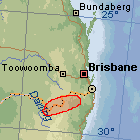
Distribution of Callitris monticola (Bowman and Harris 1995). Basemap from Expedia Maps. You can also create a highly detailed map, and access specimen data, using the "search" function at the Australia Virtual Herbarium.

Distribution of Callitris monticola (Bowman and Harris 1995). Basemap from Expedia Maps. You can also create a highly detailed map, and access specimen data, using the "search" function at the Australia Virtual Herbarium.
Conservation Status

Callitris monticola
Steelhead (Harden 1990).
This species is sister to C. roei, in a clade sister to C. preissii, with a late Miocene date for the most recent common ancestor (Larter et al. 2017).
Tree: Erect glaucous bushy shrub to 2.5 m tall. Leaves: Glaucous, 2-4 mm long. Cones: Solitary or several together, widely ovoid to depressed-globose, 15-25 mm in diameter, glaucous when young, often with greyish markings around edge of scales at maturity. Cone scales: Thick, each with a dorsal protuberance close to the apex, the alternate scales reduced in size; columella large and widely 3-lobed, often to 5 mm long (Harden 1990).
Australia: New South Wales and Queensland. "Mostly found in granite areas, sometimes on sandstone; rare in N.S.W., from the Gibraltar Range N.P. to the Tenterfield district" (Harden 1990).
Zone 10 (cold hardiness limit between -1°C and +4.4°C) (Bannister and Neuner 2001).
No data as of 2026-01-27.
No data as of 2026-01-27.
No data as of 2026-01-27.
No data as of 2026-01-27.
Bowman, D. M. J. S. and Stephen Harris. 1995. Conifers of Australia's dry forests and open woodland. Pp. 252-270 in Enright, Neal J. and Robert S. Hill (eds.) Ecology of the southern conifers. Washington, DC: Smithsonian. 342pp.
Garden, J. 1957. A revision of the genus Callitris. Contributions from the New South Wales National Herbarium 2(5):384-385.
Larter, Maximilian, Sebastian Pfautsch, Jean-Christophe Domec, Santiago Trueba, Nathalie Nagalingum, and Sylvain Delzon. 2017. Aridity drove the evolution of extreme embolism resistance and the radiation of conifer genus Callitris. New Phytologist 215(1):97–112. https://doi.org/10.1111/nph.14545.
Farjon (2005) provides a detailed account, with illustrations.
Back | Home | Contact us
Copyright 2026 The Gymnosperm Database
Edited by Christopher J. Earle
This page accessed on Sunday, October 25, 2026
Last Modified 2026-01-27
 Back to top