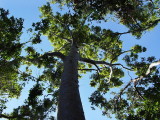
Looking up into the crown of a mature tree [Peter Richardson, 2007.09.08].
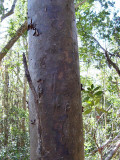
The almost smooth, purplish bark [Peter Richardson, 2007.09.08].
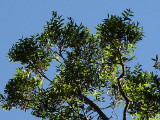
Foliage of a mature tree [Peter Richardson, 2007.09.08].

Looking up into the crown of a mature tree [Peter Richardson, 2007.09.08].
The almost smooth, purplish bark [Peter Richardson, 2007.09.08].
Foliage of a mature tree [Peter Richardson, 2007.09.08].
Conservation Status

Agathis atropurpurea
Blue kauri, black kauri.
No data as of 2026-01-15.
Tree to 50 m tall. Bark purplish-brown or purplish-black, sometimes glaucous, smooth to coarsely scaly. Branchlets sometimes glaucous. Buds globular, to 1.5 mm long. Leaves oval-lanceolate to oblong-elliptic, 37–45 mm long by 8–14 mm wide, closely set, glaucous beneath, apex bluntly notched. Male cones 9–16 mm long by 4–7 mm wide; microsporophylls strongly imbricate, margins entire; anthers 2–5; on a peduncle 2–3 mm long. Female cone globular, 35–55 mm wide, olive-green, somewhat glaucous. Seeds tan, to 12 mm long, wings cinnamon-brown, larger wing to 15 mm wide (Silba 1986).
Australia: N Queensland, Bellenden Ker Range, at 900–1500 m elevation (Silba 1986). You can also create a highly detailed map, and access specimen data, using the "search" function at the Australia Virtual Herbarium.
The World Conservation Monitoring Centre (2001) found that "Wherever logging is allowed exploitation has been very heavy and populations have declined. A large percentage of the forests is now protected."
No data as of 2026-01-15.
No data as of 2026-01-15.
Best seen in Wurunuru National Park. I don't have a precise location but supposedly it can be seen along a popular waterfall hike. It can also be seen on the hike to the top of Mt. Bartle Frere.
The epithet is compounded from atro, "dark", and purpurea, "purple", referring to the bark.
Hyland, B. 1978. A revision of the genus Agathis (Araucariaceae) in Australia. Brunonia 1(3):103–115 (p. 109).
World Conservation Monitoring Centre. 2001. World Conservation Monitoring Centre - Trees. http://www.wcmc.org.uk/cgi-bin/SaCGI.cgi/trees.exe, accessed 2001.07.13, now defunct.
The species account at Threatened Conifers of the World.
Back | Home | Contact us
Copyright 2026 The Gymnosperm Database
Edited by Christopher J. Earle
This page accessed on Sunday, May 17, 2026
Last Modified 2026-01-15
 Back to top