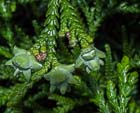
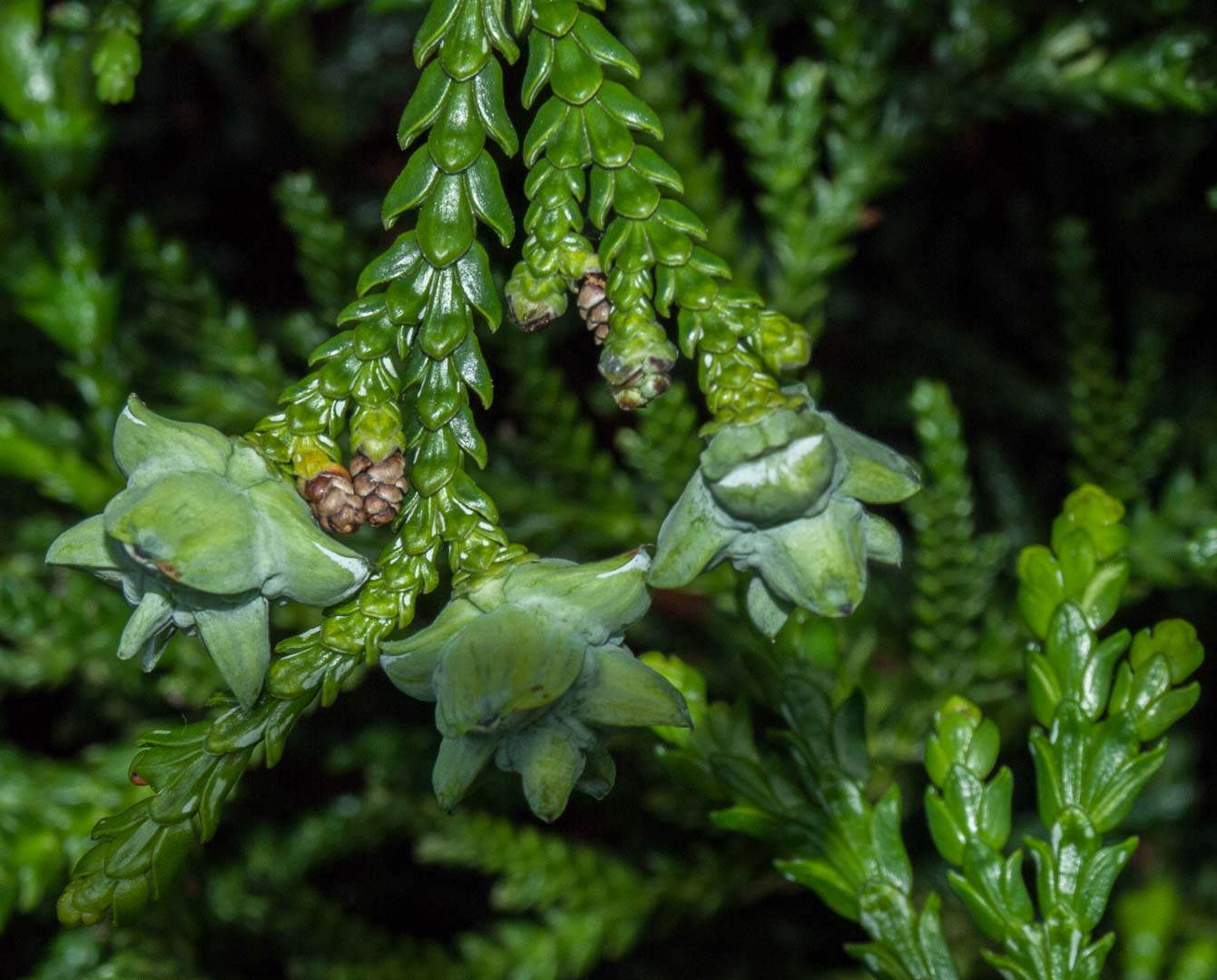
Foliage, immature seed cones, and old pollen cone on an ornamental specimen at Kew Gardens, UK [C.J. Earle, 2010.06.14].
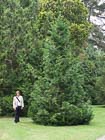
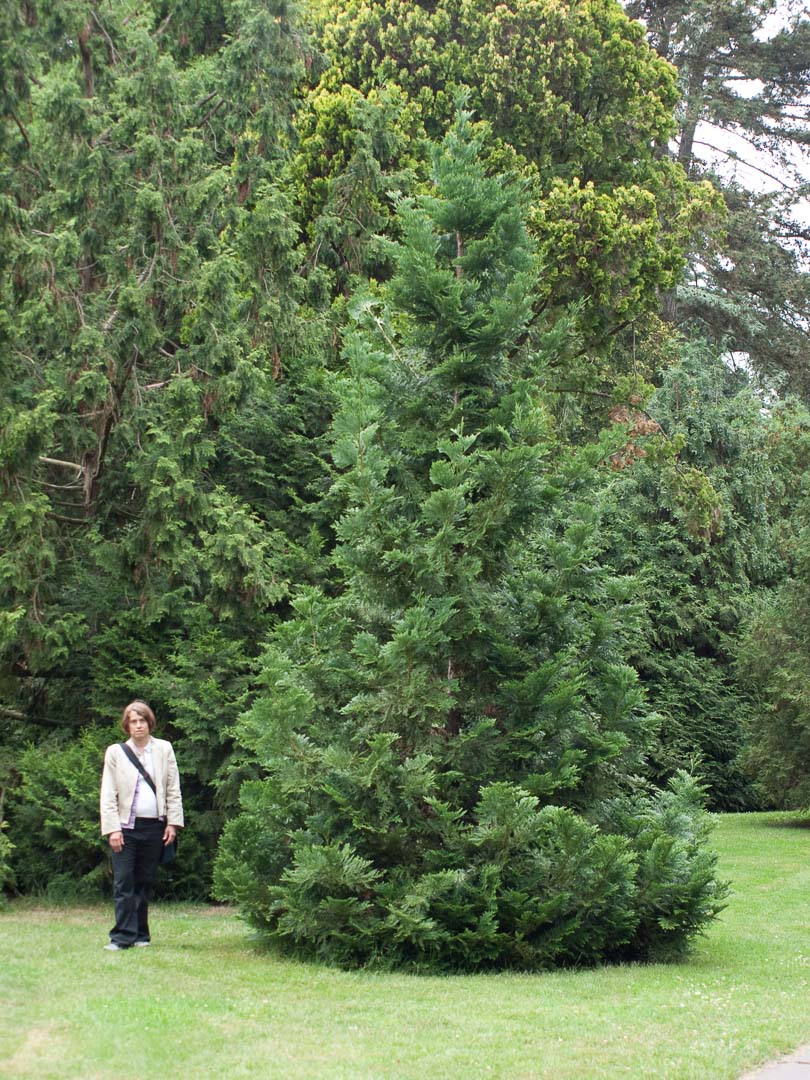
A relatively large ornamental specimen at Kew Gardens, UK [C.J. Earle, 2010.06.14].
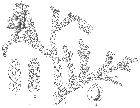
1: Cone-bearing branchlet and seed cones; 2: Branchlet with leaves, adaxial view; 3: Branchlet with leaves, abaxial view; 4: Seed [Liu Chunrong, redrawn by Li Aili] (Fu et al. 1999).

Conservation Status

(var. dolabrata)
Conservation Status
(var. hondae)
Thujopsis dolabrata
(Thunberg ex Linnaeus f.) Siebold et Zuccarini 1844
Common names
アスナロ asuhi [Japanese]; hiba arborvitae; 罗汉柏 luo han bai [Chinese].
Taxonomic notes
The sole species in Thujopsis (Thunberg ex Linnaeus f.) Siebold et Zuccarini ex Endlicher 1842. It was actually first described as Dolophyllum Salisbury 1817, a fact not discovered until the early 1990s. Salisbury did not describe an accompanying species and did not make the combination Dolophyllum dolabratum, so the type species remains Thuja dolabrata L. f. Since all publications since 1844 have cited Thujopsis and the genus is widely known by that name in the horticultural trade and to others who have occasion to deal with it, the name Thujopsis has been conserved against Dolophyllum as proposed by Farjon and Hunt (1994). The genus has also been cited, due to orthographic errors, as Thuiopsis and Thuyopsis (Farjon and Hunt 1994).
There are two varieties, the type and T. dolabrata var. hondae Makino 1901.
Thujopsis dolabrata var. dolabrata synonymy:
- Thuja dolabrata Thunberg ex Linnaeus f. 1782;
- Platycladus dolabrata (Thunberg ex Linnaeus f.) Spach 1841;
- Thujopsis dolabrata var. australis A. Henry 1907.
Description
Monoecious trees to 15 m tall; bark thin, gray or reddish brown, peeling off in long strips; crown pyramidal; branches ascending; branchlets 4-6 mm in diameter, arranged in a plane, flattened, lower side with white powder. Leaves decussate, scalelike, dimorphic along branchlets; lateral leaves boat-shaped, deep green adaxially, ovate-lanceolate, 4-7×1.5-2.2 mm, with a white stomatal band abaxially, apex obtuse, slightly incurved, overlapping margins of facial leaves, which are appressed, broadly obovate. Cones terminal, solitary. Pollen cones cylindric; microsporophylls 12-20. Seed cones 1-1.6 cm diameter, subglobose; cones scales 6-8, flat, woody, usually mucronate below apex, each fertile scale with 3-5 seeds. Seeds ellipsoid, 4-5×3-3.5 mm, with 2 thick, lateral, narrow wings. Cotyledons 2 (Fu et al. 1999). See García Esteban et al. (2004) for a detailed characterization of the wood anatomy.
Distribution and Ecology
Japan. The type variety on S Honshu, Kyushu and Shikoku; var. hondai on Hokkaido and N Honshu. Climate cool, moist. Found in mixed conifer and conifer-angiosperm forests from lowland coastal to montane elevations. Typically found in groves, at maturity it is a canopy emergent (Farjon 1998). Hardy to Zone 6 (cold hardiness limit between -23.2°C and -17.8°C) (Bannister and Neuner 2001).
Remarkable Specimens
The only size record I have is for a specimen in Queens Gardens, Nelson, New Zealand, that was 71.9 cm dbh and 14.8 m tall when measured in 2011; it was planted ca. 1895 (Cadwallader 2011). This would easily be the largest of all the ornamental specimens I have seen.
Ethnobotany
I have evidence of one study in dendrochronology (Ohyama et al. 2007).
Observations
Remarks
Thujopsis combines Thuja with the Greek "opsis" indicating appearance; thus the genus appears similar to Thuja. The epithet is from the Latin dolabra, "hatchet", referring to the leaf shape.
Citations
Cadwallader, B. 2011. New Zealand Tree Register database entry for tree NNR/1127. https://register.notabletrees.org.nz/tree/view/1127, accessed 2017.01.03.
Farjon, Aljos and David R. Hunt. 1994. Proposal to conserve Thujopsis Endl. against Dolophyllum Salisb. (Cupressaceae). Taxon 43(2):291-292.
Ohyama, M., M. Ohwada, and M. Suzuki. 2007. Chronology development of Hiba arbor-vitae (Thujopsis dolabrata var. hondae) and dating of timbers from an old building. Journal of Wood Science 53:5367-5373.
See also
Elwes and Henry 1906-1913 at the Biodiversity Heritage Library (Photo). This series of volumes, privately printed, provides some of the most engaging descriptions of conifers ever published. Although they only treat species cultivated in the U.K. and Ireland, and the taxonomy is a bit dated, still these accounts are thorough, treating such topics as species description, range, varieties, exceptionally old or tall specimens, remarkable trees, and cultivation. Despite being over a century old, they are generally accurate, and are illustrated with some remarkable photographs and lithographs.
Farjon 2005 (as one species with two varieties).

 Back to top