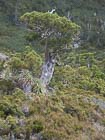
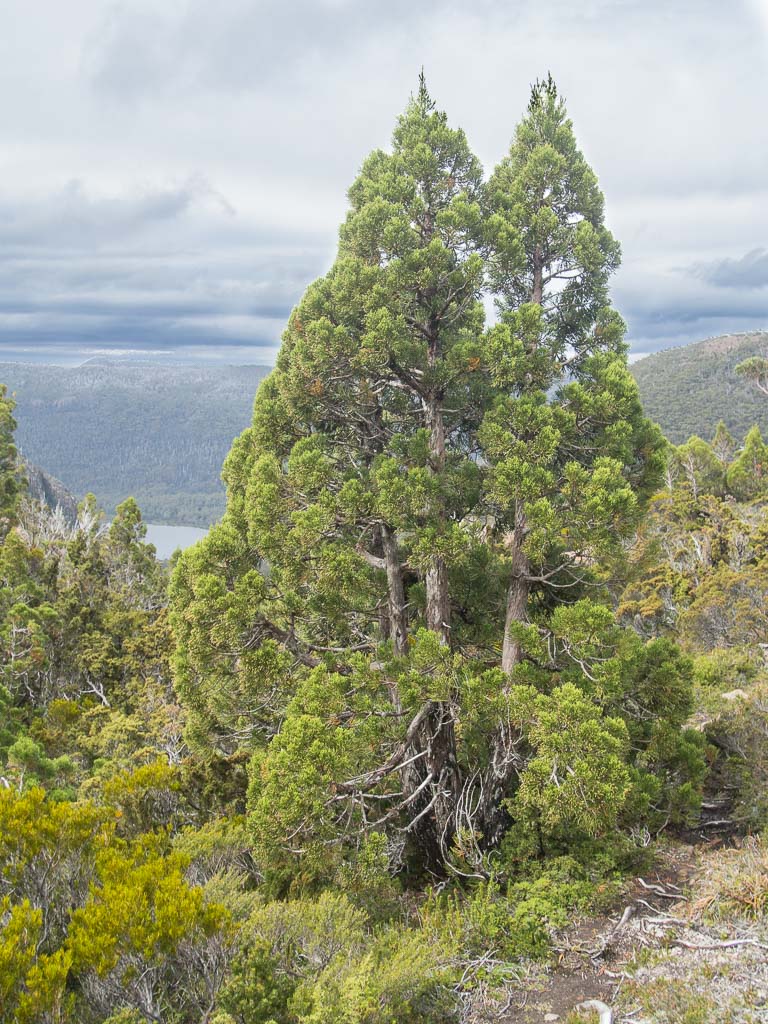
A. cupressoides, old tree by a tarn on the Shelf Tarns track, Mt. Field National Park [C. J. Earle, 2015.02.27].
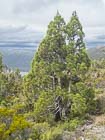
A. cupressoides about 5 m tall, in alpine heath on the Shelf Tarns track, Mt. Field National Park [C. J. Earle, 2015.02.27].
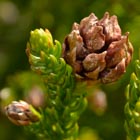
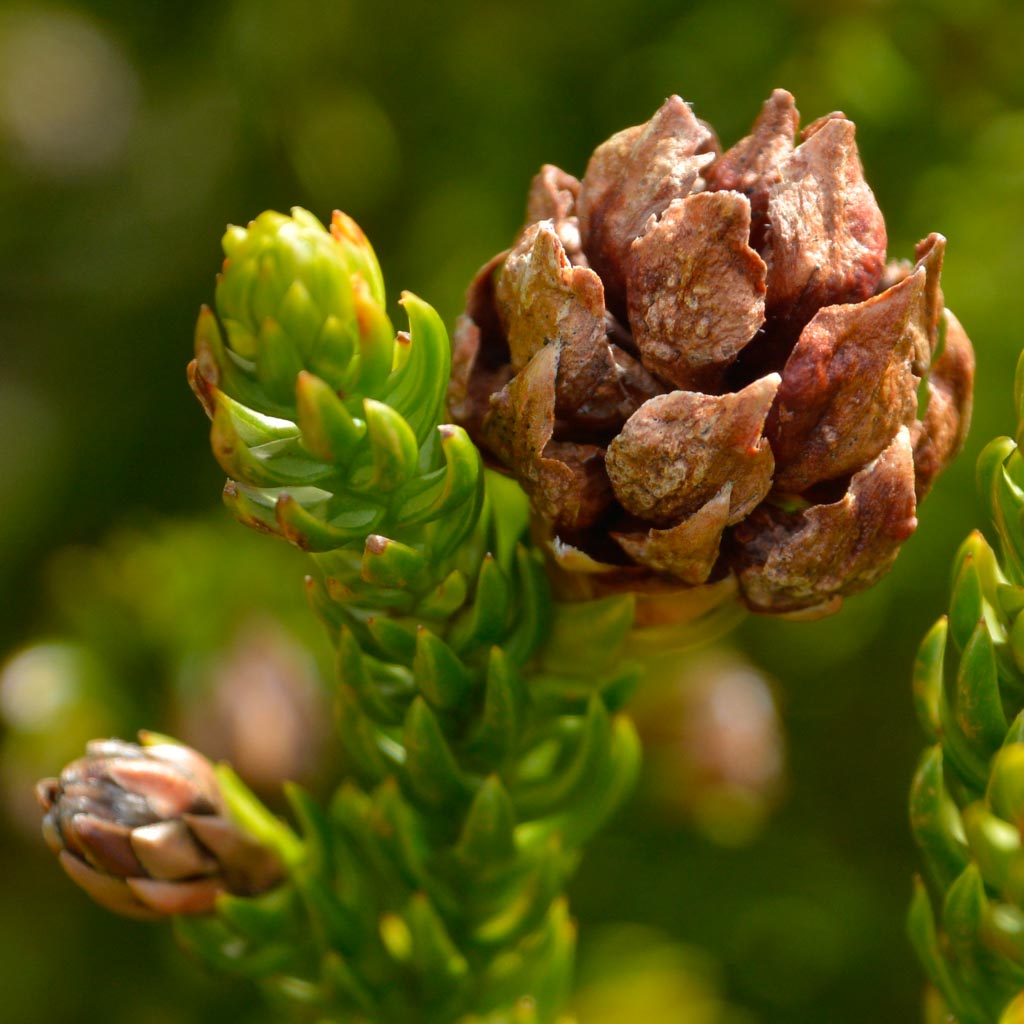
A. selaginoides, seed cone approaching maturity, and an older pollen cone [C. J. Earle, 2015.03.01].
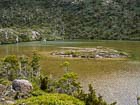
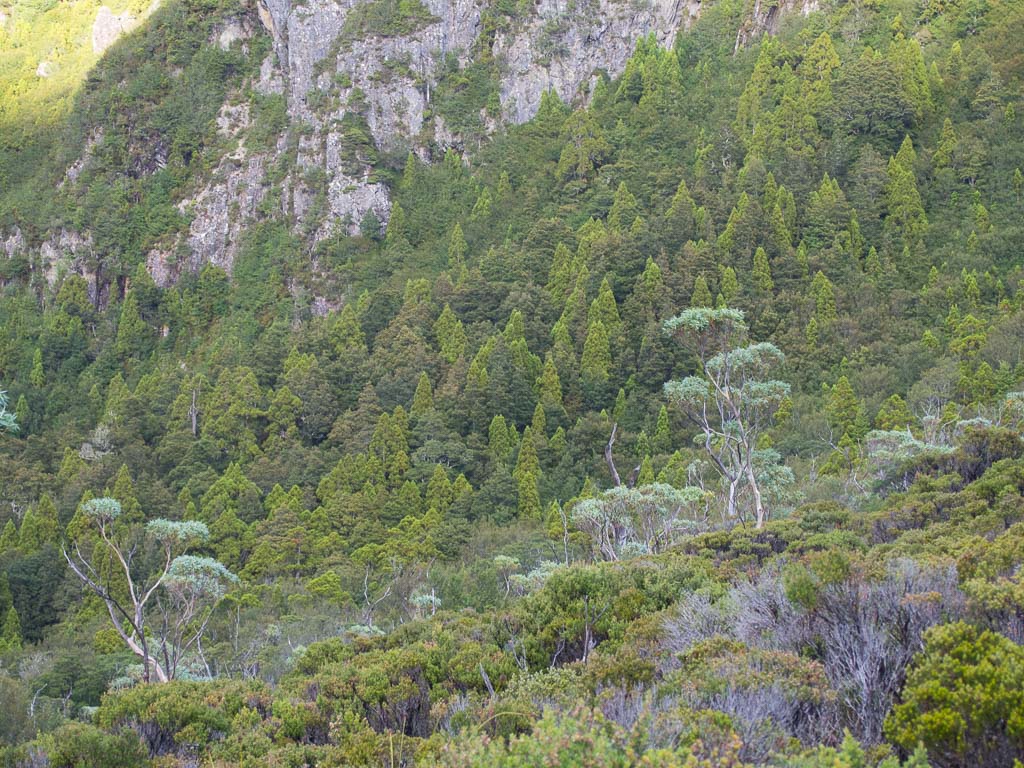
A. cupressoides in habitat [C. J. Earle, 2015.02.27].
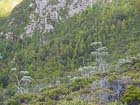
A. selaginoides in habitat [C. J. Earle, 2015.03.03].
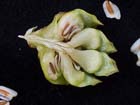
A. selaginoides seed cone section, showing developing seeds [C. J. Earle, 2015.03.01].
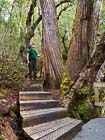
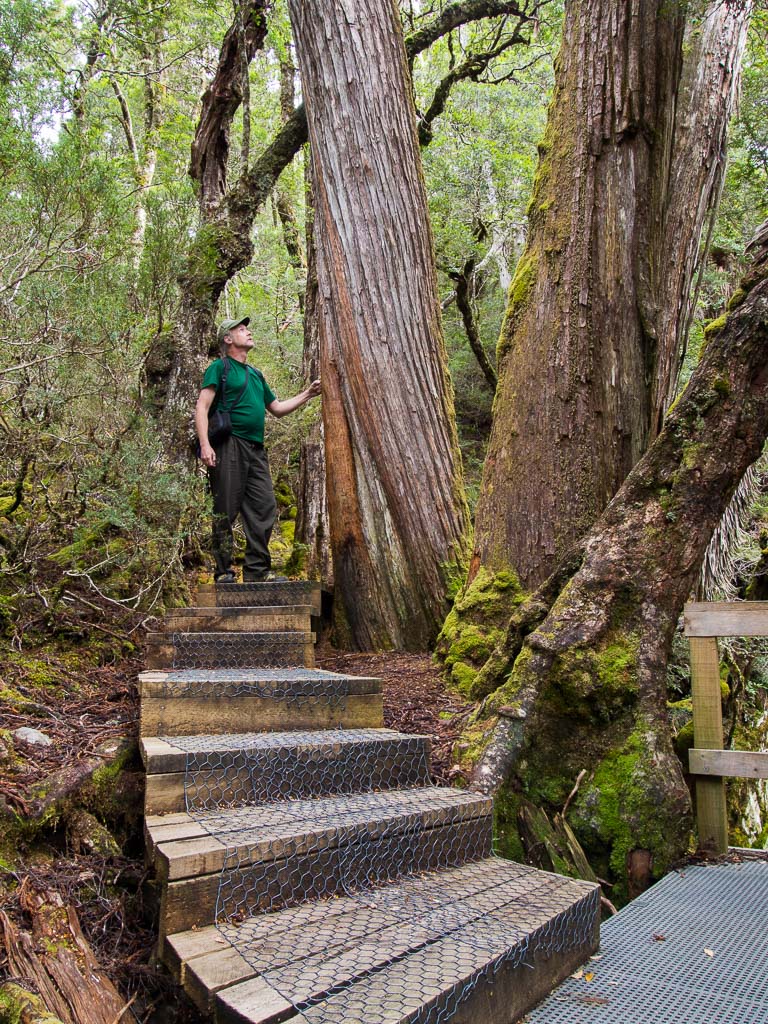
Uncommonly large trees of A. selaginoides [C. J. Earle, 2015.03.02].

Athrotaxis
D. Don 1841
Common names
Tasmanian cedar.
Taxonomic notes
A genus of two species and one fertile nothospecies:
Studies of wild individuals have found that in all cases the paternal parent of A. x laxifolia is A. selaginoides and the maternal parent is A. cupressoides (Isoda et al. 2000).
Description
Monoecious evergreen trees to 30 m tall, with a conical crown that usually becomes irregular with age. Bark reddish-brown, first smooth, flaky, later peeling off in thin, long strips. Twigs spreading, thick, ultimate twigs deciduous. Buds inconspicuous. Leaves scale-like, decurrent, imbricate, helically inserted, 5-ranked, uniform in shape and size. Pollen cones solitary at base of shoot, each with 10-15 helically arranged triangular microsporophylls; pollen globose, without a papilla. Seed cones terminal, solitary, woody, globose, maturing in one year, with up to 30 helically arranged scales. Seeds 3-6 per scale, oblong, thin, with 2 narrow even wings. Cotyledons 2 (Silba 1986, Farjon 2010).
There is really not much risk of mistaking Athrotaxis for anything else; the cones and foliage of each species are pretty much unique among conifers, though the seed cones and foliage of A. selaginoides and A. x laxifolia do bear a slight resemblance to those of Cryptomeria and Taiwania, two other conifer genera formerly assigned to the Taxodiaceae.
A. cupressoides has leaves so closely appressed and imbricate that the twigs resemble green dowels, hence the common name pencil pine. A. selaginoides has much larger leaves (7-18 × 3-4 mm), spreading distally from the twig. Their hybrid, A. x laxifolia, has an intermediate appearance: leaves 4-12 × 2-3 mm, mostly connate but with a free tip (Farjon 2010 and my observations in habitat, 2015).
Distribution and Ecology
The montane and subalpine portions of the temperate rain forests of Tasmania. Both taxa occasionally occur in open subalpine bogs and on rocky outcrops, and in those settings may adopt a krummholz growth form. Open subalpine areas are also the most common place to find A. × laxifolia, perhaps because of the greater potential for long-distance pollen dispersal.
Remarkable Specimens
The largest and tallest trees are specimens of A. selaginoides. Comparable maximum ages are achieved by both species. Ogden (1985)) cites, without reference to evidence, a claim of over 1,000 years for A. cupressoides; but he provides hard evidence in the form of a continuous tree-ring record of 777 years for A. selaginoides.
Ethnobotany
Neither species has been subject to much commercial use, likely due to limited accessibility and slow growth rates; they do see limited use for craftwood, though. Waldheim, a historically significant lodge at Cradle Mountain National Park, was built of A. selaginoides. Athrotaxis may have been used by aboriginal Tasmanians, but I can find no record of it.
Both species have been useful in dendrochronological research. A recent but brief review was presented by Allen et al. (2011), as part of an interesting dendroclimatic study. Norton & Palmer (1992) provide a general review; see the two species for particulars.
Observations
Both species can be readily seen at the principal National Parks within their range, of which the most accessible and probably the most remarkable is Cradle Mountain National Park. The trails behind Waldheim provide access to some of the finest surviving large, old specimens of A. selaginoides, while the hike up Cradle Mountain will show you alpine settings of A. cupressoides. Both species also occur at Mount Field National Park, where the Shelf Tarns walk is one of the best places to see very old specimens of A. cupressoides, as well as several areas with A. × laxifolia.
Remarks
The genus name is from the Greek, and means "crowded arrangement." The type description does not indicate what is crowded, but in both species, the twigs are completely sheathed in leaves.
Citations
Allen, K. J., J. Ogden, B. M. Buckley, E. R. Cook, and P. J. Baker. 2011. The potential to reconstruct broadscale climate indices associated with southeast Australian droughts from Athrotaxis species, Tasmania. Climate Dynamics, DOI 10.1007/s00382-011-1011-7.
[ANBG] Australian National Botanic Gardens. [no date]. Australian Conifers. http://www.anbg.gov.au/anbg/conifers/, accessed 2002.11.09, now defunct.
Isoda, Keiya, Tim Brodribb and Susumu Shiraishi. 2000. Hybrid origin of Athrotaxis laxifolia (Taxodiaceae) confirmed by random amplified polymorphic DNA analysis. Australian Journal of Botany 48(6):753-758.
See also
Farjon 2005.


 Back to top